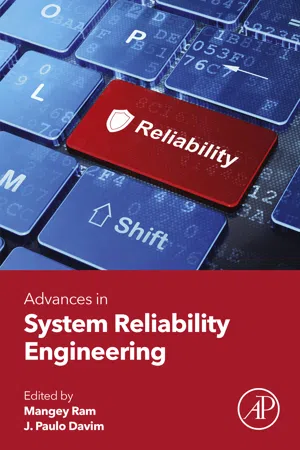
Recent Advances in System Reliability Engineering describes and evaluates the latest tools, techniques, strategies, and methods in this topic for a variety of applications. Special emphasis is put on simulation and modelling technology which is growing in influence in industry, and presents challenges as well as opportunities to reliability and systems engineers. Several manufacturing engineering applications are addressed, making this a particularly valuable reference for readers in that sector.
- Contains comprehensive discussions on state-of-the-art tools, techniques, and strategies from industry
- Connects the latest academic research to applications in industry including system reliability, safety assessment, and preventive maintenance
- Gives an in-depth analysis of the benefits and applications of modelling and simulation to reliability
Delay-Time-Based Maintenance Modeling for Technical Systems—Theory and Practice
Sylwia Werbińska-Wojciechowska Department of Operation and Maintenance of Logistic Systems, Transportation Systems and Hydraulic Systems, Wroclaw University of Science and Technology, Wroclaw, Poland
Abstract
This chapter will be a valuable resource for understanding the latest developments in maintenance modeling issues in the field of delay-time approach implementation. This chapter presents the literature review on delay-time modeling for single- and multiunit systems. The maintenance models for single-unit systems assume two-stage or three-stage failure processes. In the case of complex systems, the discussed problems are with regard to models’ parameters, estimation issues, case studies analysis, or hybrid modeling approach implementation. The maintenance models for multiunit systems examine the known models for nonseries systems. A case study for maintenance modeling for multiunit systems based on a delay-time approach is provided. The directions for further research work are defined.
Keywords
Delay-time concept; Multiunit systems; Literature review; Maintenance modeling; Optimization
Abbreviations
AICAkaike information criterion
BIBlock Inspection
CMcorrective maintenance
DTdelay time
DTAdelay-time approach
DTMdelay-time models
ELECTREelimination and choice expressing the reality
HPPhomogeneous Poisson process
MAUTmultiattribute utility theory
MCMonte Carlo
MLEmaximum likelihood estimation
MRTmean repair time
MTBFmean time between failures
NHPPnonhomogeneous Poisson process
PARproportional age reduction
PMpreventive maintenance
PROMETHEEpreference ranking organization method for enrichment evaluations
Important Notations
c(Tin)expected cost over each inspection cycle
c(Tini)expected cost over ith inspection cycle
C(Tin)total costs resulting from chosen maintenance policy
ccsclean-up cost connected with cleaning up any spillage that may result in a failure
cincost of inspection action performance
cpcost of preventive replacement of a unit
crcost of failed unit replacement
dintime of single inspection action performance
dpthe time of preventive replacement of a system
drtime of corrective replacement of a system (after a failure)
E[x]expected value of random variable x
Ed(Tin)expected downtime in an inspection cycle of length Tin
F(t)probability distribution function of system/unit lifetime;
(t)=1−F(t)
Fh(h)probability distribution function of system delay time
fh(h)probability density function of system delay time
Fhi(h)probability distribution function of ith element delay time
fhi(h)probability density function of ith element delay time
Gh(t)probability distribution function of the initial time u, which elapses from the beginning of operation by “as good as new” elements of a system until the moment of first symptoms of failure occurrence
gh(t)probability density function of the initial time u, which elapses from the beginning of operation by “as good as new” elements of a system until the moment of first symptoms of failure occurrence
Ghi(t)probability distribution function of initial time u of ith element in a system
ghi(t)probability density function of initial time u of ith element in a system
hdelay time of a defect, denoting the period between the moment of appearance of the first symptoms of potential failure and the moment of an object's failure occurrence
kuconstant rate for fault's arrival in a technical system for any inspection period
Mcsmeasure of possible impact of a failure of a piece of equipment on an environment
Menv(Tin)environmental model of a technical object
mnumber of failures until element replacement
nnumber of elements in a system
nkminimum number of operating components to make a system function (performance in nk-out-of-n reliability structure)
Nrin(ti–1in, tiin)expected number of failures over inspection interval (ti–1in, tiin)
pcsprobability of a failure resulting in a spillage requiring clean up
pinprobability of imperfect inspection occurrence
PuF(Tin)probability of a fault arising as a breakdown in a system
pwprobability that, during system inspection, performance symptoms of forthcoming failures (if they occur in a system) are identified
R(t)reliability function of a system
RTin(t)component reliability at time t
RTinica cubic approximation of average reliability over an ith inspection
RTiniLa linear approximation of average reliability over an ith inspection
rmrrepair cost rate
rTin(i)(t)reliability function for a component at time t
r˙(k)Tin(kTin)left-hand derivative of reliability function at t = kTin
tfr...
Table of contents
Cover image
Title page
Table of Contents
Copyright
Contributors
Editors Biography
Preface
Acknowledgments
Chapter 1: Delay-Time-Based Maintenance Modeling for Technical Systems—Theory and Practice
Chapter 2: Deterministic and Probabilistic Safety Analyses
Chapter 3: Reliability-Game Theory
Chapter 4: Integrating Reliability Models and Adaptive Algorithms for Wind Power Forecasting
Chapter 5: Time-Dependent Analysis of Series-Parallel Multistate Systems Using Structure Function and Markov Processes
Chapter 6: Modeling Correlated Counts in Reliability Engineering
Chapter 7: Statistical Inference of an Imperfect Repair Model with Uniform Distributed Repair Degrees
Chapter 8: Method of Fuzzy Perfectness in Human Reliability Analysis: Selection of Performance Conditions
Chapter 9: System Reliability Assessment Through Bayesian Network Modeling
Chapter 10: Multistate Multifailures System Analysis With Reworking Strategy and Imperfect Fault Coverage
Chapter 12: Tools and Techniques in Software Reliability Modeling
Index
Trusted by 375,005 students
Access to over 1.5 million titles for a fair monthly price.
Study more efficiently using our study tools.
Frequently asked questions
Yes, you can cancel anytime from the Subscription tab in your account settings on the Perlego website. Your subscription will stay active until the end of your current billing period. Learn how to cancel your subscription
No, books cannot be downloaded as external files, such as PDFs, for use outside of Perlego. However, you can download books within the Perlego app for offline reading on mobile or tablet. Learn how to download books offline
Perlego offers two plans: Essential and Complete
Essential is ideal for learners and professionals who enjoy exploring a wide range of subjects. Access the Essential Library with 800,000+ trusted titles and best-sellers across business, personal growth, and the humanities. Includes unlimited reading time and Standard Read Aloud voice.
Complete: Perfect for advanced learners and researchers needing full, unrestricted access. Unlock 1.5M+ books across hundreds of subjects, including academic and specialized titles. The Complete Plan also includes advanced features like Premium Read Aloud and Research Assistant.
Both plans are available with monthly, semester, or annual billing cycles.
We are an online textbook subscription service, where you can get access to an entire online library for less than the price of a single book per month. With over 1.5 million books across 990+ topics, we’ve got you covered! Learn about our mission
Look out for the read-aloud symbol on your next book to see if you can listen to it. The read-aloud tool reads text aloud for you, highlighting the text as it is being read. You can pause it, speed it up and slow it down. Learn more about Read Aloud
Yes! You can use the Perlego app on both iOS and Android devices to read anytime, anywhere — even offline. Perfect for commutes or when you’re on the go. Please note we cannot support devices running on iOS 13 and Android 7 or earlier. Learn more about using the app
Yes, you can access Advances in System Reliability Engineering by Mangey Ram,J. Paulo Davim in PDF and/or ePUB format, as well as other popular books in Technology & Engineering & Mechanical Engineering. We have over 1.5 million books available in our catalogue for you to explore.