eBook - ePub
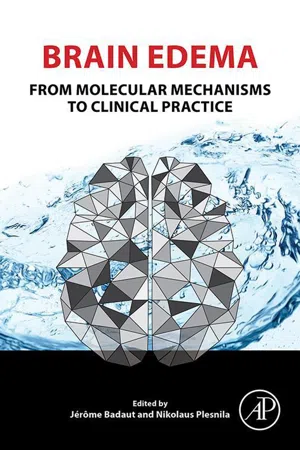
Brain Edema
From Molecular Mechanisms to Clinical Practice
- 554 pages
- English
- ePUB (mobile friendly)
- Available on iOS & Android
eBook - ePub
About this book
Brain Edema: From Molecular Mechanisms to Clinical Practice brings together the most widely recognized experts in experimental and clinical brain edema research to review the current knowledge gathered on the molecular and cellular pathophysiology and clinical management of brain edema. This timely book also discusses future directions of research and treatment.
Brain edema is an integral and acutely life-threatening part of the pathophysiology of multiple cerebral and non-cerebral disorders, including traumatic brain injury, cerebral ischemia, brain tumors, cardiac arrest, altitude sickness and liver failure. Affecting millions worldwide, research over the past few years has shown that a plethora of complex molecular and cellular mechanisms contribute to this pathological accumulation of water in the brain parenchyma.
In parallel, the development of new neuroimaging tools has provided a new way to examine how edema develops longitudinally and in real time, both in pre-clinical models and in patients. Despite intense research over the past few decades, therapeutic options are still limited and sometimes not effective.
- Presents a comprehensive understanding of the molecular mechanisms involved in edema formation and resolution
- Discusses the specific role of edema development in several pathologies, including traumatic brain injury, stroke, brain tumors, cardiac arrest, and liver failure
- Proposes a new classification of edema based on molecular processes
- Discusses clinical management of new clinical trials coming from pre-clinical studies
- Addresses the possible link between edema formation, other molecular and cellular processes, including inflammation and neuroinflammation
Information
Section IV
Brain Edema Process in Preclinical Models
Outline
Chapter 12
Edema and BBB Breakdown in Stroke
Kathleen E. Salmeron, Danielle N. Edwards, Justin F. Fraser and Gregory J. Bix, University of Kentucky, Lexington, KY, United States
Abstract
Stroke is a leading cause of death and disability affecting 15 million people worldwide. Although rapid recognition and treatment have dropped mortality rates, many are left with permanent disability. Approximately 87% of all strokes result from the occlusion of cerebrovasculature (ischemic strokes). Current research distinguishes between zones of core infarct and areas of metabolically compromised but potentially viable tissue receiving collateral circulation known as penumbra. Research has long focused on how endogenous mechanisms of neuroprotection and neurorepair affect penumbral expansion. Such therapeutic approaches have included antiinflammatory interventions, reactive oxygen species scavengers, and many other targets with the common goal of mitigating the acute and chronic inflammatory responses typically seen in an ischemic stroke. This chapter will discuss acute and chronic molecular mechanisms underlying edema following ischemic stroke.
Keywords
BBB breakdown; cerebrovasculature; edema; penumbra; stroke
Introduction
Stroke is a leading cause of death and disability affecting 15 million people worldwide. Although rapid recognition and treatment have dropped mortality rates, many are left with permanent disability. Approximately 87% of all strokes result from the occlusion of cerebrovasculature (ischemic strokes).1 Current research distinguishes between zones of core infarct and areas of metabolically compromised but potentially viable tissue receiving collateral circulation known as penumbra.2 Research has long focused on how endogenous mechanisms of neuroprotection and neurorepair affect penumbral expansion. Such therapeutic approaches have included antiinflammatory interventions, reactive oxygen species (ROS) scavengers, and many other targets with the common goal of mitigating the acute and chronic inflammatory responses typically seen in an ischemic stroke. This chapter will discuss acute and chronic molecular mechanisms underlying edema following ischemic stroke.
Despite advancements in reperfusion and recanalization through intravenous tPA and mechanical thrombectomy, stroke still often results in significant disability. Edema and inflammation compound the injury and can turn a disabling infarct into a deadly lesion causing mass effect. Despite advancements in recanalization, the expansion of ischemic injury occurs regardless of the restoration of blood flow. A key component of such injury expansion is the breakdown of the blood–brain barrier (BBB).3 Here, we will examine how this breakdown leads to brain swelling (edema). To do this, we the first need to understand the composition and physiologic function of the BBB.
Physiologic Structure and Function of the Blood–Brain Barrier
Under physiologic conditions, the BBB separates the healthy brain from the systemic blood supply. It is a multilayered unit made up of astrocytic endfeet, extracellular matrix (ECM), microglia, pericytes, and nonfenestrated capillaries, which are tightly interconnected in order to protect the brain parenchyma from noxious substances in blood such as immune cells and cytokines. Moreover, the BBB is also responsible for regulating the flow of nutrients into the brain and metabolic by-products out of the brain, thereby helping to maintain a healthy brain environment.4,5 Specifically, although the vasculature in the majority of the brain is tightly contained, astrocytes with endfeet in close proximity to the vasculature are tasked with filtering nutrients and water into the brain parenchyma and delivering them to neurons.5,6 Importantly, astrocytes remain unreactive under normal conditions.7 Astrocytic endfeet are anchored to, and separated from the endothelium by, the ECM.4,5 The same is true with vascular endothelial cells, which are anchored to the matrix. Previously, biochemists believed that the ECM was just a water-based substance that filled the space between cells throughout the body. Today, we know that the matrix provides crucial signal transduction proteins, scaffolding for cell stability and motility, and facilitates homeostasis.8
Among the most important cellular signaling receptors that interact with the ECM are integrins. These interactions with ECM components such as collagen, laminin, and fibronectin, aid in cell signaling, activation, and migration.5,9–13 In addition, brain endothelial cells form intercellular barriers called tight junctions (TJs), made up of TJs proteins including claudin, occludin, and junction adhesion molecules.5 TJs are responsible for regulating and maintaining the relative impermeability of the brain parenchyma to cells as well as to large molecules.4,5 Pericytes, while not as well understood, are thought to aid in this regulation of BBB permeability under normal conditions.14,15 Taken together, the barrier is essential for protecting the brain parenchyma and, if disturbed, can result in or exacerbate brain injury.
The Phases of Edema in Stroke
Stroke occurs in three main phases: acute (can be further split into hyperacute and acute phases), subacute, and chronic. The hyperacute phase, occurring within the first several minutes of stroke onset, is the phase in which clinical symptoms appear but is not the phase in which most damage occurs. The second phase, the acute phase, occurs within the first few hours of a stroke and is the phase in which most, if not all, clinical intervention must occur for there to be any positive change in patient outcome.2 The subacute phase occurs 24–48 hours after onset. This phase is difficult to define because the infarct has not yet reached its maximum volume. It is, however, past the therapeutic window for either IV t-PA or for endovascular thrombectomy.2,6,16,17 The final or chronic phase can last for 1–2 weeks. This is the phase wherein the brain pathophysiology transitions from neuroprotective to neuroreparative mechanisms.5,6,16
Hyperacute Phase: The First Few Minutes
The brain’s response to an ischemic event is swift. Because the cells are not receiving the oxygen and energy that they need, ion pumps fail to maintain homeostatic sodium and potassium concentrations, resulting in calcium influx into the cytoplasm. This rapid ion exchange causes excitatory cells (neurons) to depolarize in a process called anoxic depolarization,18 which releases glutamate into the extracellular space. Astrocytes, in carrying out their physiological function, take up the released glutamate using the glutamate–sodium cotransporter. In addition, the further influx of water through channels, known as aquaporins, causes osmotic swelling of the cell.2,19 The end result is that neurons and astrocytes within the ischemic core terminally depolarize and will eventually undergo apoptosis. Some studies have shown that blockade or selective knock-down of these aquaporins, particularly aquaporin-4, helps to prevent the formation of metabolic edema after events such as stroke and traumatic brain injury.6,19
Meanwhile, the cells of the neurovascular unit release Hypoxia Inducible Factors (HIFs) as well as other signaling molecules, which rapidly activate glial cells. HIFs are typically not released in sufficient quantities to initiate widespread effects. Local astrocytes and microglia; however, will release pro- and antiinflammatory cytokines and other inflammatory markers into the core of the infarcted area.17 This release of inflammatory mediators results in acute, local swelling, which triggers a decrease in diameter of the vasculature.5,6 In addition, many of the cytokines released by glial cells cause a breech in the integrity of the BBB.17 Although this process is just beginning within the first few minutes of ischemia, these early initial events set up a ca...
Table of contents
- Cover image
- Title page
- Table of Contents
- Copyright
- Dedication
- Acknowledgments
- List of Contributors
- Introduction: Brain Edema Formation—Significance for Patient Outcome
- Section I: General Introduction
- Section II: Techniques to Investigate Cerebral Blood
- Section III: Molecular Basis and Concepts in Brain Edema Formation for New Treatment Development
- Section IV: Brain Edema Process in Preclinical Models
- Section V: Clinical Features and Management of Brain Edema
- Index
Trusted by 375,005 students
Access to over 1.5 million titles for a fair monthly price.
Study more efficiently using our study tools.
Frequently asked questions
Yes, you can cancel anytime from the Subscription tab in your account settings on the Perlego website. Your subscription will stay active until the end of your current billing period. Learn how to cancel your subscription
No, books cannot be downloaded as external files, such as PDFs, for use outside of Perlego. However, you can download books within the Perlego app for offline reading on mobile or tablet. Learn how to download books offline
Perlego offers two plans: Essential and Complete
- Essential is ideal for learners and professionals who enjoy exploring a wide range of subjects. Access the Essential Library with 800,000+ trusted titles and best-sellers across business, personal growth, and the humanities. Includes unlimited reading time and Standard Read Aloud voice.
- Complete: Perfect for advanced learners and researchers needing full, unrestricted access. Unlock 1.5M+ books across hundreds of subjects, including academic and specialized titles. The Complete Plan also includes advanced features like Premium Read Aloud and Research Assistant.
We are an online textbook subscription service, where you can get access to an entire online library for less than the price of a single book per month. With over 1.5 million books across 990+ topics, we’ve got you covered! Learn about our mission
Look out for the read-aloud symbol on your next book to see if you can listen to it. The read-aloud tool reads text aloud for you, highlighting the text as it is being read. You can pause it, speed it up and slow it down. Learn more about Read Aloud
Yes! You can use the Perlego app on both iOS and Android devices to read anytime, anywhere — even offline. Perfect for commutes or when you’re on the go.
Please note we cannot support devices running on iOS 13 and Android 7 or earlier. Learn more about using the app
Please note we cannot support devices running on iOS 13 and Android 7 or earlier. Learn more about using the app
Yes, you can access Brain Edema by Jerome Badaut,Nikolaus Plesnila in PDF and/or ePUB format, as well as other popular books in Biological Sciences & Neuroscience. We have over 1.5 million books available in our catalogue for you to explore.