- 241 pages
- English
- ePUB (mobile friendly)
- Available on iOS & Android
eBook - ePub
About this book
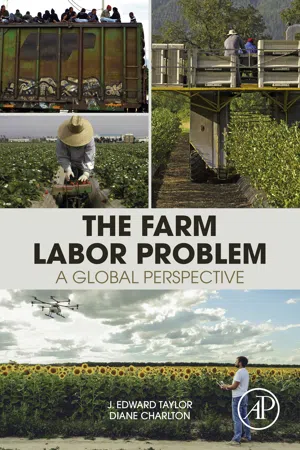
The Farm Labor Problem: A Global Perspective explores the unique character of agricultural labor markets and the implications for food production, farm worker welfare and advocacy, and immigration policy. Agricultural labor markets differ from other labor markets in fundamental ways related to seasonality and uncertainty, and they evolve differently than other labor markets as economies develop. We weave economic analysis with the history of agricultural labor markets using data and real-world events. The farm labor history of California and the United States is particularly rich, so it plays a central role in the book, but the book has a global perspective ensuring its relevance to Europe and high-income Asian countries.
The chapters in this book provide readers with the basics for understanding how farm labor markets work (labor in agricultural household models, farm labor supply and demand, spatial market equilibria); farm labor and immigration policy; farm labor organizing; farm employment and rural poverty; unionization and the United Farm Workers movement; the Fair Food Program as a new approach to collective bargaining; the declining immigrant farm labor supply; and what economic development in relatively low-income countries portends for the future of agriculture in the United States and other high-income countries. The book concludes with a chapter called "Robots in the Fields," which extrapolates current trends to a perhaps not-so-distant future.
The Farm Labor Problem serves as both a guide to policy makers, farmworker advocates and international development organizations and as a textbook for students of agricultural economics and economics.
- Describes the unique character of agricultural labor markets providing consequential insights
- Contextualizes the economics of agricultural labor with a global perspective
- Examines the history of farm labor, immigration, policy and collective bargaining with a view to the future
Information
Chapter 1
Introduction
Abstract
Agriculture is different from other economic sectors of the economy in ways that have far-reaching implications for the analysis of labor markets (Timmer, 1988). A multitude of farms are scattered across a vast geographic space. Production and labor demands are seasonal and uncertain, separated in time and dependent on the whims of nature. Farmers make their planting decisions months (and in the case of perennial crops, years) ahead of harvest. Labor and other inputs have to be available exactly when farmers need them, with little to no advance notice. Perishable crops not harvested on time can rot in the fields. Late harvests can cause farmers to miss key marketing windows or contract deadlines, and crops left in the field are exposed to disease and weather risks. If labor is not available earlier in the season to plant crops and apply inputs on time, or if the rains do not come, there might not be anything to harvest at all. All of these considerations make the demand and supply of farm labor uncertain and dynamic, and they frequently lead farmers to rely on an immigrant farm workforce.
Keywords
Agriculture; Farm labor demand; Farm labor supply; Technological change; Crops; Immigration
The fight is never about grapes or lettuce. It is always about people.
Cesar Chavez
Agriculture is different from other economic sectors of the economy in ways that have far-reaching implications for the analysis of labor markets (Timmer, 1988). A multitude of farms are scattered across a vast geographic space. Production and labor demands are seasonal and uncertain, separated in time and dependent on the whims of nature. Farmers make their planting decisions months (and in the case of perennial crops, years) ahead of harvest. Labor and other inputs have to be available exactly when farmers need them, sometimes with little to no advance notice. Perishable crops not harvested on time can rot in the fields. Late harvests can cause farmers to miss key marketing windows or contract deadlines, and crops left in the field are exposed to disease and weather risks. If labor is not available to plant crops and apply inputs on time, or if the rains do not come, there might not be anything to harvest at all. All of these considerations make the demand for farm labor uncertain and dynamic—that is, it changes over time.
The supply of farm workers is also uncertain and dynamic. As countries develop and their per-capita incomes rise, their workforces move out of agriculture and into nonfarm jobs, creating the specter of farm labor scarcity. Farmers in rich countries pressure their governments to open the doors to workers from poorer countries to fill the void. Even if there is an overall abundance of farm workers, local labor shortages materialize if workers are not available in the right place at the right time. Crops ripen unevenly across space, creating demand for follow-the-crop migrant workers. History shows that people do not choose to do follow-the-crop migration if they have other options.
This chapter introduces the complex challenges associated with farm labor demand and supply, the uncertain and seasonal equilibrium between the two, and the role of immigration in addressing the farm labor problem. It concludes with a view toward the future, discussing how agriculture must adjust to a new farm labor equilibrium as people move off the farm and the global demand for food continues to rise.
The Problem of Farm Labor Demand
The demand for farm labor derives from farmers’ production decisions, which we will learn about in detail in Chapter 2. Agriculture differs from other industries in intrinsic ways that differentiate the timing and magnitude of labor demand. The agricultural production process is biological. It relies heavily on inputs from nature (land and weather). Consequently, agricultural production is highly seasonal. There are long time lags between applying inputs and harvesting outputs. Although farmers can directly control how much they plant, uncertainty surrounds how large the harvestable crop will be and how the harvested crop will be valued on the market. Farming requires land, so agriculture is dispersed over a wide geographic area. Because agricultural production is spread out geographically, involves long time lags, and is highly seasonal and uncertain, timely access to labor, like other inputs, is critical to the success and competitiveness of farm operations.
Agricultural production and access to labor vary substantially around the world. In parts of the United States, large agribusinesses [which the American journalist Carey McWilliams referred to as “factories in the field”] dominate the farm landscape (McWilliams, 2000). Millions of small family farmers dominate production in low-income countries.1 In most of the world, households, not firms, make most of the agricultural production decisions, and the family provides most or all of the labor needed on the farm. Often, hired labor is an imperfect substitute for family labor, because hired workers might not work as hard, they might not be available for hire near the farm, and poor farmers might lack the cash to hire workers, particularly in the preharvest period prior to receiving payment for the harvest.
Agriculture is marked by a high degree of uncertainty; thus, considerations of risk are a hallmark of agricultural decision-making (Moschini and Hennessy, 2001). There are two broad categories of risk in agriculture: Production risk and marketing risk. On the plus side, nature provides inputs like sunshine and rainfall at no cost. The downside is that farmers cannot predict when the rains will or will not come, whether there will be a long season with no sunshine, or whether a swarm of locusts will devastate the crop. Shocks of nature break the engineering relationship between inputs and outputs. Variables outside farmers’ control determine how much of a harvestable crop there will be on the tree or in the field—not only the vagaries of weather, but also risks associated with pests and access to inputs, including labor.
This sort of uncertainty generally does not arise in manufacturing, where engineering relationships govern production processes. Farmers’ access to hired workers and other inputs, credit, insurance, and a market for the harvested crop impacts how they will respond to seasonality and uncertainty in agricultural production. New evidence suggests that climate change is increasing agricultural production risk as well as impacting agricultural labor markets.2
Once the harvestable stock of produce is mature in the fields or on the trees, agricultural production is largely a resource-extraction problem—how to harvest the crop and get it to market in the most economically efficient way. Most of the risk at this stage revolves around the availability of harvest labor and market prices. Seasonal variations in spot-market prices create critical timing windows for agricultural producers. Increasingly, grower-shippers have time-sensitive contractual commitments as preferred suppliers to mass merchandisers (e.g., Walmart and Costco), supermarket chains, and food service industries. This is true in developing as well as high-income countries (Reardon et al., 2003). Failure to harvest a field on time can result in the grower-shipper failing to meet delivery commitments to buyers under Vender Managed Inventory Replacement (VMIR) and other preferred supplier agreements. Some research suggests that, with the consolidation of the retail sector, shippers have less negotiating power and are more fearful of losing accounts if they fail to comply with buyer requests. Increasing trade integration creates price competition and narrows marketing windows, intensifying pressure on farmers. Having access to workers at critical moments in the production process can make the difference between meeting delivery commitments or not.
Labor supply risks are paramount at harvest time. An important potential component of risk is the lack of available labor at the times and places needed to harvest crops. Production risk can result from an insufficient labor supply if fruit spoils on the trees before it can be harvested or if labor shortages prevent farmers from marketing their harvest on time and complying with their contractual obligations higher up on the supply chain.
The Agricultural Production Function
The production function occupies center stage in farmers’ decisions, as it does in the microeconomics of all firms. It describes a technological relationship, a recipe to convert inputs into outputs. In most sectors of the economy, the production function represents a known engineering relationship between inputs and outputs, like how many copies of this book can be produced from a given amount of paper, ink, capital (printing machines), labor, and so on. Like a kitchen recipe, a production function can describe a fixed relationship between inputs and outputs. For example, a tomato harvester might pick an average of 30–33 1-pound buckets in an hour, implying around 1.9 min of labor per harvested bucket.3 Most production functions are not linear, though. They reflect decreasing marginal productivity of inputs as well as the possibility that inputs may substitute for one another (unlike flour and salt in a pancake recipe). Increased use of machinery can reduce labor needs. Even in the harvest, diminishing returns eventually set in if too many workers are added to the harvest crew.
The harvest depends on the stock of produce in the orchard or field ready to harvest as well as the inputs applied at harvest time. The harvestable stock, in turn, is uncertain, and it depends on decisions made prior to the harvest. Input-output relationships involved in putting a harvestable crop in the field or on the tree are different from those involved at harvest time. Agricultural production is sequential, with different production functions describing input-output relationships at different stages of the production process. The sequential nature of crop production and risk means that we should not treat farm labor like other production inputs or like labor in other sectors of the economy using a conventional single-stage production model—even though most researchers do just that.
Commercial farmers, like other producers, use the technology at their disposal to combine inputs and produce output, with the objective of maximizing profits. (They may have other objectives as well, but for most purposes, profits are a reasonable focus in agricultural models.) Profit maximization implies employing additional variable inputs, including labor, up to the point where the benefit of adding an additional unit of input (the marginal value product of the input) just equals the input's per-unit price, given the production function. A farmer will not pay employees for an addit...
Table of contents
- Cover image
- Title page
- Table of Contents
- Copyright
- Author Biography
- Preface
- Chapter 1: Introduction
- Chapter 2: Agricultural Labor Demand
- Chapter 3: The Farm Labor Supply: Who Does Farm Work and Who Does Not?
- Chapter 4: Equilibrium and Immigration in the Farm Labor Market
- Chapter 5: Labor in an Agricultural Household
- Chapter 6: Farm Labor and Immigration Policy
- Chapter 7: Farm Labor Organizing From Cesar Chavez and the United Farm Workers to Fair Foods
- Chapter 8: The End of Farm Labor Abundance
- Chapter 9: Robots in the Fields
- Index
Trusted by 375,005 students
Access to over 1.5 million titles for a fair monthly price.
Study more efficiently using our study tools.
Frequently asked questions
Yes, you can cancel anytime from the Subscription tab in your account settings on the Perlego website. Your subscription will stay active until the end of your current billing period. Learn how to cancel your subscription
No, books cannot be downloaded as external files, such as PDFs, for use outside of Perlego. However, you can download books within the Perlego app for offline reading on mobile or tablet. Learn how to download books offline
Perlego offers two plans: Essential and Complete
- Essential is ideal for learners and professionals who enjoy exploring a wide range of subjects. Access the Essential Library with 800,000+ trusted titles and best-sellers across business, personal growth, and the humanities. Includes unlimited reading time and Standard Read Aloud voice.
- Complete: Perfect for advanced learners and researchers needing full, unrestricted access. Unlock 1.5M+ books across hundreds of subjects, including academic and specialized titles. The Complete Plan also includes advanced features like Premium Read Aloud and Research Assistant.
We are an online textbook subscription service, where you can get access to an entire online library for less than the price of a single book per month. With over 1.5 million books across 990+ topics, we’ve got you covered! Learn about our mission
Look out for the read-aloud symbol on your next book to see if you can listen to it. The read-aloud tool reads text aloud for you, highlighting the text as it is being read. You can pause it, speed it up and slow it down. Learn more about Read Aloud
Yes! You can use the Perlego app on both iOS and Android devices to read anytime, anywhere — even offline. Perfect for commutes or when you’re on the go.
Please note we cannot support devices running on iOS 13 and Android 7 or earlier. Learn more about using the app
Please note we cannot support devices running on iOS 13 and Android 7 or earlier. Learn more about using the app
Yes, you can access The Farm Labor Problem by J. Edward Taylor,Diane Charlton in PDF and/or ePUB format, as well as other popular books in Economics & Economic Theory. We have over 1.5 million books available in our catalogue for you to explore.