- 268 pages
- English
- ePUB (mobile friendly)
- Available on iOS & Android
eBook - ePub
Concepts and Techniques in Genomics and Proteomics
About this book
Concepts and techniques in genomics and proteomics covers the important concepts of high-throughput modern techniques used in the genomics and proteomics field. Each technique is explained with its underlying concepts, and simple line diagrams and flow charts are included to aid understanding and memory. A summary of key points precedes each chapter within the book, followed by detailed description in the subsections. Each subsection concludes with suggested relevant original references.
- Provides definitions for key concepts
- Case studies are included to illustrate ideas
- Important points to remember are noted
Information
1
Introduction to genes and genomes
Abstract:
The cell is the basic structural and functional unit of all living organisms. Information governing cellular activity is stored in the nucleus of the cells. In all organisms, except in few viruses, the hereditary material is the deoxyribonucleic acid (DNA). In this chapter, a brief introduction to the building blocks of DNA and its structures is given. Many experiments that prove that DNA is the genetic material are discussed. Structures of prokaryotic and eukaryotic genes and genomes are also dealt with.
Key words
chromosome
DNA
gene
gene expression
genome
nucleosome
operon
ORF
replication
transcription
translation
All living forms are the lineal descendants of those which lived long before.
Charles Darwin
Key concepts
•. All living organisms possess genetic material which is inherited from their parents.
•. DNA is the genetic material in most organisms except in a few viruses.
•. The entire genetic content present in a cell of an organism is known as the genome.
•. The genome consists of coding and non-coding sequences of DNA.
•. Prokaryotes have comparatively smaller genomes and are haploid. Genes of prokaryotes are organized into operons.
•. Eukaryotes have large and complex genomes which are mostly diploid and sometimes polyploids. Genes of eukaryotes comprise exons and introns.
•. Genetic information, which is stored in the nucleus, is used for synthesizing RNA, which, in turn, codes for a protein which executes cellular functions. This series of events is known as gene expression.
1.1 Introduction
Life on Earth originated about 3.5 billion years ago. Although many theories had been put forward to explain the origin of life on Earth, scientifically conclusive evidence came from the experiment by Miller and Urey. They found they could obtain several organic compounds resembling biological molecules from inorganic compounds by simulating the atmospheric conditions that prevailed on the primordial Earth. Primitive anaerobic self-living organisms were derived from early biomolecules, which are called coacervates. Today, there are about 1.75 million well-documented organisms in the world and it is estimated that about 30 million species are yet to be explored.
1.2 The cell
The cell is the basic structural and functional unit of life. In the seventeenth century, Robert Hooke discovered cells when he was observing cork, which he described as having a honeycomb-like structure. The information for life and heredity is stored in the cells of living organisms. Based on the structure of the nucleus, living organisms are grouped into two broad categories, the prokaryotes and the eukaryotes. In prokaryotes, the genetic material is not contained in a true nucleus, as opposed to eukaryotes, in which the genetic material is stored in a separate well-organized membrane bound organelle, called the nucleus (Figure 1.1).
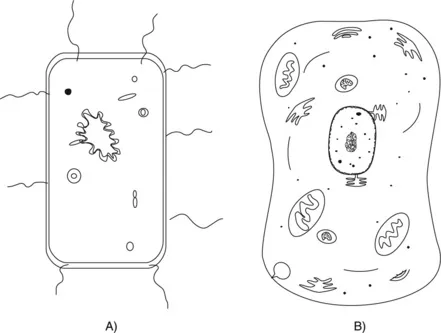
Figure 1.1 Prokaryotic cell (A) has simple internal structures and the genetic material is not contained inside nucleolar membrane. Eukaryotic cell (B) has complex internal structures and their genetic material is contained within defined nucleolar membrane.
1.3 Mendel’s contributions
All living organisms possess well-defined cellular architecture which is controlled by the genes that they have inherited from their parents. The branch of science dealing with heredity and variation is known as genetics. The history of genes and genetics dates back to Gregor Mendel’s work on pea plants in the nineteenth century. Before Mendel’s work, pangenesis and blending inheritance theories were the accepted theories in the biological world to explain inheritance in living organisms, but Mendel’s work explained the inheritance based on scientific experiments. He is honoured with title ‘Father of Genetics’. He observed that different traits such as height, colour of the flower, etc., are controlled by particulate matters present in the cell, which he termed factors. The factor controlling each trait is particulate in nature and the factors interact with each other when they are passed on to the progenies but they do not contaminate each other. In 1905, Mendel’s work was rediscovered by Hugo de Vries, Carl Correns and Erich von Tschermak. Subsequently, Mendel’s laws of inheritance were explained.
1.4 The chromosomal theory of inheritance
Scientists were looking for the physical material of inheritance and they discovered that it is located in the chromosomes; this is an important step in exploring the nature of genes and its chemical make-up. Chromosomes are physical entities that can be seen and which carry the genetic material in the cell. Chromosomes are well-organized structures made of DNA and protein; since they can be stained intensely with dyes, they are called chromosomes. Cell division in somatic cells undergoes mitotic division, during which chromosomes duplicate and are equally distributed among daughter cells. Another type of cell division is meiosis, which occurs in germ line cells, in which the number of chromosomes in daughter cells is reduced to half.
After fertilization, the actual chromosome number of that species is restored. Careful study of movement of chromosomes during meiosis showed that chromosomes are t...
Table of contents
- Cover image
- Title page
- Table of Contents
- Copyright
- List of figures
- List of tables
- Preface
- Acknowledgements
- List of abbreviations
- About the authors
- Chapter 1: Introduction to genes and genomes
- Chapter 2: The human genome project
- Chapter 3: Genomes of model organisms
- Chapter 4: High capacity vectors
- Chapter 5: DNA sequencing methods
- Chapter 6: Genome mapping
- Chapter 7: Genome sequencing methods
- Chapter 8: Genome sequence assembly and annotation
- Chapter 9: Functional genomics
- Chapter 10: Introduction to proteomics
- Chapter 11: Two-dimensional gel electrophoresis of proteins
- Chapter 12: Mass spectrometry for proteomics
- Chapter 13: Protein Identification by Peptide Mass Fingerprinting (PMF)
- Chapter 14: Protein sequencing techniques
- Chapter 15: Phosphoproteomics
- Chapter 16: Glycoproteomics
- Conclusion
- Glossary
- Index
Trusted by 375,005 students
Access to over 1.5 million titles for a fair monthly price.
Study more efficiently using our study tools.
Frequently asked questions
Yes, you can cancel anytime from the Subscription tab in your account settings on the Perlego website. Your subscription will stay active until the end of your current billing period. Learn how to cancel your subscription
No, books cannot be downloaded as external files, such as PDFs, for use outside of Perlego. However, you can download books within the Perlego app for offline reading on mobile or tablet. Learn how to download books offline
Perlego offers two plans: Essential and Complete
- Essential is ideal for learners and professionals who enjoy exploring a wide range of subjects. Access the Essential Library with 800,000+ trusted titles and best-sellers across business, personal growth, and the humanities. Includes unlimited reading time and Standard Read Aloud voice.
- Complete: Perfect for advanced learners and researchers needing full, unrestricted access. Unlock 1.5M+ books across hundreds of subjects, including academic and specialized titles. The Complete Plan also includes advanced features like Premium Read Aloud and Research Assistant.
We are an online textbook subscription service, where you can get access to an entire online library for less than the price of a single book per month. With over 1.5 million books across 990+ topics, we’ve got you covered! Learn about our mission
Look out for the read-aloud symbol on your next book to see if you can listen to it. The read-aloud tool reads text aloud for you, highlighting the text as it is being read. You can pause it, speed it up and slow it down. Learn more about Read Aloud
Yes! You can use the Perlego app on both iOS and Android devices to read anytime, anywhere — even offline. Perfect for commutes or when you’re on the go.
Please note we cannot support devices running on iOS 13 and Android 7 or earlier. Learn more about using the app
Please note we cannot support devices running on iOS 13 and Android 7 or earlier. Learn more about using the app
Yes, you can access Concepts and Techniques in Genomics and Proteomics by N Saraswathy,P Ramalingam in PDF and/or ePUB format, as well as other popular books in Biological Sciences & Genetics & Genomics. We have over 1.5 million books available in our catalogue for you to explore.