eBook - ePub
Neuroscience Basics
A Guide to the Brain's Involvement in Everyday Activities
- 128 pages
- English
- ePUB (mobile friendly)
- Available on iOS & Android
eBook - ePub
About this book
Neuroscience Basics: A Guide to the Brain's Involvement in Everyday Activities examines how our brain works in everyday activities like sleeping, eating, love, and exercise. Many want to better understand how the brain works, but the terminology and jargon of books can be overwhelming. The book covers the basics taught in an introductory neurobiology course designed for anyone new to the neuroscience field, including non-neuroscientists. While each of the chapters explore the brain in a normal state, Neuroscience Basics also discusses disruptions of the normal state—psychosis, Alzheimer's, Parkinson's, autism, learning disorders, etc. This book breaks down the topics into language that is more accessible while making the neuroscience topics fun and relevant.
- Provides basic understanding of neuroscience topics that are part of everyday life
- Provides basic diagrams and descriptions of some basic anatomy
- Explores and explains current research in each of the chapters and topics
- Examines basics that are taught in an introductory neuroscience course to provide working knowledge of how the brain works for non-neuroscientists
Information
Chapter 1
How to Build a Human Brain
Keywords
Brain development; brain injury; organization of the nervous system; Down syndrome; autism; schizophrenia
Summary
In order for us to understand how the brain works during a normal day, we must first understand what is a brain and how does the brain develop during pregnancy and childhood. During brain development, the brain is organized so that the daily functions carried out by the brain are organized and efficient. Finally, we will cover a few of the disorders that can occur when development does not go according to plan.
1.1 What is the Brain?
In order to understand how the brain works, we need to understand what the brain is. The term brain usually refers to the tissue found within a skull that generates behavior. The mind usually refers to personality, opinions, experiences, and memories. There is an age-old philosophical debate arguing the brain and the mind are the same thing versus they are separate things. Aristotle (384–322 BCE) and Plato (428–348 BCE) argued that the soul of a person was the center of intelligence or wisdom and that the soul was not something physical; therefore, the mind and the brain were different. Descartes (1596–1650) was a French philosopher who believed that the mind controlled consciousness and self-awareness and was separate from the brain, but the brain was the seat of intelligence. Another side of the debate is given by a researcher in the field of artificial intelligence (AI), Marvin Minsky (1927–2016). In the early 1970s, Minsky was working in an AI lab at MIT where he developed with others the Society of the Mind Theory. The theory was published in Minsky’s book in 1986—The Society of the Mind. Minsky stated that “minds are simply what the brains do.” There are many more philosophers and researchers who have weighed in on this debate spanning several centuries. While this interesting debate continues, we will direct our focus on the physical tissue inside the skull, the brain.
In order to understand how the brain functions properly through the day, we need to first understand how the brain develops during pregnancy and childhood.
1.2 Overview of Brain Development
Have you ever tried to follow a professional’s recipe? Trying to recreate something a professional dreamed up is not an easy task. In a similar fashion, brain development must follow its recipe; otherwise, problems can arise. There are many steps to making a brain, and each of them is tightly regulated. The remainder of this chapter will cover the five steps to making a brain; how childhood is necessary for brain development; how the brain organizes itself during development; and what happens when brain development doesn’t go according to plan.
The majority of the brain’s “thinking cells,” the neurons, are already in place in the womb. In the womb, the brain weighs less than 300 grams. Directly after birth, the brain triples in size and other cells the brain needs to do its task have been put into place. By adulthood, the human brain weighs between 1300–1400 grams.
There are five main steps in growing a brain:
Creation and closing of the neural tube (neurulation)
Birth and growth of precursor cells
Cells find their proper location (migration)
Precursor cells figure out what kind of cell they are going to be (differentiation)
Connections between different cells are made—the brain is starting to be wired together (targeting/synaptogenesis).
1.3 Brain Development Steps
1.3.1 Step 1: Creation and Closing of the Neural Tube (Neurulation)
Humans all start off as just two cells—an egg and a sperm. Eventually, those cells divide and create four cells, then eight, doubling constantly. Eventually, the cells make something of a sheet, initially with two layers. This two-layer sheet (bilaminate epiblast) occurs during day 14–15 gestation in humans. This two-layer sheet becomes a three-layer sheet in a process called gastrulation. The three layers are: endoderm, ectoderm, and mesoderm. The endoderm becomes the epidermis and associated structures as well as the nervous system. The ectoderm becomes the glands and the inner lining for both the digestive and respiratory system. Finally, the mesoderm becomes the muscles, bones, cartilage, circulatory system, excretory system, gonads, and the outer covering of the internal organs. As this three-layer ball starts to organize, it will form a tube that closes. The open tube is formed around day 18–19 gestation in humans and begins the folding around day 21 and fusing to form a closed tube around day 27 gestation. When the neural tube fails to close properly, diseases like spina bifida or brain hernias can result. About 2 days after full closure of the neural tube, arm buds begin to form. This entire process, just 27 days of the gestation, are intense and tightly regulated in order to regulate proper neural tube closure.
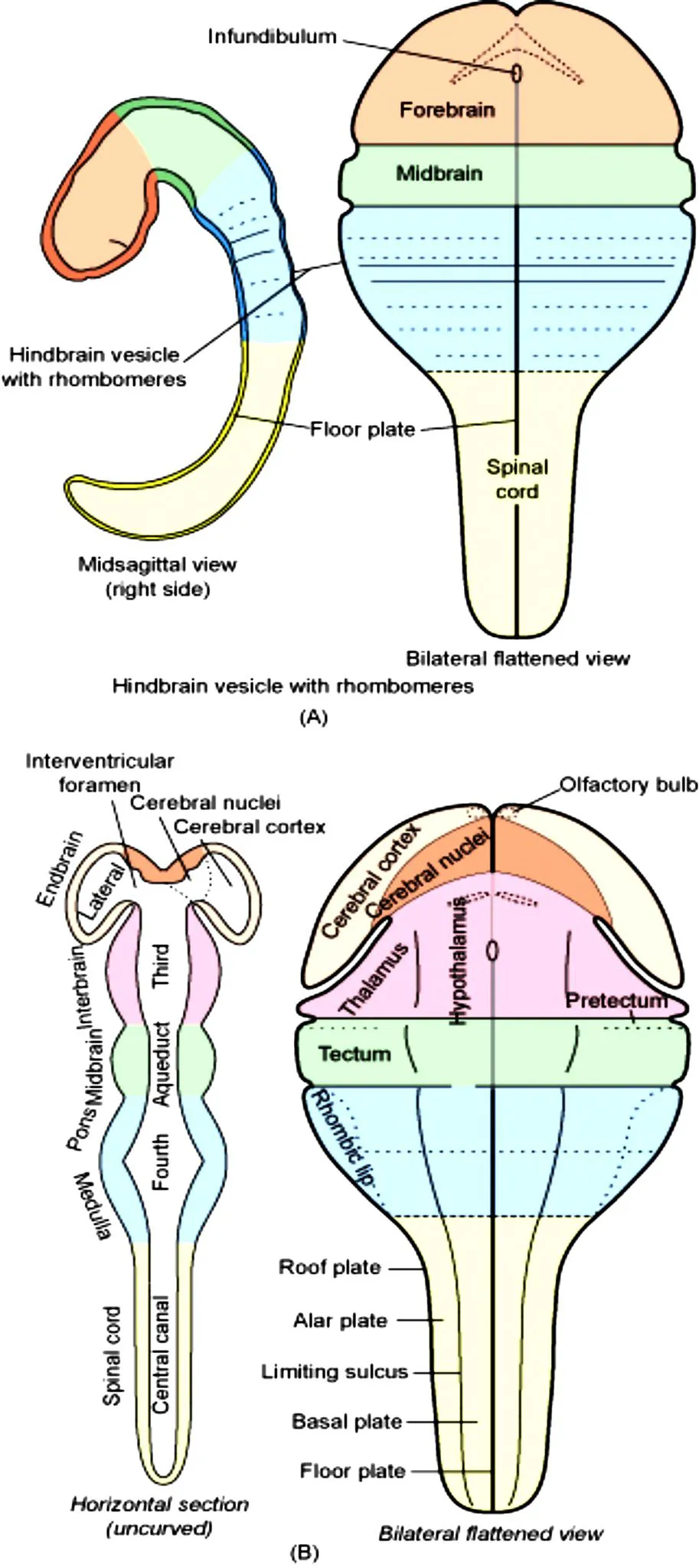
At day 21, as the neural tube is closing, the tube begins specialization. The tube forms three regions: the prosencephalon, the mesencephalon, and the rhombencephalon (Fig. 1.1). The prosencephalon becomes the forebrain, the mesencephalon becomes the midbrain, and the rhombencephalon becomes the hindbrain. So 3–4 weeks into gestation, the brain is already well on its way! Precursors are in place and filled with the cells necessary for further development.
At this point in gestation, most humans are unaware or at best, are unsure if they are pregnant. Most women begin to question if they are pregnant due to a missed menstrual cycle. The menstrual cycle should usually occurs 1–2 weeks (7–14 days) after gestation. There is a tighter range that is more “textbook” but some women have ovulation cycles that are not textbook. In order for pregnancy to continue, hormone levels must rise. These elevated hormone levels are utilized in pregnancy tests and detected in the urine. Currently, some home pregnancy tests boast that they will detect a pregnancy 5 days before a period. Most tests are less reliable the earlier they are used. Usually, a test is reliable 1 week after a missed menstrual cycle, which would put a woman at 2–3 weeks (14–21 days) gestation around the time of the test.
By 8 weeks of gestation, the prosencephalon has further organized into the telencephalon and diencephalon. The mesencephalon is still present and the rhombencephalon becomes the metencephalon and myelencephalon (Fig. 1.1). Each of those “cephalons” later become a region of the brain. The telencephalon later becomes the cortex, hippocampus, basal ganglia, and olfactory bulb, the diencephalon becomes the thalamus and the hypothalamus as well as the optic cups, the mesencephalon becomes the midbrain, the metencephalon becomes the pons and the cerebellum and the myelencephlon becomes the medulla (Fig. 1.1). The bottom line is, at 8 weeks, the precursors to all the major brain regions are in place.
1.3.2 Step 2: Birth and Growth of Cells That Could Become a Lot of Things (Precursor Cells) and Step 3: Cells Find Their Proper Location (Migration)
There are precursor cells, called stem cells, which generate the types of cells found in the brain. Once all the cells are born and they move to the region where they can carry out their specific function and the whole nervous system gets organized based on what functions are to be carried out, a brain has been formed. These migrations are aided by other cells (namely, radial glia) and signals that attract or repel new cells. These steps occur from about the fifth week of gestation to 7 months postnatally.
1.3.3 Step 4: Precursor Cells Figure Out What Kind of Cell They Are Going to Be (Differentiation)
At this point (usually at 25 weeks gestation to 5 months postnatally), the brain is creating more cells in order for the brain to function properly. It needs a large army to keep you working every day. More stem cells are called in and they respond to different cues in order to figure out what their function is in a brain. There are signals inside and outside the cell which tell the cell who it needs to be in order for the brain to function properly.
1.3.4 Step 5: Connections Between Different Cells Are Made—The Brain Is Starting to Be Wired Together (Targeting/Synaptogenesis)
Most of brain connections (synapses) are solidified during the formative years of childhood. Experiences and learning impact the developing brains in ways scientists are still exploring. Eventually, the brain stops growing and dials back (pruning) the growth just a touch to make sure that proper and strong connections are established between brain regions and communication between the brain’s thinking cells (neurons) is correct. The brain prunes back some of the connections so that the brain is not “overwired.” Too many connections in the brain are the equivalent of too many chefs in the kitchen. The proper number and strength of connections are important in development. There cannot be too many or too few. Most of the pruning and strengthening of the connections occur between 8 and 12 years of age. The last part of the brain to develop is a region that is necessary for assessing risk, personality, and long-term memory—the prefrontal cortex, which matures in the mid-20s, when driver insurance rates drop and you can rent a car.
The ability to change connections, called plasticity, is a characteristic of the human brain throughout a lifetime. The connections in the brain that are made are called synapses. So the ability of the brain to change is called synaptic plasticity. Because the brain is plastic, humans are able to learn and are also able to forget.
We have defined what a brain is and we have discussed the basic steps of human brain development. In this section, we have learned that connections are being formed and changed throughout childhood. We have also learned that many of the stem cells are determining their fate after birth. So what role does childhood serve in brain development? How does our childhood experiences impact our everyday adult life?
1.4 What Purpose Does Human Childhood Serve? Back to the Sandbox
Connections (synapses) between the brain’s thinking cells (neurons) are being made through late childhood/prepuberty. What is fascinating here is that humans have this time of brain growth after birth. And this time of brain growth after birth allows interactions with the environment and ex...
Table of contents
- Cover image
- Title page
- Table of Contents
- Copyright
- Dedication
- Preface
- Chapter 1. How to Build a Human Brain
- Chapter 2. 6:00 a.m. Time to Start the Day! How Our Senses Help Us Wake up!
- Chapter 3. 6:35 a.m. Time to Run—How Does the Brain Tell Our Muscles to Move?
- Chapter 4. 9:00 a.m. Lions and Tigers and Bears, Oh My! Oh Wait, No, It’s Just Work!
- Chapter 5. 10:00 a.m. Staff Meeting About the New Thing and How We Have to Learn It to Do Our Job!
- Chapter 6. 11:30 a.m. Hanger: (n) Hunger-Induced Anger
- Chapter 7. 1:00 p.m. Mid-Afternoon Blues
- Chapter 8. 10:00 p.m. Counting Sheep
- Index
Trusted by 375,005 students
Access to over 1.5 million titles for a fair monthly price.
Study more efficiently using our study tools.
Frequently asked questions
Yes, you can cancel anytime from the Subscription tab in your account settings on the Perlego website. Your subscription will stay active until the end of your current billing period. Learn how to cancel your subscription
No, books cannot be downloaded as external files, such as PDFs, for use outside of Perlego. However, you can download books within the Perlego app for offline reading on mobile or tablet. Learn how to download books offline
We are an online textbook subscription service, where you can get access to an entire online library for less than the price of a single book per month. With over 1.5 million books across 990+ topics, we’ve got you covered! Learn about our mission
Look out for the read-aloud symbol on your next book to see if you can listen to it. The read-aloud tool reads text aloud for you, highlighting the text as it is being read. You can pause it, speed it up and slow it down. Learn more about Read Aloud
Yes! You can use the Perlego app on both iOS and Android devices to read anytime, anywhere — even offline. Perfect for commutes or when you’re on the go.
Please note we cannot support devices running on iOS 13 and Android 7 or earlier. Learn more about using the app
Please note we cannot support devices running on iOS 13 and Android 7 or earlier. Learn more about using the app
Yes, you can access Neuroscience Basics by Jennifer L. Larimore in PDF and/or ePUB format, as well as other popular books in Biological Sciences & Biology. We have over 1.5 million books available in our catalogue for you to explore.