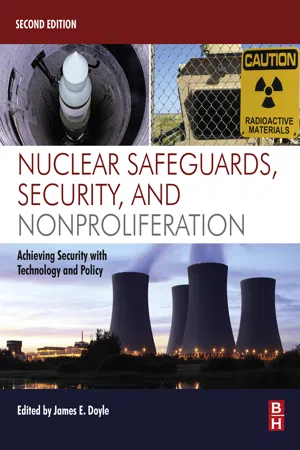
eBook - ePub
Nuclear Safeguards, Security, and Nonproliferation
Achieving Security with Technology and Policy
- 480 pages
- English
- ePUB (mobile friendly)
- Available on iOS & Android
eBook - ePub
Nuclear Safeguards, Security, and Nonproliferation
Achieving Security with Technology and Policy
About this book
Nuclear Safeguards, Security and Nonproliferation: Achieving Security with Technology and Policy, Second Edition is a comprehensive reference covering the cutting-edge technologies used to trace, track and safeguard nuclear material. Sections cover security, the illicit trafficking of nuclear materials, improvised nuclear devices, and how to prevent nuclear terrorism. International case studies of security at nuclear facilities and illegal nuclear trade activities provide specific examples of the complex issues surrounding the technology and policy for nuclear material protection, control and accountability. New case studies include analyses of nuclear programs of important countries, such as North Korea, Iran, and Kazakhstan, among others.
This is a thoroughly updated, must-have volume for private and public organizations involved in driving national security, domestic and international policy issues relating to nuclear material security, non-proliferation, and nuclear transparency.
- Covers the continuing efforts to reduce the size of nuclear arsenals
- Highlights the challenges of verifying nuclear weapons reduction
- Summarizes issues from the 2015 Nonproliferation Treaty Review Conference
- Illuminates the evolving status of nonproliferation and safeguards in Iran and DPRK
Information
Part 1
Nuclear Arms Reductions: The Status of Global Efforts
Chapter 1
Global Nuclear Arsenals, 1990–2018
Hans M. Kristensen Nuclear Information Project, Federation of Information Project, Washington, DC, United States
Abstract
This chapter assesses the global status of nuclear arsenals by summarizing the current capabilities, strategies, and force structure plans of all states possessing nuclear weapons. Several trends are evident. The four main nuclear competitors of the Cold War—Britain, France, Russia, and the United States—have greatly reduced the size of their Cold War nuclear arsenals over the past three decades. However, the pace of these reductions has slowed and, in some cases, concluded. These nations, along with the five others possessing nuclear weapons (China, India, Pakistan, Israel, and North Korea), are all modernizing their forces and intend to maintain them for the next 30–40 years, if not through the end of the century. They are placing increasing emphasis on the role that nuclear weapons play in their national strategies and adding new types of weapons to their arsenals. Most disconcertingly, they are discussing the role of nuclear weapons in a way that appears to borrow from the Cold War playbook that increases reliance on tactical and low-yield nuclear weapons in limited regional scenarios, a move that increases the chance of nuclear war.
Keywords
Cold War; Intercontinental ballistic missile; Nuclear Non-Proliferation Treaty; Nuclear Posture Review; Non-strategic nuclear weapons; Nuclear weapon states; Sea-launched cruise missilex
Introduction
Nearly three decades after the Cold War ended, the world’s nine nuclear-armed states are busy modernizing their nuclear arsenals to last through most of this century and reaffirming the importance of nuclear weapons in their defense strategies.
The four main nuclear competitors of the Cold War—Britain, France, Russia, and the United States—have made enormous progress in reducing the size of their Cold War nuclear arsenals over the past three decades. Yet the progress and hopes and aspirations in the 1990s about deep cuts and nuclear disarmament are a far cry from the conditions in 2018.
The pace of nuclear reduction has slowed; arms control has essentially stalled and become less restrictive and failed to achieve limits on many categories of nuclear weapons, and some agreements have been abandoned, while others are in jeopardy.
Moreover, Russia and NATO have descended into a new Cold War–like adversarial relationship dominated by bickering, embrace of “great power competition,” overt threats, revival of offensive military planning and operations, and violations or dismissal of arms control.
The adversarial relationship is boosting existing already substantial nuclear weapons modernization programs with plans to develop and deploy new and better nuclear weapons. For the first time in four decades, the United States is accusing Russia of increasing its nuclear arsenal, both in numbers and types of weapons. China has been increasing its arsenal for several years and appears intent on continuing to do so. Through their nuclear revival, the five original nuclear weapon states now appear to be going back on their obligations under the Nuclear Non-Proliferation Treaty (NPT) to pursue negotiations to end the nuclear arms race and to nuclear disarmament.
The nuclear-armed states outside the NPT—India, Israel, North Korea, and Pakistan—are also modernizing their arsenals, with India and Pakistan working on significant expansions of their arsenals in a regional arms race, and North Korea has been rapidly improving its missile capabilities and nuclear warhead designs.
Once countries acquire nuclear weapons, they will sooner or later have to modernize them to ensure they continue to work. With each modernization cycle, new technologies can provide enhanced or new capabilities or even entirely new weapon types. During the Cold War, the modernization programs created bigger and bigger arsenals with nuclear weapons being incorporated into almost every major weapons category. Since the mid-1980s, the combined arsenal of Russia and the United States (as well as Britain and France) has been decreasing, but the pace of reductions has slowed and appears to be leveling out. Over the past couple of decades, moreover, the arsenals of China, India, Pakistan, and North Korea have been increasing. All have been modernizing their arsenals, although in different ways, but the new adversarial relationship between NATO and Russia has significantly stimulated a revival of modernization plans, operations, and strategy.
Some have warned that Russia and the United States are now on the brink of a new “arms race.” 1 Although an arms race similar to the one that characterized the Cold War—a race for who could build the most nuclear weapons—fortunately does not seem imminent, there are plenty of warning signs that a small Cold War has started, characterized by an intense technological and political competition. The combined effects of political disagreement and bickering, increased military posturing and Great Power competition, and more or less overt nuclear threats, combined with the extensive nuclear modernization programs, have the potential to halt nuclear reductions and even result in an increase of weapons types and numbers in the future.
Overall, the substantial and broad modernization programs effectively plan for the sustainment of large nuclear arsenals farther into the future than the nuclear era has lasted so far.
The nuclear-armed states and many of their allies frequently emphasize the importance of nuclear weapons to national and international security. That commitment is deepening. To maintain and demonstrate this role, nuclear weapon systems are periodically test launched, and nuclear exercises are frequently conducted to practice and refine offensive strike plans against potential adversaries. In recent years, Russia and the United States have both increased the profile and operational presence of their nuclear-capable forces.
Although a surprise nuclear first strike is viewed as highly unlikely, the United States, Russia, Britain, and France keep large numbers of nuclear warheads—possibly around 1800—on alert and capable of being launched on relatively short notice. Moreover, the nuclear doctrines of these nations include the possibility that they could use nuclear weapons first in a conflict. Maintaining nuclear forces on alert increases the risk of accidents and incidents and fuels adversarial and competitive policies and worst-case planning. Moreover, the highly alerted nuclear postures of the United States, Russia, Britain, and France may help motivate smaller nuclear-armed states such as China, India, and Pakistan to increase the readiness level of their nuclear forces as well, developments that could significantly worsen regional stability. 2
Missiles with the capability to deliver MIRV (multiple independently targetable reentry vehicles) were important and visible symbols of the Cold War. They were key to rapidly increasing the size of the arsenals, building first-strike capabilities, and to nuclear war-fighting strategies. The START II treaty in 1993 included an important ban on MIRV on intercontinental ballistic missiles (ICBMs) but was abandoned by the United States an...
Table of contents
- Cover image
- Title page
- Table of Contents
- Copyright
- List of Contributors
- Introduction: Nuclear Security and Global Challenges
- Part 1. Nuclear Arms Reductions: The Status of Global Efforts
- Part 2. Technologies and Processes to Prevent Nuclear Proliferation and Strengthen Nuclear Materials Security
- Part 3. Preventing Nuclear Terrorism and Illicit Nuclear Trade
- Index
Trusted by 375,005 students
Access to over 1.5 million titles for a fair monthly price.
Study more efficiently using our study tools.
Frequently asked questions
Yes, you can cancel anytime from the Subscription tab in your account settings on the Perlego website. Your subscription will stay active until the end of your current billing period. Learn how to cancel your subscription
No, books cannot be downloaded as external files, such as PDFs, for use outside of Perlego. However, you can download books within the Perlego app for offline reading on mobile or tablet. Learn how to download books offline
Perlego offers two plans: Essential and Complete
- Essential is ideal for learners and professionals who enjoy exploring a wide range of subjects. Access the Essential Library with 800,000+ trusted titles and best-sellers across business, personal growth, and the humanities. Includes unlimited reading time and Standard Read Aloud voice.
- Complete: Perfect for advanced learners and researchers needing full, unrestricted access. Unlock 1.5M+ books across hundreds of subjects, including academic and specialized titles. The Complete Plan also includes advanced features like Premium Read Aloud and Research Assistant.
We are an online textbook subscription service, where you can get access to an entire online library for less than the price of a single book per month. With over 1.5 million books across 990+ topics, we’ve got you covered! Learn about our mission
Look out for the read-aloud symbol on your next book to see if you can listen to it. The read-aloud tool reads text aloud for you, highlighting the text as it is being read. You can pause it, speed it up and slow it down. Learn more about Read Aloud
Yes! You can use the Perlego app on both iOS and Android devices to read anytime, anywhere — even offline. Perfect for commutes or when you’re on the go.
Please note we cannot support devices running on iOS 13 and Android 7 or earlier. Learn more about using the app
Please note we cannot support devices running on iOS 13 and Android 7 or earlier. Learn more about using the app
Yes, you can access Nuclear Safeguards, Security, and Nonproliferation by James Doyle in PDF and/or ePUB format, as well as other popular books in Technology & Engineering & Engineering General. We have over 1.5 million books available in our catalogue for you to explore.