- 648 pages
- English
- ePUB (mobile friendly)
- Available on iOS & Android
eBook - ePub
Biomedical Composites
About this book
Biocomposites are widely used in the medical industry to repair and restore bone, tooth, cartilage skin and other tissues. Biomedical composites, provides a thorough review of the current status, recent progress and future trends in composites for biomedical applications.Part one discusses the fundamentals of biocomposites with chapters on natural composites, design and fabrication of biocomposites, and hard and soft tissue applications of biocomposites. Part two then reviews applications of biocomposites. Chapters discuss composites for bone repair, composite coatings for implants, composites for spinal implants, injectable composites and composites for tissue engineered scaffolds. Chapters in part three discuss the biocompatibility, mechanical behaviour and failure of biocomposites with such topics as cellular response, testing of biocomposites and tribology of biocomposites. Finally part four reviews the future for biocomposites with chapters on nano-structured biocomposites, developing biocomposites as scaffolds and biocomposites in tissue engineering and regenerative medicine.With its distinguished editor and team of international contributors, Biomedical composites is an essential reference to materials scientists and researchers in industry and academia, as well as all those concerned with this increasingly important field.
- Provides a thorough review of the current status, recent progress and future trends in composites for biomedical applications
- Discusses the fundamentals of biocomposites with chapters on natural composites, design and fabrication of biocomposites and their applications
- Chapters address composites for bone repair, spinal implants and various other applications and discuss biocompatability, mechanical behaviour and failure of biocomposites
Information
Subtopic
WerkstoffwissenschaftPart I
Introduction to biocomposites
1
Natural composites: structure–property relationships in bone, cartilage, ligament and tendons
M. PURBRICK and L. AMBROSIO, National Research Council, Italy
M. VENTRE and P. NETTI, University of Naples ‘Federico II’, Italy
Abstract
The mechanical behaviour of biological tissues has been studied for decades, and the knowledge gained has been an endless source of inspiration for the design of novel composite materials. The unique mechanical properties of biological tissues arise from the exquisite multiscale hierarchical assembly of tissue macromolecules. Modern nanotechnology has shed great light on the nanometre scale features of biological tissues. What we learn from this not only provides a better understanding of the intimate relationship between the nano- and micrometre scale architecture and the macroscopic response of these tissues, but it also provides valuable insights into the mechanisms that nature uses to create these extraordinarily complex structures, starting from simple building blocks. This chapter reviews recent work on the multiscale characterization of biological tissues, ranging from macromolecules up to the whole tissue level.
Key words
natural composites
tissue engineering
bone
cartilage
ligament
tendon
1.1 Introduction
An understanding of the structures, and the structure–property relationships, for natural composites, i.e., the composite systems found in natural tissue, is fundamental to the design and realization of effective biomedical materials and tissue engineering constructs for their replacement. In this chapter, we will consider the structure–property relationships apparent in the natural composite material systems found in human bone, cartilage, tendon and ligament tissues. A similar approach could be taken with other tissues, such as skin, muscle, vascular tissue, the intervertebral disc and eye tissue. Some of these are briefly discussed elsewhere in this book.
The first natural composite discussed in this chapter is bone tissue. A key feature of bone tissue is that it is organized as a hierarchical composite, whose material properties change with changes in scale. The nature of the hierarchical structure of bone will therefore be discussed before moving on to consider the procedures used for the determination of structure–property relationships. The structure of bone tissue requires that it must be studied at each scale level, i.e., the nano-, micro- and macrostructural levels, to compile a representative understanding of its behaviour. This is essential in the determination of appropriate design parameters for composite material replacements that are generated using either synthetic processing or tissue engineering.
There are three main types of cartilage in the human body, namely elastic cartilage, fibrocartilage and hyaline cartilage. This chapter will concentrate on hyaline cartilage (also called articular cartilage) whose most prominent role is as the surface covering for all the diarthrodial joints in the human body. Articular cartilage is, therefore, the most significant type to consider in the context of this book.
The remaining two natural composites reviewed here, namely the tendon and the ligament, are dense connective tissues, whose main function is to transmit forces and displacements of the anatomical segments which they connect. Both tissues share several similarities in terms of microarchitecture and gross mechanical behaviour, and are therefore usually discussed in parallel, as they will be here.
This chapter concludes by considering the implications of what is being learned about the structures and mechanical properties of the natural composites reviewed – one, cartilage, tendon and ligament – for the field of tissue engineering, particularly with respect to the design, development and fabrication of constructs for tissue regeneration and tissue repair. Characteristic of natural systems, each of these tissues shows an exquisite elegance and refinement of design in meeting the demands of the particular application. For each tissue, and in each of a single tissue’s different locations in the body, the required performance is delivered through the specific refinement and adaptation of a hierarchical composite structure. This structural refinement and adaptation of the tissue must address all the diverse criteria – atomical, mechanical, physiological, developmental, biochemical, sensing, signalling, and many others – Pertaining to its particular application.
1.2 Bone
1.2.1 Structure, composition and properties: an overview
Bone is a natural hybrid nanocomposite comprising a mineral component, plate-shaped hydroxyapatite particles, dispersed in an organic matrix, formed predominantly of oriented collagen. This structure gives bone its balance of stiffness, toughness, and vibrational damping properties (Fyhrie and Kimura, 1999). It also enables bone tissue to be highly versatile and adaptable in vivo. In the body, bone performs well in an extensive range of applications, with only small structural changes being required to adjust its properties to cope with many widely varying loading geometries. There have been many biomechanical and biomimetic studies, reviewed elsewhere (Fyhrie and Kimura, 1999), which provide the basis for the understanding of structure–property relationships in bone tissue. The structure and composition of bone, and their influence on its properties, are discussed below in further detail.
1.2.2 Organic matrix
The polymeric matrix phase of bone is formed from the protein collagen. Macromolecular chains of collagen are arranged in the triple helix structure of tropocollagen, which is stabilized by hydrogen bonding between the amide groups and the osteoid water. The pitch of the tropocollagen α-helix is ca. 10 nm and its diameter is ca. 1.3 nm. The helical structure of tropocollagen stops the polyamide chains from collapsing into a random coil structure and so facilitates the orientation of collagen in biological tissues such as bone, ligaments and tendons. Further details may be found in a recent and comprehensive review (Boskey, 2005).
1.2.3 Mineral component of bone
The mineral component of bone is an analogue of the naturally occurring mineral hydroxyapatite (HA). The unit cell of HA has the chemical formula Ca10(PO4)6(OH)2. However, extracted bone mineral shows a Ca: P molar ratio ranging from 1.3:1 to 1.9:1. Whilst this is owing, in part, to the contribution of organic phosphate in the bone matrix, it is also attributable to composition of the bone mineral itself. With respect to naturally occurring (geologic) HA, the bone mineral is a hydroxyl- and calcium-deficient, carbonated apatite. Further structural and functional detail (Boskey, 2005), and an account of the process of cell-mediated biomineralization (Gokhale et al., 2001) may be found elsewhere.
1.2.4 Hierarchical structure of bone: effect of scale on material properties
Bone tissue is organized as a hierarchical composite, whose material properties change with changes in scale (Fig. 1.1). Bone tissue must, therefore, be studied at each scale level, i.e., the nano-, micro- and macrostructural levels, to compile a representative understanding of its behaviour. This is essential in the determination of appropriate design parameters for composite material replacements that are generated using either synthetic processing or tissue engineering. Scale considerations play a significant role in understanding and modelling the behaviour of these calcified tissues. On the nanoscale, they are essentially material composites based on the interdigitation of the collagen, the most prevalent biopolymer in the body, and an apatitic mineralite component, the inorganic substance. These tissues then organize into microstructural composites to support loads, which is one of their primary functions.
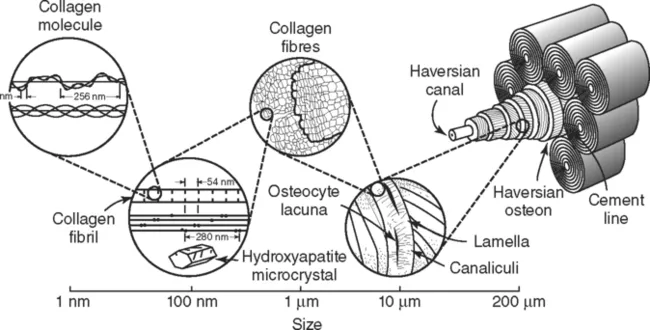
Table of contents
- Cover image
- Title page
- Table of Contents
- Related titles
- Copyright
- Contributor contact details
- Dedication
- Preface
- Part I: Introduction to biocomposites
- Part II: Particular applications of biocomposites
- Part III: Biocompatibility, mechanical behaviour and failure of biocomposites
- Part IV: The future for biocomposites
- Index
Trusted by 375,005 students
Access to over 1.5 million titles for a fair monthly price.
Study more efficiently using our study tools.
Frequently asked questions
Yes, you can cancel anytime from the Subscription tab in your account settings on the Perlego website. Your subscription will stay active until the end of your current billing period. Learn how to cancel your subscription
No, books cannot be downloaded as external files, such as PDFs, for use outside of Perlego. However, you can download books within the Perlego app for offline reading on mobile or tablet. Learn how to download books offline
We are an online textbook subscription service, where you can get access to an entire online library for less than the price of a single book per month. With over 1.5 million books across 990+ topics, we’ve got you covered! Learn about our mission
Look out for the read-aloud symbol on your next book to see if you can listen to it. The read-aloud tool reads text aloud for you, highlighting the text as it is being read. You can pause it, speed it up and slow it down. Learn more about Read Aloud
Yes! You can use the Perlego app on both iOS and Android devices to read anytime, anywhere — even offline. Perfect for commutes or when you’re on the go.
Please note we cannot support devices running on iOS 13 and Android 7 or earlier. Learn more about using the app
Please note we cannot support devices running on iOS 13 and Android 7 or earlier. Learn more about using the app
Yes, you can access Biomedical Composites by Luigi Ambrosio in PDF and/or ePUB format, as well as other popular books in Technik & Maschinenbau & Werkstoffwissenschaft. We have over 1.5 million books available in our catalogue for you to explore.