- 810 pages
- English
- ePUB (mobile friendly)
- Available on iOS & Android
eBook - ePub
About this book
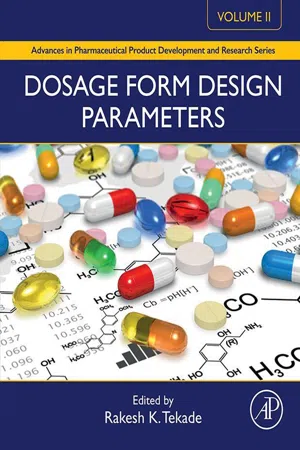
Dosage Form Design Parameters, Volume II, examines the history and current state of the field within the pharmaceutical sciences, presenting key developments. Content includes drug development issues, the scale up of formulations, regulatory issues, intellectual property, solid state properties and polymorphism. Written by experts in the field, this volume in the Advances in Pharmaceutical Product Development and Research series deepens our understanding of dosage form design parameters. Chapters delve into a particular aspect of this fundamental field, covering principles, methodologies and the technologies employed by pharmaceutical scientists. In addition, the book contains a comprehensive examination suitable for researchers and advanced students working in pharmaceuticals, cosmetics, biotechnology and related industries.
- Examines the history and recent developments in drug dosage forms for pharmaceutical sciences
- Focuses on physicochemical aspects, prefomulation solid state properties and polymorphism
- Contains extensive references for further discovery and learning that are appropriate for advanced undergraduates, graduate students and those interested in drug dosage design
Information
Table of contents
- Cover image
- Title page
- Table of Contents
- Copyright
- Dedication
- List of Contributors
- About the Editor
- Chapter 1. Levels of Solid State Properties: Role of Different Levels During Pharmaceutical Product Development
- Chapter 2. Polymorphism and its Implications in Pharmaceutical Product Development
- Chapter 3. Basics of Crystallization Process Applied in Drug Exploration
- Chapter 4. Role of Amorphous State in Drug Delivery
- Chapter 5. Particulate Level Properties and its Implications on Product Performance and Processing
- Chapter 6. Bulk Level Properties and its Role in Formulation Development and Processing
- Chapter 7. Concepts of Hypothesis Testing and Types of Errors
- Chapter 8. Experimental Design and Analysis of Variance
- Chapter 9. Basic Concept and Application of Sampling Procedures
- Chapter 10. Statistical Techniques in Pharmaceutical Product Development
- Chapter 11. Drug–Excipient Interaction and Incompatibilities
- Chapter 12. Documentation Protocol in Product Development Including Clinical Records
- Chapter 13. Correlation Between In Vitro and In Vivo Screens: Special Emphasis on High Throughput Screening and High Throughput Pharmacokinetic Analysis
- Chapter 14. Sterilization of Pharmaceuticals: Technology, Equipment, and Validation
- Chapter 15. Package Development of Pharmaceutical Products: Aspects of Packaging Materials Used for Pharmaceutical Products
- Chapter 16. Package Types for Different Dosage Forms
- Chapter 17. Food and Drug Laws Affecting Pharmaceutical Product Design, Development, and Commercial Manufacturing
- Chapter 18. Guiding Principles for Human and Animal Research During Pharmaceutical Product Development
- Chapter 19. Applications of Computers in Pharmaceutical Product Formulation
- Chapter 20. Patents and Other Intellectual Property Rights in Drug Delivery
- Chapter 21. Computer-Aided Prediction of Pharmacokinetic (ADMET) Properties
- Chapter 22. Ethics and Legal Protection of Uses of Computer Applications in Pharmaceutical Research
- Index
Trusted by 375,005 students
Access to over 1.5 million titles for a fair monthly price.
Study more efficiently using our study tools.
Frequently asked questions
Yes, you can cancel anytime from the Subscription tab in your account settings on the Perlego website. Your subscription will stay active until the end of your current billing period. Learn how to cancel your subscription
No, books cannot be downloaded as external files, such as PDFs, for use outside of Perlego. However, you can download books within the Perlego app for offline reading on mobile or tablet. Learn how to download books offline
Perlego offers two plans: Essential and Complete
- Essential is ideal for learners and professionals who enjoy exploring a wide range of subjects. Access the Essential Library with 800,000+ trusted titles and best-sellers across business, personal growth, and the humanities. Includes unlimited reading time and Standard Read Aloud voice.
- Complete: Perfect for advanced learners and researchers needing full, unrestricted access. Unlock 1.5M+ books across hundreds of subjects, including academic and specialized titles. The Complete Plan also includes advanced features like Premium Read Aloud and Research Assistant.
We are an online textbook subscription service, where you can get access to an entire online library for less than the price of a single book per month. With over 1.5 million books across 990+ topics, we’ve got you covered! Learn about our mission
Look out for the read-aloud symbol on your next book to see if you can listen to it. The read-aloud tool reads text aloud for you, highlighting the text as it is being read. You can pause it, speed it up and slow it down. Learn more about Read Aloud
Yes! You can use the Perlego app on both iOS and Android devices to read anytime, anywhere — even offline. Perfect for commutes or when you’re on the go.
Please note we cannot support devices running on iOS 13 and Android 7 or earlier. Learn more about using the app
Please note we cannot support devices running on iOS 13 and Android 7 or earlier. Learn more about using the app
Yes, you can access Dosage Form Design Parameters by in PDF and/or ePUB format, as well as other popular books in Medicine & Pharmaceutical, Biotechnology & Healthcare Industry. We have over 1.5 million books available in our catalogue for you to explore.