eBook - ePub
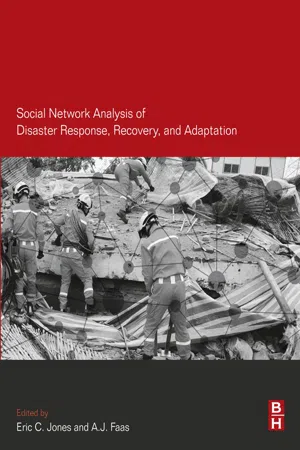
Social Network Analysis of Disaster Response, Recovery, and Adaptation
- 322 pages
- English
- ePUB (mobile friendly)
- Available on iOS & Android
eBook - ePub
Social Network Analysis of Disaster Response, Recovery, and Adaptation
About this book
Social Network Analysis of Disaster Response, Recovery, and Adaptation covers systematic social network analysis and how people and institutions function in disasters, after disasters, and the ways they adapt to hazard settings. As hazards become disasters, the opportunities and constraints for maintaining a safe and secure life and livelihood become too strained for many people. Anecdotally, and through many case studies, we know that social interactions exacerbate or mitigate those strains, necessitating a concerted, intellectual effort to understand the variation in how ties within, and outside, communities respond and are affected by hazards and disasters.
- Examines the role of societal relationships in a disaster context, incorporating theory and case studies by experts in the field
- Integrates research in the areas of social network analysis and inter-organizational networks
- Presents a range of studies from around the world, employing different approaches to network analysis in disaster contexts
Information
Part 1
Social Network Analysis in Disaster Response, Recovery and Adaptation
Chapter 1
An Introduction to Social Network Analysis in Disaster Contexts
Eric C. Jones1, and A.J. Faas2 1University of Texas Health Science Center at Houston, El Paso, TX, United States 2San Jose State University, San Jose, CA, United States
Abstract
We introduce this book and the field of disaster networks briefly in this chapter. We indicate what we mean by networks, and we advocate reading the rest of the book keeping the following things in mind since they're not always present or explicit in research in this field: the ways types of roles and types of relationships in disaster settings produce fundamentally different kinds of network dynamics; levels of analysis; interdisciplinarity; potential versus realized ties; ethics; and applications or translation. The book's chapters cover hazards originating from human carelessness and those originating in the earth's biophysical environment, and generally focus topically either on social support or coordination of emergency management, and some chapters methodologically cover network structures or longitudinal network dynamics.
Keywords
Disaster networks; Disasters; Hazards; Risk; Social network analysis
Introduction
Hazards become disasters as the opportunities and constraints for maintaining a safe and secure life and livelihood become too strained for many people. Anecdotally and through many case studies, we know that social interactions exacerbate or mitigate those strains. However, we need a concerted intellectual effort to understand the variation in how ties within and between groups, communities, and organizations both respond to and are affected by hazards and disasters. Network research allows us to be incredibly creative in the ways that we capture the subtle, intricate, and dynamic power of relationships and interactions in the areas of disaster response, recovery, and adaptation.
Before, during, and after a disaster, people, agencies, and organizations help and hinder each other, alternatively opening up new possibilities and hamstringing others. To be sure, exposures to hazards become disasters in large part as a result of relational patterns in societies, and our responses to disasters—emergency deployment, mitigation, coping, and adaptation—are likewise facilitated and obstructed by variations in coordination and support between networks of actors. The social network is therefore a seductive concept in the social science of disasters—a potentially robust tool for investigating complex patterns of social relations and human-environment entanglements.
Social networks are typically invoked in one of two general ways in social science research: (1) metaphorically or heuristically, as descriptive or analytical concepts that summarize researchers’ perceived patterns of relationships or interactions in particular contexts, or else as guides for systematic observations of relationships and interactions; and (2) as a formal system of measurement of either personal or whole (i.e., community or institutional) patterns of relationships or interaction employing one or more measures derived from graph theory (e.g., density, centralization, bridging, etc.) and, more recently, examining complexity and network change. This book is principally focused on the second broad approach to network analysis, though contributors draw heavily on concepts and empirical trends identified in studies that engage networks more metaphorically.
This book is the first of its kind; it presents a great deal of the diversity in network approaches to better understanding how people and groups experience extreme events. Since both network analysis and disaster studies are often separated out into the publishing confines of multiple disciplines—and we do not always read outside of these disciplines—this cutting-edge scholarly work would otherwise be scattered in disparate journals and books. Not only does this book bring this work from different disciplines together but it brings together the relatively minimally interacting fields of interpersonal disaster networks and interorganizational disaster networks. By doing so, we can start to explore the theoretical disconnects between the ways networks are deployed by scholars. For example, we note that the study of bridging—or being a relatively unique connection between at least a couple of parts of a network—in the field of interpersonal networks usually means we are examining power, vulnerability, or assets/liabilities, while in the field of interorganizational networks we are typically examining the effectiveness of communication and, to a lesser extent, goal alignment.
We have tried to keep the studies in this book to those that revolve around identifiable disasters and that use systematic qualitative or quantitative analysis of dyadic data—the specific kinds of relationships between specific individuals, roles, or institutions. This said, we would like even more studies to go beyond dyadic analyses and to engage the entire web of relationships involved in disasters. In other words, exchange and dyadic interaction is a minimum in our mind for the study relationships and disasters, but it does not fully leverage the possibilities of social network analysis because the dependence of a dyad on other individuals and dyads and cliques (and the rest of the network) is left unexamined when only paying attention to dyads. While we have chosen studies for this book that we consider to use the methodologies of social network analysis, our interest is less on the importance of conducting social network analysis and more on the kinds of things it can tell us about human behavior in extreme settings.
The Content and Layout of the Book
This first section provides orientations to theory on individual and organizational networks in disaster settings plus a methodological overview of the loosely organized field. Then empirical work comprises the sections on response, recovery, and adaptation/mitigation. Each empirical chapter also addresses methodological and theoretical concerns. Since we are addressing a fairly new and somewhat specialized field, we end the book with a chapter that provides insight into how this new and specialized knowledge can be applied to improve response, recovery, and adaptation.
The authors in this book cover some major events of our times like Hurricanes Katrina, Sandy, and Ike in the United States, the Wenchuan earthquake in China, the Kobe earthquake in Japan, and the Canterbury earthquakes in New Zealand, plus some lesser known events, like volcanic eruptions in Ecuador and Mexico, landslides in Mexico, a day care fire in Mexico, a typhoon in Fiji, wildfires in the United States, and drought in East Africa. These studies include those in contexts of geophysical and hydrometereological hazards (volcanoes and mudslides—Tobin and colleagues; earthquakes—Stevenson, Lee and Sugiura, Lu; hurricanes—Marcum and colleagues, Harris and Doerfel, Meyer; typhoons—Takasaki; droughts—Moritz; wildfires—Nowell and colleagues, Almquist and colleagues), and those caused by human carelessness or recklessness (a building fire—Rangel and colleagues). We purposefully avoided including events of conflict or mass terror since—although we see them theoretically as extreme events, too—intentionality in such events often involves some very different responses and adaptations.
Table 1.1 presents the general focus and methodological approach of each empirical chapter. These chapters cover considerable variation in the kinds of networks that are studied. There is not always a clear division between egocentric networks that focus on the ties in each individual’s or organization’s own network versus sociocentric networks that focus on an identifiable group or interaction sphere. However, it is worth noting the degree to which this book’s chapters cover networks that are more methodologically relying on ties focused on a given individual/organization versus ties that exist within a group of people/institutions that are likely to interact. Among the book’s 12 case study chapters, only two chapters break the pattern of egocentric networks being about individuals and sociocentric networks being about organizations. Similarly, few chapters cover network structure (e.g., density, cohesion, bridging, path distance) or employ longitudinal design. It was not our goal to have all chapters cover structure or network dynamics/change, but it is clear that these approaches are not in the majority for disaster network research.
To the extent the data allowed, the authors have tried to address temporal aspects of networks, although we only marked them as longitudinal when comparable data was collected at two or more points in time. Since people may rely on different kinds of people for different things at different points as hazards, the contributors have attempted to account for dynamic shifts in needs, constraints, and help seeking.
Table 1.1
Approaches and Foci of the Empirical Chapters
| Chapters | Egocentric/Sociocentric, and Individuals/Organizations | Social Support | Coordination | Structure | Longitudinal |
| 5 | Sociocentric—organizations | x | x | ||
| 6 | Sociocentric—organizations | x | x | x | |
| 7 | Sociocentric—organizations | x | x | x | |
| 8 | Egocentric—individuals | x | x | ||
| 9 | Egocentric—individuals | x | |||
| 10 | Sociocentric—organizations | x | x | x | |
| 11 | Egocentric—organizations | x | x | ||
| 12 | Sociocentric—individuals | x | x | ||
| 13 | Egoc... |
Table of contents
- Cover image
- Title page
- Table of Contents
- Copyright
- List of Contributors
- Acknowledgments
- Part 1. Social Network Analysis in Disaster Response, Recovery and Adaptation
- Part 2. Networks in Disaster Response
- Part 3. Networks in Disaster Recovery
- Part 4. Networks in Hazard Mitigation and Adaptation
- Part 5. Conclusions
- References
- Index
Trusted by 375,005 students
Access to over 1.5 million titles for a fair monthly price.
Study more efficiently using our study tools.
Frequently asked questions
Yes, you can cancel anytime from the Subscription tab in your account settings on the Perlego website. Your subscription will stay active until the end of your current billing period. Learn how to cancel your subscription
No, books cannot be downloaded as external files, such as PDFs, for use outside of Perlego. However, you can download books within the Perlego app for offline reading on mobile or tablet. Learn how to download books offline
Perlego offers two plans: Essential and Complete
- Essential is ideal for learners and professionals who enjoy exploring a wide range of subjects. Access the Essential Library with 800,000+ trusted titles and best-sellers across business, personal growth, and the humanities. Includes unlimited reading time and Standard Read Aloud voice.
- Complete: Perfect for advanced learners and researchers needing full, unrestricted access. Unlock 1.5M+ books across hundreds of subjects, including academic and specialized titles. The Complete Plan also includes advanced features like Premium Read Aloud and Research Assistant.
We are an online textbook subscription service, where you can get access to an entire online library for less than the price of a single book per month. With over 1.5 million books across 990+ topics, we’ve got you covered! Learn about our mission
Look out for the read-aloud symbol on your next book to see if you can listen to it. The read-aloud tool reads text aloud for you, highlighting the text as it is being read. You can pause it, speed it up and slow it down. Learn more about Read Aloud
Yes! You can use the Perlego app on both iOS and Android devices to read anytime, anywhere — even offline. Perfect for commutes or when you’re on the go.
Please note we cannot support devices running on iOS 13 and Android 7 or earlier. Learn more about using the app
Please note we cannot support devices running on iOS 13 and Android 7 or earlier. Learn more about using the app
Yes, you can access Social Network Analysis of Disaster Response, Recovery, and Adaptation by Eric C Jones,A.J. Faas in PDF and/or ePUB format, as well as other popular books in Computer Science & Computer Science General. We have over 1.5 million books available in our catalogue for you to explore.