- 462 pages
- English
- ePUB (mobile friendly)
- Available on iOS & Android
eBook - ePub
Solar Energy Forecasting and Resource Assessment
About this book
Solar Energy Forecasting and Resource Assessment is a vital text for solar energy professionals, addressing a critical gap in the core literature of the field. As major barriers to solar energy implementation, such as materials cost and low conversion efficiency, continue to fall, issues of intermittency and reliability have come to the fore. Scrutiny from solar project developers and their financiers on the accuracy of long-term resource projections and grid operators' concerns about variable short-term power generation have made the field of solar forecasting and resource assessment pivotally important. This volume provides an authoritative voice on the topic, incorporating contributions from an internationally recognized group of top authors from both industry and academia, focused on providing information from underlying scientific fundamentals to practical applications and emphasizing the latest technological developments driving this discipline forward.
- The only reference dedicated to forecasting and assessing solar resources enables a complete understanding of the state of the art from the world's most renowned experts.
- Demonstrates how to derive reliable data on solar resource availability and variability at specific locations to support accurate prediction of solar plant performance and attendant financial analysis.
- Provides cutting-edge information on recent advances in solar forecasting through monitoring, satellite and ground remote sensing, and numerical weather prediction.
Information
Chapter 1
Terms and Definitions
Tom Stoffel, Solar Resources and Forecasting Group, National Renewable Energy Laboratory
Chapter Outline
1.1. Introduction
1.2. Overview of Solar-Power Conversion Technologies
1.2.1. Photovoltaic
1.2.2. Concentrating Solar Power
1.3. Solar Power Versus Solar Irradiance
1.4. Direct, Diffuse, and Global Solar Radiation and Instrumentation
1.5. Atmospheric Properties Affecting Solar Irradiance
References
1.1 Introduction
The reader may feel inclined to skip this chapter to delve into the “real content” of the book. However, The information given here will prepare the reader to better absorb the detailed and comprehensive subject matter provided by a group of internationally recognized authors in subsequent chapters.
Fundamentally, this book addresses a critical need to reduce the technical and financial risks of deploying solar-energy conversion technologies for producing electricity. Many of these risks can be mitigated through a better understanding of available solar-resource assessment and forecasting methods applicable to each solar-energy conversion technology. Unlike conventional sources of power, solar-energy conversion systems must rely on a more diffuse (lower-energy-density) fuel that is driven by the weather and therefore varies in quantity with time and location. Accurate solar-energy forecasting and resource assessment can reduce the risk in selecting the project location, designing the appropriate solar-energy conversion technology, and operating new sources of solar-power generation integrated into the electricity grid.
Solar-resource assessment is the characterization of solar irradiance available for energy conversion for a region or specific location over a historical time period of interest. Solar-energy forecasting is required for the routine operation of an electrical grid with solar-power generation. Specifically, the information produced through solar-resource assessment and accurate solar-energy forecasting is important to each phase of a solar-power conversion project:
• Feasibility phase: Identifying potential system locations and power-technology options based on historically available solar resources and economic, engineering, logistical, and other project constraints.
• Design phase: Selecting the best power-conversion technology option and modeling plausible system configurations for producing the desired power output over the life of the system
• Deployment phase: Applying due diligence in the construction, performance testing, and commissioning of the power system.
• Operation phase: Integrating new power-generation systems into routine operation by an electrical utility, consistent with the needs of independent system operators (ISOs), regional transmission organizations (RTOs), and regulatory agencies (e.g., Federal Energy Regulatory Commission, or FERC).
This chapter addresses four topics designed to give the reader a shared vocabulary and understanding of the latest technological developments driving solar-energy forecasting and resource assessment. Section 1.2 summarizes solar-power conversion technologies and their corresponding needs for solar-resource information. Section 1.3 covers solar-power versus solar-irradiance and related terminology. Section 1.4 describes fundamental solar-resource components and their measurement. Section 1.5 presents an overview of the atmospheric properties affecting solar-irradiance and available solar-resource forecasting tools to prepare the reader for the content of subsequent chapters.
1.2 Overview of Solar-Power Conversion Technologies
Solar energy can be converted to chemical, electrical, and thermal forms of energy. This section briefly summarizes the energy-conversion technologies used to generate electricity, and it introduces the relevant aspects of solar-energy forecasting and resource assessment.
1.2.1 Photovoltaic
Photovoltaic (PV) systems use semiconductor materials for the direct conversion of light into electricity by the photoelectric effect, which was first observed by Heinrich Hertz in 1887 and explained by Albert Einstein in 1905. The amount of electricity produced by the photoelectric effect is a function of semiconductor composition and the intensity and wavelength of solar radiation available to the PV device (Hertz, 1887; Einstein, 1905). By 1954, three researchers at Bell Laboratories had developed the first practical “solar battery”—a PV cell that converted 6% of the incident solar radiation to electricity (Perlin, 2004). Advances in the research and development of PV devices have steadily produced increases in conversion efficiency, with the present world record at 43.5% (Figure 1.1).
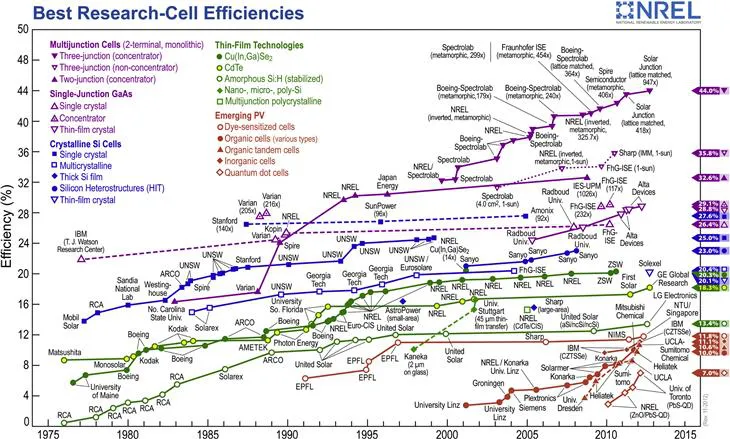
FIGURE 1.1 Chronology of improvements in PV-cell efficiencies according to device technology since 1976. (Courtesy of NREL Image Gallery, http://www.nrel.gov/ncpv/images.) This figure is reproduced in color in the color section.
Initially a high-value source of electricity used for space applications with total production capacities measured in watts, the global PV industry now provides an installed capacity of more than 40 GW and is growing about 25% annually (REN21, 2011). PV technologies are used in a variety of collector designs, including flat panels positioned at a fixed tilt or on Sun-following trackers, integrated into building designs (building-integrated PV, or BIPV) and deployed in concentrating PV (CPV) systems, as shown in Figure 1.2. The amount of solar radiation available to each of these collector modes and orientations requires special consideration when assessing historical solar resources or when forecasting operational system performance.
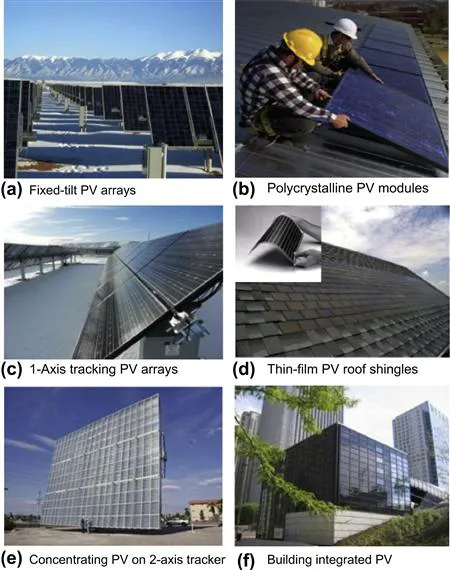
FIGURE 1.2 Examples of commercially available PV systems for producing electricity in a variety of applications: (a) fixed-tilt PV arrays; (b) polycrystalline PV modules; (c) fixed-tilt PV arrays; (d) thin-film PV roof shingles; (e) concentrating PV on 2-axis tracker; (f) building-integrated PV. (Courtesy of NREL Image Gallery, http://images.nrel.gov.) This figure is reproduced in color in the color section.
The modular nature of PV systems is well suited to rooftop distributed generation, where electrical power is produced near the point of use, but is also scalable for larger, utility-scale central power generation, which requires electricity transmission . Understanding the spatial variability of solar radiation is important for the success of both distributed- and central-generation systems. PV systems have a very fast response to changes in solar radiation (settling time for individual cells is ∼10 μs). Therefore, the temporal variations in solar radiation must be characterized to design and operate a PV system that can provide the most stable power output.
Photovoltaic devices are based on single- and multicrystalline silicon (most prevalent), amorphous silicon, microcrystalline silicon, or polycrystalline thin-film materials such as cadmium telluride (CdTe) and copper indium gallium diselenide (CIGS). Multijunction PV devices have achieved the highest energy-conversion efficiencies. In late 2012, the world record for PV cell efficiency was 43.5% for a GaInP/GaAs/GaLnNAs(Sb) (Kurt, 2012). To predict electrical-power output, each PV technology requires specific information about the broadband amount and spectral distribution of solar irradiance available to the device (Figure 1.3). Because the performance of PV devices depends on several environmental factors, standards have been developed for rating PV modules based on reference test conditions, including standards for the spectral distribution of solar irradiance (ASTM International,; Myers, 2011).
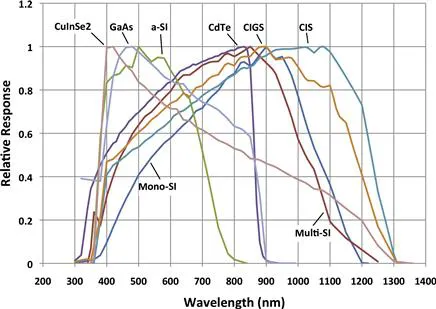
FIGURE 1.3 Spectral response functions of selected PV materials illustrating their selective abilities to convert solar irradiance to electricity. (Courtesy of Chris Gueymard.) This figure is reproduced in color in the color sect...
Table of contents
- Cover image
- Title page
- Table of Contents
- Copyright
- Preface
- Biography
- Chapter 1. Terms and Definitions
- Chapter 2. Semi-Empirical Satellite Models
- Chapter 3. Physically Based Satellite Methods
- Chapter 4. Evaluation of Resource Risk in Solar-Project Financing
- Chapter 5. Bankable Solar-Radiation Datasets
- Chapter 6. Solar Resource Variability
- Chapter 7. Quantifying and Simulating Solar-Plant Variability Using Irradiance Data
- Chapter 8. Overview of Solar-Forecasting Methods and a Metric for Accuracy Evaluation
- Chapter 9. Sky-Imaging Systems for Short-Term Forecasting
- Chapter 10. SolarAnywhere Forecasting
- Chapter 11. Satellite-Based Irradiance and Power Forecasting for the German Energy Market
- Chapter 12. Forecasting Solar Irradiance with Numerical Weather Prediction Models
- Chapter 13. Data Assimilation in Numerical Weather Prediction and Sample Applications
- Chapter 14. Case Studies of Solar Forecasting with the Weather Research and Forecasting Model at GL-Garrad Hassan
- Chapter 15. Stochastic-Learning Methods
- Color Plates
- Index
Trusted by 375,005 students
Access to over 1.5 million titles for a fair monthly price.
Study more efficiently using our study tools.
Frequently asked questions
Yes, you can cancel anytime from the Subscription tab in your account settings on the Perlego website. Your subscription will stay active until the end of your current billing period. Learn how to cancel your subscription
No, books cannot be downloaded as external files, such as PDFs, for use outside of Perlego. However, you can download books within the Perlego app for offline reading on mobile or tablet. Learn how to download books offline
Perlego offers two plans: Essential and Complete
- Essential is ideal for learners and professionals who enjoy exploring a wide range of subjects. Access the Essential Library with 800,000+ trusted titles and best-sellers across business, personal growth, and the humanities. Includes unlimited reading time and Standard Read Aloud voice.
- Complete: Perfect for advanced learners and researchers needing full, unrestricted access. Unlock 1.5M+ books across hundreds of subjects, including academic and specialized titles. The Complete Plan also includes advanced features like Premium Read Aloud and Research Assistant.
We are an online textbook subscription service, where you can get access to an entire online library for less than the price of a single book per month. With over 1.5 million books across 990+ topics, we’ve got you covered! Learn about our mission
Look out for the read-aloud symbol on your next book to see if you can listen to it. The read-aloud tool reads text aloud for you, highlighting the text as it is being read. You can pause it, speed it up and slow it down. Learn more about Read Aloud
Yes! You can use the Perlego app on both iOS and Android devices to read anytime, anywhere — even offline. Perfect for commutes or when you’re on the go.
Please note we cannot support devices running on iOS 13 and Android 7 or earlier. Learn more about using the app
Please note we cannot support devices running on iOS 13 and Android 7 or earlier. Learn more about using the app
Yes, you can access Solar Energy Forecasting and Resource Assessment by Jan Kleissl in PDF and/or ePUB format, as well as other popular books in Technology & Engineering & Energy Industry. We have over 1.5 million books available in our catalogue for you to explore.