- 860 pages
- English
- ePUB (mobile friendly)
- Available on iOS & Android
eBook - ePub
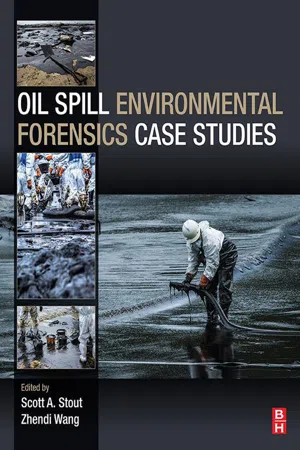
Oil Spill Environmental Forensics Case Studies
About this book
Oil Spill Environmental Forensics Case Studies includes 34 chapters that serve to present various aspects of environmental forensics in relation to "real-world oil spill case studies from around the globe. Authors representing academic, government, and private researcher groups from 14 countries bring a diverse and global perspective to this volume.
Oil Spill Environmental Forensics Case Studies addresses releases of natural gas/methane, automotive gasoline and other petroleum fuels, lubricants, vegetable oils, paraffin waxes, bitumen, manufactured gas plant residues, urban runoff, and, of course, crude oil, the latter ranging from light Bakken shale oil to heavy Canadian oil sands oil. New challenges surrounding forensic investigations of stray gas in the shallow subsurface, volatiles in air, dissolved chemicals in water (including passive samplers), and biological tissues associated with oil spills are included, as are the effects and long-term oil weathering, long-term monitoring in urbanized and non-urbanized environments, fate and transport, forensic historical research, new analytical and chemical data processing and interpretation methods.
- Presents cases in each chapter on the application of specific oil spill environmental forensic techniques
- Features chapters written by international experts from both academia and industry
- Includes relevant concepts and theories elucidated for each theme
Information
Chapter 1
Critical Review of an Interlaboratory Forensic Dataset
Effects on Data Interpretation in Oil Spill Studies
Eric Litman, Stephen Emsbo-Mattingly and Wendy Wong, NewFields Environmental Forensics Practice, LLC, Rockland, MA, United States
Abstract
Large-scale and long-term environmental investigations, like regional oil spills, typically employ multiple laboratories to prepare and analyze large numbers of samples within regulatory holding times and contractual specifications. These projects generate large quantities of quality control data for assessing method performance. In this study we compare intra- and interlaboratory variability among laboratories participating in the Deepwater Horizon Natural Resource Damage Assessment between 2010 and 2015. Results show that although interlaboratory measurements of EPA Priority Pollutant polycyclic aromatic hydrocarbons (PAHs) were consistent with environmental industry standards the concentrations of alkylated PAHs and geochemical biomarkers exhibited high variability.
These observations serve as important benchmarks when designing sampling and analysis plans for source identification or other forensic purposes. As such, interlaboratory datasets generally lack the level of precision and accuracy needed to differentiate compositionally similar sources, low-level impacts from background, contaminant mobility, and natural recovery in multimedia samples.
Keywords
Intralaboratory; alkylated; PAH; petroleum; biomarkers; diagnostic; ratios; precision; accuracy; data; interpretation; variability
Biographies
Eric Litman is an environmental scientist with 15 years of laboratory and consulting experience specializing in applied chemistry and technical project management. Since 2010, he has been a consulting scientist at NewFields Environmental Forensics Practice, LLC in Rockland, Massachusetts working in support of governmental and industrial clients. During this time he has managed a variety of regulatory and industrial site investigations focused on the chemical characterization of environmental contaminants and conducted extensive research during the NRDA investigation following the Deepwater Horizon oil spill. His research interests include the optimization of analytical techniques and the development of emerging environmental technologies.
Wendy Wong is a consulting scientist at NewFields Environmental Forensics Practice, LLC in Rockland, Massachusetts. Ms. Wong has 19 years of experience in the field of environmental chemistry and specializes in detailed chemical analysis, chemical fingerprinting, and applications of environmental forensic principles for advanced site investigation projects. Over the years, Ms. Wong has worked on numerous site assessment and investigative projects, including roles as analyst, consulting chemist and technical project leader. She has managed laboratory operations during multiple large-scale oil spill investigations including the Exxon Valdez, Saudi/Gulf War, Cosco Busan, and Deepwater Horizon oil spills. As an experienced forensics chemist and a strong operations professional, she has optimized laboratory operations through staff training, process improvement, scaling of analytical capabilities, enhancement of real-time quality control measures, and augment client and laboratory communication to meet the demands of these high-profile, technical forensics programs.
Stephen Emsbo-Mattingly is a senior scientist at the NewFields Environmental Forensics Practice in Rockland, MA. He has 28 years of environmental chemistry and forensic investigation expertise. He specializes in the source identification of petroleum, tar, PAHs, PCBs, dioxins, and chlorinated solvent products in the environment. His chemical fingerprinting involve extensive research concerning the process chemistry associated with petroleum and tar refineries, coal...
Table of contents
- Cover image
- Title page
- Table of Contents
- Copyright
- List of Contributors
- Preface
- Chapter 1. Critical Review of an Interlaboratory Forensic Dataset: Effects on Data Interpretation in Oil Spill Studies
- Chapter 2. Fifty Years of Petroleum Geochemistry: A Valuable Asset in Oil Spill Environmental Forensics
- Chapter 3. Fingerprinting Analysis and Source Differentiation of Petroleum-Contaminated Environmental Samples
- Chapter 4. The Application of Isotope Geochemistry in Stray Gas Investigations: Case Studies
- Chapter 5. Forensic Aspects of Airborne Constituents Following Releases of Crude Oil Into the Environment
- Chapter 6. Combined Gas and Liquid Chromatography Tandem Mass Spectrometry Applications for Forensic Lubricant and Vegetable Oil Spill Identification
- Chapter 7. Environmental Forensics Study of Crude Oil and Petroleum Product Spills in Coastal and Oilfield Settings: Combined Insights From Conventional GC–MS, Thermodesorption–GC–MS, and Pyrolysis–GC–MS
- Chapter 8. Paraffin Wax Spill Identification by GC–FID and GC–MS
- Chapter 9. Challenges and Mysteries in Oil Spill Fate and Transport Modeling
- Chapter 10. Unraveling the Complexities of Upland Spilled Fuels: Selected Case Studies
- Chapter 11. Advantages of Multidimensional Chemical Fingerprinting in Identifying the Source of Marine Oil Spills in Bohai Bay, China
- Chapter 12. Distinguishing Genetically-Similar Diesel Fuels in Taiwan Using Principal Component Analysis of Diagnostic Ratios
- Chapter 13. Application of CEN Methodology in Evaluating Sources of Multiple Land-Based Fuel Spills in Alberta, Canada
- Chapter 14. Development and Application of Phase-Specific Methods in Oiled-Water Forensic Studies
- Chapter 15. Applications of the CEN Methodology in Multiple Oil Spills in Spanish Waters
- Chapter 16. Fingerprinting of Petroleum Hydrocarbons in Malaysia Using Environmental Forensic Techniques: A 20-Year Field Data Review
- Chapter 17. Long-Term Monitoring Study of Beached Oils Around the Shetland Isles, United Kingdom
- Chapter 18. The Erika Oil Spill: 10 Years Monitoring Program and Effects of the Weathering Processes
- Chapter 19. Environmental Assessment of Spills Related to Oil Exploitation in Canada’s Oil Sands Region
- Chapter 20. Chemical Fingerprinting Assessment of the Impact to River Sediments Following the Bakken Crude Oil Train Derailment and Fire, Mount Carbon, West Virginia
- Chapter 21. The Pixel-Based Chemometric Approach for Oil Spill Identification and Hydrocarbon Source Differentiation: Two Case Studies From the Persian Gulf
- Chapter 22. Use of Passive Samplers to Determine the Source of Dissolved PAHs in the Ottawa River, Toledo, Ohio
- Chapter 23. Fingerprint and Weathering Characteristics of Petroleum Hydrocarbons in the Coastal Zone Following the “7-16” Dalian Crude Oil Spill, China
- Chapter 24. Case Study in the Use of Forensic History in Matters Involving Pipeline Ruptures
- Chapter 25. Comparison of Quantitative and Semiquantitative Methods in Source Identification Following the OSPAR Oil Spill, in Paraná, Brazil
- Chapter 26. Different Forensic Approaches for Hydrocarbons Sources Identification in an Urban Cluster Environment: Guanabara Bay
- Chapter 27. Hydrocarbon Sources and Biotechnology Applications in Todos os Santos Bay, Brazil
- Chapter 28. Assessing the Role of Environmental Conditions on the Degradation of Oil Following the Deepwater Horizon Oil Spill
- Chapter 29. Using Stable and Radiocarbon Analyses as a Forensic Tool to Find Evidence of Oil in the Particulates of the Water Column and on the Seafloor Following the 2010 Gulf of Mexico Oil Spill
- Chapter 30. Red Crabs as Sentinel Organisms in Exposure of Deep-Sea Benthos to Macondo Oil Following the Deepwater Horizon Oil Spill
- Chapter 31. Modeling Distribution, Fate, and Concentrations of Deepwater Horizon Oil in Subsurface Waters of the Gulf of Mexico
- Chapter 32. Louisiana Coastal Marsh Environments and MC252 Oil Biomarker Chemistry
- Chapter 33. Novel Biological Exposures Following the Deepwater Horizon Oil Spill Revealed by Chemical Fingerprinting
- Chapter 34. Forensic Identification of Historical and Ongoing Tar Oil Releases in Nearshore Environments
- Index
Trusted by 375,005 students
Access to over 1.5 million titles for a fair monthly price.
Study more efficiently using our study tools.
Frequently asked questions
Yes, you can cancel anytime from the Subscription tab in your account settings on the Perlego website. Your subscription will stay active until the end of your current billing period. Learn how to cancel your subscription
No, books cannot be downloaded as external files, such as PDFs, for use outside of Perlego. However, you can download books within the Perlego app for offline reading on mobile or tablet. Learn how to download books offline
Perlego offers two plans: Essential and Complete
- Essential is ideal for learners and professionals who enjoy exploring a wide range of subjects. Access the Essential Library with 800,000+ trusted titles and best-sellers across business, personal growth, and the humanities. Includes unlimited reading time and Standard Read Aloud voice.
- Complete: Perfect for advanced learners and researchers needing full, unrestricted access. Unlock 1.5M+ books across hundreds of subjects, including academic and specialized titles. The Complete Plan also includes advanced features like Premium Read Aloud and Research Assistant.
We are an online textbook subscription service, where you can get access to an entire online library for less than the price of a single book per month. With over 1.5 million books across 990+ topics, we’ve got you covered! Learn about our mission
Look out for the read-aloud symbol on your next book to see if you can listen to it. The read-aloud tool reads text aloud for you, highlighting the text as it is being read. You can pause it, speed it up and slow it down. Learn more about Read Aloud
Yes! You can use the Perlego app on both iOS and Android devices to read anytime, anywhere — even offline. Perfect for commutes or when you’re on the go.
Please note we cannot support devices running on iOS 13 and Android 7 or earlier. Learn more about using the app
Please note we cannot support devices running on iOS 13 and Android 7 or earlier. Learn more about using the app
Yes, you can access Oil Spill Environmental Forensics Case Studies by Scott Stout,Zhendi Wang in PDF and/or ePUB format, as well as other popular books in Technology & Engineering & Environmental Management. We have over 1.5 million books available in our catalogue for you to explore.