- 218 pages
- English
- ePUB (mobile friendly)
- Available on iOS & Android
eBook - ePub
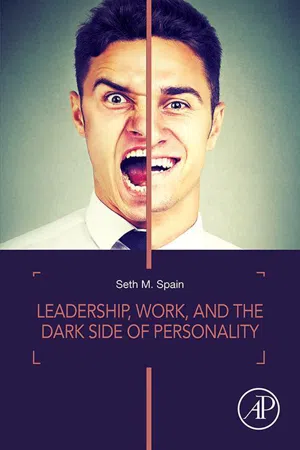
Leadership, Work, and the Dark Side of Personality
About this book
Leadership, Work, and the Dark Side of Personality uses an interpersonal psychological perspective to unite general theories of both personality and leadership. By focusing in on the interpersonal, the book characterizes social behaviors by their agency (how dominant they are) and by their communion (how relational and nurturing they are). It argues that these interpersonal dimensions align closely with the traditional structure of leader behaviors—both task-related and relationship oriented behaviors—and uses those frameworks to orient trait theory for both normal-range personality traits and subclinical (dark side) traits.
After overviewing the history of leadership theory, reviewing normal range personality traits (Extraversion, Neuroticism, Conscientiousness, Agreeableness and Openness) and subclinical traits, such as the Dark Triad (Narcissism, Machiavellianism and Psychopathy), the book moves on to thoroughly bring the perspective of interpersonal psychology to bear on questions of personality and leadership, and ends by narrowing in on how the dark side of personality affects the leadership process—for better and for worse.
- Discusses the role of personality in job performance and satisfaction
- Critiques both historical and contemporary leadership approaches
- Includes lesser known approaches to leadership, such as paternalism and empowerment
- Narrows in on the dark side of personality and the role it plays in the leadership process
- Distinguishes between effective leaders and successful leaders
Information
Chapter 1
Foundations of Self and Leadership
Abstract
One of the fundamental maxims of the Apollonian Temple at Delphi was know thyself, a phrase whose meaning Socrates absorbed in his own maxim, “The unexamined life is not worth living.” This dictate should be fundamental to anyone considering taking on the role of leader. No other aspect of ordinary work raises such deep issues of self-knowledge and identity more than does leadership. Only creative work likely rivals it. To lead, one should know what his or her fundamental values, beliefs, and assumptions are, because when those are known, they can serve to guide one’s decisions and actions, but when they are not known, chaos, or at least confusion and incoherence, is the most likely result of one’s actions. Leaders show others a vision of how the world could be, so if that vision is deeply flawed or fails to correctly reflect the leader’s true values, it will not direct followers’ behaviors well. Therefore the leader needs to understand him- or herself. But what does “understanding oneself” entail?
Keywords
Self; self knowledge; leadership
One of the fundamental maxims of the Apollonian Temple at Delphi was know thyself (Pausânias, 1903), a phrase whose meaning Socrates absorbed in his own maxim, “The unexamined life is not worth living.” (Plato, 2005). This dictate should be fundamental to anyone considering taking on the role of leader. No other aspect of ordinary work raises such deep issues of self-knowledge and identity more than does leadership (e.g., Engle & Lord, 1997; Lord & Brown, 2001; Lord & Hall, 2005; Shamir & Eilam, 2005). Only creative work likely rivals it. To lead, one should know what his or her fundamental values, beliefs, and assumptions are, because when those are known, they can serve to guide one’s decisions and actions, but when they are not known, chaos, or at least confusion and incoherence, is the most likely result of one’s actions (cf., Spain & Kim, 2018). Leaders show others a vision of how the world could be, so if that vision is deeply flawed or fails to correctly reflect the leader’s true values, it will not direct followers’ behaviors well. Therefore the leader needs to understand him- or herself. But what does “understanding oneself” entail?
The Self?
For my part, when I enter most intimately into what I call myself, I always stumble on some particular perception or other, of heat or cold, light or shade, love or hatred, pain or pleasure. I never can catch myself at any time without a perception and never can observe any thing but the perception. When my perceptions are remov’d for any time, as by sound-sleep; so long am I insensible of myself, and my truly be said not to exist. (Hume, 1969, p. 300, emphasis original)
In the quotation above, the skeptical Scottish philosopher David Hume presents his most visceral argument against the reality of the “self.” The fundamentals of his argument for the nonexistence of the self generally agree with Buddhist tenets (e.g., Mathur, 1978), though Hume drew very different ethical principles from this analysis. The analysis also agrees with Williams James analysis of the stream of thought (James, 1950; now usually referred to as the “stream of consciousness” after the literary technique, e.g., Joyce, 1990). James, however, was more positive about the practical existence of a sense of personal identity we might usually call “the self.” Largely, this overarching concept is what the philosopher and cognitive scientist Daniel Dennett refers to as the “self as the center of narrative gravity” (Dennett, 1992). From this viewpoint, the self is an “illusion” that helps to glue our perceptual experiences together (cf., Dennett’s excellent philosophical short story, “Where am I,” Dennett, 1978).
For the purposes of this discussion, we take a Jamesian line that the self is practically real (cf., James, 2003). That is, the idea of the self has practical consequences. The self is an organizing principle for an individual’s perceptions, experiences, for his or her life. While it may not be metaphysically real as a kind of “substance,” the self is real as a kind of knowledge structure; in fact, the largest structure of the entire cognitive system, encompassing all knowledge and experience that is personally relevant into a self-concept (e.g., Nowak, Vallacher, Tesser, & Borkowski, 2000). In general, this is also largely consistent with the Jungian conception of the self as the largest organizing principle of the psyche (cf., Stevens, 1994), though the “self” has deep metaphysical, nearly religious overtones in Jungian psychology that need not concern us here. The need to understand this self-concept is the essence of the present chapter. Below, I will outline the process of deep self-understanding, in the sense of achieving high self-concept clarity, helps to solidify a person as a leader.
Vision as a Reflection of the Self
As described above, it is important for leaders to understand themselves to be effective, otherwise chaos may result from their attempts to guide, persuade, and influence others. For instance, consider this account of US President Donald Trump’s decision to withdraw from the Paris climate agreement1: “The speech was striking in its demonstration of how Trump has melded his self-conception to his vision of the nation he leads,” (Waldman, 2017). Trump gives every appearance of being psychologically shallow; he seems to lack self-awareness, existing as a creature of gut instinct and erratic egotism (McAdams, 2016), so there may be no particular design in matching his vision of the United States so closely with his own personality. Leaders do, however, seem to imprint their personality into an organization’s culture (cf., Berson, Oreg, & Dvir, 2008; O’Reilly, Caldwell, Chatman, & Doerr, 2014). That is, CEOs, and especially founders, tend to craft organizations that reflect their values and priorities.
Trump, or any other leader with a so-called “personality cult” around them, is emblematic of another interesting feature of leadership: leaders are highly salient in human groups (cf., Henrich & Gil-White, 2001). That is, people are prone to pay attention to their leaders. As societal reference points in this way, one important function that leaders provide is sense-making (Pye, 2005). In this function, leaders help their followers to create a story or model for (some aspect of) the world, especially new, confusing, or unanticipated events or experiences (Maitlis & Christianson, 2014; Weick, 1995). This story or model, and moreover its integration into a larger goal or goals, is precisely what we mean by the word vision.
And vision—a leader’s articulation of a picture of the future, a direction for their group to work toward—is, at least for many writers, the critical component separating leadership from ordinary management (e.g., Isaacson, 2011; Rowe, 2001; cf., Drucker, 2008). In contrast, “managers” technically or bureaucratically implement the means of pursuing the goals manifest in the vision (e.g., Rowe, 2001). Each of these elements is critical for effective strategic leadership (Rowe, 2001); the expression, “a bird needs two wings to fly,” is a cliché for a reason.
To continue the above example, as he gives no evidence for possessing a clear understanding of himself and his values or core beliefs, Trump’s candidacy and presidency has been described, even by conservative commentators, as chaotic (Goldberg, 2017) or unmoored (Will, 2015). There is no clear overarching vision (Graham, 2018), so policy is informed primarily by Trump’s idiosyncratic and fleeting perceptions and in-the-moment needs. Specifically, the lack of vision impairs even technocratic-managerial implementation, despite installing an apparently effective manager, in John Kelly, as chief-of-staff (Baker & Haberman, 2017). Such failures contrast with successful instances of strategic leadership, such as Apple during the period where CEO Steve Jobs supplied vision and COO Tim Cook took care of managerial implementation (the two roles need not be present in one person, cf., Isaacson, 2011; Rowe, 2001).
These contrasting examples hopefully help to paint a clear picture of what leaders (contra managers or administrators) do—they present a vision of what their social group should do; they give a goal to pursue or a destination to drive toward. But that function does not, in itself, give a strong indication about who fulfills the leadership role. Questions about what sort of person can be a great leader date to antiquity. Answers have differed throughout history. In the 20th and 21st century, the influence of psychology has helped to place the focus on personal characteristics of the individuals inhabiting leadership roles (e.g., Bass, 1990; cf., Burns, 1978). This particular turn, though perhaps surprising to behaviorists and 19th century sociologists, would probably be a considered normal to the pre-Socratic philosopher Heraclitus, who opined that character is destiny (Heraclitus, n.d.).
One prominent idea is that great leaders often have a nearly unshakeable faith in themselves (Hogan & Warrenfeltz, 2003; cf., Lilienfeld et al., 2012). These leaders clearly know what they want and what they care about. They have a clear identity, in that they have clear goals and values (Hogan & Warrenfeltz, 2003; Kaiser, Hogan, & Craig, 2008). As an example, biographer Walter Isaacson presented a portrait of the late Apple cofounder and CEO Steve Jobs as a man of strong beliefs and exacting standards for himself and others (Isaacson, 2011).
The most fundamental skills that a would-be leader must master are intrapersonal skills (Hogan & Warrenfeltz, 2003)—it is almost axiomatic that effective leaders know their own characters and motivations clearly. Hogan and Warrenfeltz argued that, of all the domains of skills that a manager needs (intrapersonal, interpersonal, leadership, and business skills), that intrapersonal skills are foundational and are the most difficult to develop, and therefore require considerable effort and time. In this chapter, we will argue that self-concept clarity is a useful conceptual tool for examining this self-knowledge and placing individuals’ careers and ascent into leadership roles into con...
Table of contents
- Cover image
- Title page
- Table of Contents
- Copyright
- Dedication
- Biography
- Overview
- Acknowledgments
- Chapter 1. Foundations of Self and Leadership
- Chapter 2. Introduction to Personality Theory
- Chapter 3. The Dark Side of Personality
- Chapter 4. Leadership and Organization
- Chapter 5. Modern Approaches to Leadership
- Chapter 6. Leadership and Personality
- Conclusion
- Index
Trusted by 375,005 students
Access to over 1.5 million titles for a fair monthly price.
Study more efficiently using our study tools.
Frequently asked questions
Yes, you can cancel anytime from the Subscription tab in your account settings on the Perlego website. Your subscription will stay active until the end of your current billing period. Learn how to cancel your subscription
No, books cannot be downloaded as external files, such as PDFs, for use outside of Perlego. However, you can download books within the Perlego app for offline reading on mobile or tablet. Learn how to download books offline
Perlego offers two plans: Essential and Complete
- Essential is ideal for learners and professionals who enjoy exploring a wide range of subjects. Access the Essential Library with 800,000+ trusted titles and best-sellers across business, personal growth, and the humanities. Includes unlimited reading time and Standard Read Aloud voice.
- Complete: Perfect for advanced learners and researchers needing full, unrestricted access. Unlock 1.5M+ books across hundreds of subjects, including academic and specialized titles. The Complete Plan also includes advanced features like Premium Read Aloud and Research Assistant.
We are an online textbook subscription service, where you can get access to an entire online library for less than the price of a single book per month. With over 1.5 million books across 990+ topics, we’ve got you covered! Learn about our mission
Look out for the read-aloud symbol on your next book to see if you can listen to it. The read-aloud tool reads text aloud for you, highlighting the text as it is being read. You can pause it, speed it up and slow it down. Learn more about Read Aloud
Yes! You can use the Perlego app on both iOS and Android devices to read anytime, anywhere — even offline. Perfect for commutes or when you’re on the go.
Please note we cannot support devices running on iOS 13 and Android 7 or earlier. Learn more about using the app
Please note we cannot support devices running on iOS 13 and Android 7 or earlier. Learn more about using the app
Yes, you can access Leadership, Work, and the Dark Side of Personality by Seth M. Spain in PDF and/or ePUB format, as well as other popular books in Psychology & Applied Psychology. We have over 1.5 million books available in our catalogue for you to explore.