- 608 pages
- English
- ePUB (mobile friendly)
- Available on iOS & Android
eBook - ePub
About this book
Rice is a unique and highly significant crop, thought to help feed nearly half the planet on a daily basis. An understanding of its properties and their significance is essential for the provision of high quality products. This is all the more true today as international trade in rice trade has been increasing rapidly in recent years. This important book reviews variability in rice characteristics and their effects on rice quality.After an introduction on rice quality that also explores paradoxes associated with the crop, the book goes on to examine rice physical properties and milling quality. This leads to a discussion of the effects that the degree of milling has on rice quality. The ageing of rice and its cooking and eating quality are investigated in the following chapters before an analysis of the effect of parboiling on rice quality. Later chapters consider the product-making and nutritional quality of rice and investigate speciality rices and rice breeding for desirable quality. The book concludes with an extensive chapter on rice quality analysis and an appendix containing selected rice quality test procedures.With its distinguished author Rice quality: a guide to rice properties and analysis proves an invaluable resource for professionals in the rice industry and researchers and post-graduate students interested in rice.
- Examines the physical properties of rice, such as grain appearance and density and friction
- Investigates the ageing of rice and its cooking and eating quality
- The product making and nutritional aspects of rice are also considered
Information
1
An introduction to rice: its qualities and mysteries
Abstract:
Contrariness is the other name for rice. It is both concentrated and dispersed, a subsistence crop and a high-value one, it feeds the world but is associated with a relatively undeveloped area, has precise properties but is often unpredictable, it is a food for survival and a food for culture. Some 90% of the world’s rice is grown in a small area (‘rice country’) in Asia. Yet rice feeds the largest number of people in the world. At the same time rice is very flexible and grows practically all over the world. The ‘rice country’ represents only about 14% of land area, but 25% of arable land and carries 54% of the population of the world. Another characteristic of rice is its great diversity, first, among the three zones of the ‘rice country’ and, second, from variety to variety.
Key words
rice in history
rice paradoxes
rice country
rice quality
variability in rice properties
‘Rice is a unique crop of great antiquity and akin to progress in human civilization.’
Chang (2003)
‘Rice helps feed almost half the planet on a daily basis, employs tens of millions in jobs they cannot live without, and has an enormous impact on our environment … rice production has been described as the world’s single most important economic activity.’
International Year of Rice 2004
World Rice Research Conference (WRRC), Tokyo, First announcement
This chapter is an introduction to rice from two angles. Firstly, we present some unconventional facts about the common cultivated rice (Oryza sativa L.) It is an attempt to understand how rice played its part in history. Secondly, we present a summary of what we understand by rice quality and why it is important. Also presented is a glimpse of the extraordinary diversity in rice quality.
1.1 Rice in history
1.1.1 Beginning of agriculture
Hominids, i.e. early human-like species belonging to the genus Homo, evolved or appeared on Earth some three million years ago. Humans, Homo sapiens, evolved approximately 100–120 thousand years ago (Strait et al. 1997).
Once hominids came down from the trees to the ground, progress was rapid (comparatively speaking). They could now travel long distances in search of, or hunting for food. This was made possible by their being now bipedal. They could use their freed hands, so tool-making came naturally and group action could evolve. All of these factors promoted the development of language, and the brain started to expand. After spending a million years and more thus as hunter-gatherers, and crossing many a milestone on the way, partly by chance and partly by necessity, they finally stumbled into settled agriculture some 10–12 thousand years ago.
The discovery of agriculture was a watershed in human evolution, for it enabled humankind to settle down in one place. It ushered in the process of social and cultural evolution. The discovery and domestication of ‘dry’ crops within agriculture, viz. cereals, pulses or legumes, oilseeds and nuts, was another milestone. The crucial importance of these grains was that they were in equilibrium with the ambient atmosphere and hence ‘dry’, so these crops could be stored for long periods without spoilage. These grains enabled humankind to grow their main food once a year, yet serve them for the entire year. It could even leave a surplus that allowed the development of organisation and leisure for play of power, art and culture. Apparently barley, wheat, peas, lentils and flax were the first to be domesticated and grown. Cereals obviously were, and continue to be, pre-eminent among these crops because of their value as a supplier of energy and nutrition for sustenance.
1.1.2 Enter the ‘frail but economically mighty grass’
It is generally believed that agriculture first started around the Mesopotamian region in the valley between Euphrates and Tigris, or in the ‘fertile crescent’ spanning the Nile through Palestine to the confluence of Euphrates and Tigris (Storck and Teague 1952). If so, rice was probably not among the first cereals to be domesticated and cultivated. These are likely to have been barley and wheat. However, rice would not have been lagging far behind. Archaeological evidence in China, southeast Asia and the Indus Valley suggests that rice must be at least eight thousand years old, perhaps more (Grist 1959, Chang 2003). What is noteworthy is that despite possibly being marginally late in its domestication and sustained cultivation, this ‘frail but economically mighty grass’ (Chang 2003) has come to occupy such a preeminent position in human history.
1.1.3 Concentration and spread of rice cultivation
There are many surprising facts about rice. One of these is related to the extraordinary concentration of rice production in a small part of the world. A glance at Fig. 1.1 brings out this paradox. Approximately 90% or more of the world’s rice is produced in the relatively tiny area marked in the figure in south, southeast and northeast Asia – which we will refer to as the ‘rice countries of Asia’ or simply the ‘rice country’. And yet, as will be mentioned in many statements quoted below, roughly half the world’s population is said to depend on rice as their staple.
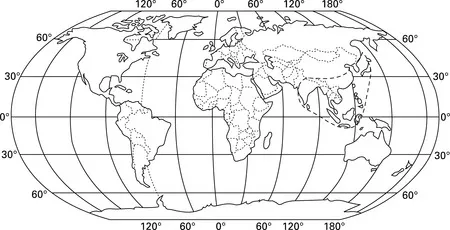
Fig. 1.1 World map highlighting ‘the rice countries of Asia’.
The reason for the extraordinary concentration of rice production has been hinted at by the following statement in the Rice Almanac brought out by the International Rice Research Institute (IRRI) in collaboration with WARDA, CIAT and FAO of the United nations as a ready reckoner of rice facts to help the international rice research community (Maclean et al. (2002)):
‘Rice occupies an extraordinarily high portion of the total planted area in South, Southeast, and East Asia. This area is subject to an alternating wet and dry seasonal cycle and also contains many of the world’s major rivers, each with its own vast delta. Here, enormous areas of flat, low-lying agricultural land are flooded annually during and immediately following the rainy season. Only two major food crops, rice and taro, adapt readily to production under these conditions of saturated soil and high temperatures.’
D. H. Grist, an authority on rice of yesteryears, who wrote many editions of his well-known book Rice, wrote (Grist 1959):
‘The great rice areas of the Far East, such as the deltas of the Irrawaddy, Bhramputra, Mekong and the greater part of the Gangelia plain and the Krishnia areas are the results of erosion. Without erosion there would be far less land suitable for paddy. It is probable that paddy is grown because there is no other cereal which can grow under such high monsoon rainfall. Rice has enabled the populations of Asia to survive and indeed increase, because paddy checks – but does not entirely prevent – erosion. Had the people of Asia attempted to live by any other cereal they could not possibly have maintained their high density population for thousands of years. To prove the truth of this assertion one has only to compare the population density in countries of large rice production with those of other tropical countries where rice is not produced as the staple crop. Growing paddy necessitates water conservation and this in turn ensures soil conservation. Some of the terraced fields in Indonesia, the Philippines and south China are over two thousand years old and are typically conservation projects. This more than any other factor accounts for the predominance of rice as the staple food in southeast Asia, in countries of high rainfall.’
Despite the above extraordinary concentration of rice production in a relatively small area of the world, however, the other paradox is that rice is also extremely adaptable. It can be grown under a wide range of climatic conditions. It is today grown in every continent other than Antartica and in at least 100 countries from 45°N (under certain conditions up to even 53°N) to 40°S latitude, from sea level to approximately an altitude of 3000 metres and from being submerged under one to two metres of water (deep water rice) to dry upland areas. The Rice Almanac (Maclean et al. 2002) states:
‘Rice is produced in a wide range of locations and under a variety of climatic conditions, from the wettest areas in the world to the driest deserts. It is produced along Myanmar’s Arakan Coast, where the growing season records an average of more than 5,100 mm of rainfall, and at Al Hasa Oasis in Saudi Arabia, where annual rainfall is less than 100 mm. Temperatures, too, vary greatly. In the Upper Sind in Pakistan, the rice season averages 33 ° C; in Otaru, Japan, the mean temperature for the growing season is 17 ° C. The crop is produced at sea level on coastal plains and in delta regions throughout Asia, and to a height of 2,600 m on the slopes of Nepal’s Himalaya. Rice is also grown under an extremely broad range of solar radiation, ranging from 25% of potential during the main rice season in portions of Myanmar, Thailand, and India’s Assam state to approximately 95% of poten...
Table of contents
- Cover image
- Title page
- Table of Contents
- Copyright
- Author contact details
- Woodhead Publishing Series in Food Science, Technology and Nutrition
- Preface
- Acknowledgements
- Dedication
- Chapter 1: An introduction to rice: its qualities and mysteries
- Chapter 2: Physical properties of rice
- Chapter 3: Milling quality of rice
- Chapter 4: Degree of milling (DM) of rice and its effect
- Chapter 5: Ageing of rice
- Chapter 6: Cooking quality of rice
- Chapter 7: Eating quality of rice
- Chapter 8: Effect of parboiling on rice quality
- Chapter 9: Product-making quality of rice
- Chapter 10: Speciality rices
- Chapter 11: Nutritional quality of rice
- Chapter 12: Rice breeding for desirable quality
- Chapter 13: Analysis of rice quality
- Appendix: some selected rice quality test procedures
- Index
Trusted by 375,005 students
Access to over 1.5 million titles for a fair monthly price.
Study more efficiently using our study tools.
Frequently asked questions
Yes, you can cancel anytime from the Subscription tab in your account settings on the Perlego website. Your subscription will stay active until the end of your current billing period. Learn how to cancel your subscription
No, books cannot be downloaded as external files, such as PDFs, for use outside of Perlego. However, you can download books within the Perlego app for offline reading on mobile or tablet. Learn how to download books offline
Perlego offers two plans: Essential and Complete
- Essential is ideal for learners and professionals who enjoy exploring a wide range of subjects. Access the Essential Library with 800,000+ trusted titles and best-sellers across business, personal growth, and the humanities. Includes unlimited reading time and Standard Read Aloud voice.
- Complete: Perfect for advanced learners and researchers needing full, unrestricted access. Unlock 1.5M+ books across hundreds of subjects, including academic and specialized titles. The Complete Plan also includes advanced features like Premium Read Aloud and Research Assistant.
We are an online textbook subscription service, where you can get access to an entire online library for less than the price of a single book per month. With over 1.5 million books across 990+ topics, we’ve got you covered! Learn about our mission
Look out for the read-aloud symbol on your next book to see if you can listen to it. The read-aloud tool reads text aloud for you, highlighting the text as it is being read. You can pause it, speed it up and slow it down. Learn more about Read Aloud
Yes! You can use the Perlego app on both iOS and Android devices to read anytime, anywhere — even offline. Perfect for commutes or when you’re on the go.
Please note we cannot support devices running on iOS 13 and Android 7 or earlier. Learn more about using the app
Please note we cannot support devices running on iOS 13 and Android 7 or earlier. Learn more about using the app
Yes, you can access Rice Quality by Kshirod R Bhattacharya in PDF and/or ePUB format, as well as other popular books in Technology & Engineering & Agronomy. We have over 1.5 million books available in our catalogue for you to explore.