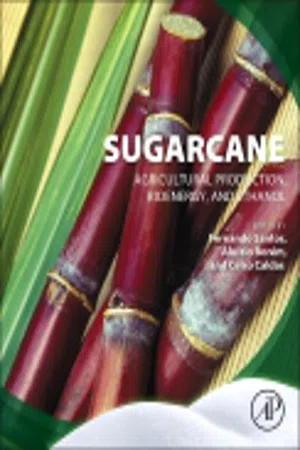
eBook - ePub
Sugarcane
Agricultural Production, Bioenergy and Ethanol
- 492 pages
- English
- ePUB (mobile friendly)
- Available on iOS & Android
eBook - ePub
About this book
Sugarcane: Agricultural Production, Bioenergy and Ethanol explores this vital source for "green" biofuel from the breeding and care of the plant all the way through to its effective and efficient transformation into bioenergy.
The book explores sugarcane's 40 year history as a fuel for cars, along with its impressive leaps in production and productivity that have created a robust global market. In addition, new prospects for the future are discussed as promising applications in agroenergy, whether for biofuels or bioelectricity, or for bagasse pellets as an alternative to firewood for home heating purposes are explored.
Experts from around the world address these topics in this timely book as global warming continues to represent a major concern for both crop and green energy production.
- Focuses on sugarcane production and processing for bioenergy
- Provides a holistic approach to sugarcane's potential – from the successful growth and harvest of the plant to the end-use product
- Presents important information for "green energy" options
Information
Subtopic
AgricultureChapter 1
Agricultural Planning
Fernando Bomfim Margarido1 and Fernando Santos2, 1Santelisa Vale, Brazil, 2Universidade Estadual do Rio Grande do Sul, Porto Alegre, RS, Brazil
According to the classical definition, it could be said that managing means planning, organizing, directing and controlling. On the basis of this definition, planning means deciding in advance what should be done for a particular purpose to be achieved, namely, to maximize agricultural and industrial yields and, thus, profits. That is the starting point for good management. Planning plays an important role in farming activities and it has taken on paramount relevance due to the expansion of areas planted with sugarcane, the influence of increased production, and the need to work to a budget. This chapter addresses planning through technical expertise aimed at operational practices. It is, therefore, a simplified view of planning.
Keywords
Sugarcane; Ethanol; Sugar; Planning; Agricultural
Introduction
Nowadays, management involves less risk than it used to. However, the responsibility involved is much greater, considering the technological processes surrounding an administrative decision. According to the classical definition, it could be said that managing means planning, organizing, directing and controlling. On the basis of this definition, planning means deciding in advance what should be done for a particular purpose to be achieved, namely, to maximize agricultural and industrial yield and, thus, profits. That is the starting point for good management.
The sugar and ethanol sector in Brazil is going through one of its best periods. There has been significant change in the sector’s dynamics resulting in reduced competitiveness among industrial units, expansion of cultivated areas and adjustments in strategies adopted by companies. This chapter addresses planning through technical expertise aimed at operational practices. It is, therefore, a simplified view of planning.
1.1 Planning
The main role of agricultural managers is to foment the activity. In simple terms, fomenting the agricultural activity means guaranteeing the supply of raw materials for the industry, which involves, in the case of sugarcane culture, agricultural production, soil conservation and preparation, planting, crop practices for cane-plants, harvesting, cr...
Table of contents
- Cover image
- Title page
- Table of Contents
- Copyright
- List of Contributors
- Foreword
- Preface
- Chapter 1. Agricultural Planning
- Chapter 2. Physiology
- Chapter 3. Planting
- Chapter 4. Nutrition and Fertilization
- Chapter 5. Management of Pests and Nematodes
- Chapter 6. Disease Management
- Chapter 7. Weed Management
- Chapter 8. Irrigation Management
- Chapter 9. Precision Agriculture and Remote Sensing
- Chapter 10. Stalk Harvesting Systems
- Chapter 11. Breeding Program and Cultivar Recommendations
- Chapter 12. Molecular Biology and Biotechnology
- Chapter 13. Quality Control in the Sugar and Ethanol Industries
- Chapter 14. The Sugar Production Process
- Chapter 15. Ethanol Fermentation
- Chapter 16. Distillation
- Chapter 17. Industrial Waste Recovery
- Chapter 18. Sugarcane Bioenergy
- Chapter 19. Remuneration System of Sugarcane
- Chapter 20. Theoretical Background of Sugarcane/Ethanol Analyses
- Chapter 21. Managing Costs of Production and Processing
- Index
Trusted by 375,005 students
Access to over 1.5 million titles for a fair monthly price.
Study more efficiently using our study tools.
Frequently asked questions
Yes, you can cancel anytime from the Subscription tab in your account settings on the Perlego website. Your subscription will stay active until the end of your current billing period. Learn how to cancel your subscription
No, books cannot be downloaded as external files, such as PDFs, for use outside of Perlego. However, you can download books within the Perlego app for offline reading on mobile or tablet. Learn how to download books offline
Perlego offers two plans: Essential and Complete
- Essential is ideal for learners and professionals who enjoy exploring a wide range of subjects. Access the Essential Library with 800,000+ trusted titles and best-sellers across business, personal growth, and the humanities. Includes unlimited reading time and Standard Read Aloud voice.
- Complete: Perfect for advanced learners and researchers needing full, unrestricted access. Unlock 1.5M+ books across hundreds of subjects, including academic and specialized titles. The Complete Plan also includes advanced features like Premium Read Aloud and Research Assistant.
We are an online textbook subscription service, where you can get access to an entire online library for less than the price of a single book per month. With over 1.5 million books across 990+ topics, we’ve got you covered! Learn about our mission
Look out for the read-aloud symbol on your next book to see if you can listen to it. The read-aloud tool reads text aloud for you, highlighting the text as it is being read. You can pause it, speed it up and slow it down. Learn more about Read Aloud
Yes! You can use the Perlego app on both iOS and Android devices to read anytime, anywhere — even offline. Perfect for commutes or when you’re on the go.
Please note we cannot support devices running on iOS 13 and Android 7 or earlier. Learn more about using the app
Please note we cannot support devices running on iOS 13 and Android 7 or earlier. Learn more about using the app
Yes, you can access Sugarcane by Fernando Santos,Aluízio Borém,Celso Caldas in PDF and/or ePUB format, as well as other popular books in Technologie et ingénierie & Agriculture. We have over 1.5 million books available in our catalogue for you to explore.