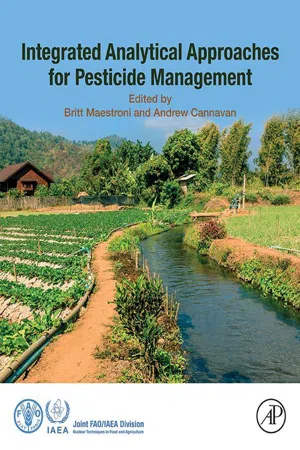
eBook - ePub
Integrated Analytical Approaches for Pesticide Management
- 338 pages
- English
- ePUB (mobile friendly)
- Available on iOS & Android
eBook - ePub
Integrated Analytical Approaches for Pesticide Management
About this book
Integrated Analytical Approaches for Pesticide Management provides proven laboratory practices/examples and methods necessary to control pesticides in food and water in various environments. The book presents insights into good laboratory practices and examples of methods used in individual specialist laboratories, thus enabling stakeholders in the agri-food industry to appreciate the importance of proven, reliable data and the associated quality assurance approaches for end product testing for toxic levels of contaminant residues in food. The book is written in a rigorous, but simple, way to make sure that a broad range of readers can appreciate its technical content.
The book's practical nature and generic guidelines distinguish it from others in the marketplace.
- Provides coverage of risk assessment and effective testing technologies
- Covers generic guidelines on pesticide analysis on different environmental matrices for use in the developed and developing world
- Presents the most up-to-date information in research sample testing preparation and method validation to detect pesticide residues in food
- Includes examples of each method for practical application
- Demonstrates proven, reliable research data and the associated quality assurance approaches for end product testing for food, water and soil sediment
- Describes the concept of integrated analytical approaches for pesticide management practices
Information
Chapter 1
Introduction
Britt Maestroni and Andrew Cannavan, Food and Environmental Protection Laboratory, Joint FAO/IAEA Division of Nuclear Applications in Food and Agriculture, International Atomic Energy Agency, Vienna, Austria
Abstract
To produce enough food for the world’s ever-growing population there has been a steady increase in the use of agrochemicals which has challenged the production of safe food and the sustainability of the environment in which we live. Preventing and controlling the pollution of water resources is essential. This book compiles the experiences of a laboratory network that applied an integrated methodology to assess the efficacy of pesticide management practices at a catchment scale.
Keywords
Good agricultural practices; catchment scale; integrated analytical approaches
Agriculture is a dominant component of the global economy, and in many developing countries the agricultural sector makes a major contribution to gross domestic product (GDP).
The pressure to produce enough food for the world’s ever-growing population has had a worldwide impact on agricultural practices. The challenge of securing enough food for present and future generations through sustainable agriculture and rural development (SARD) was first highlighted in Agenda 21 of the United Nations Conference on Environment and Development in 1992. Since then it has been reiterated at many international meetings and conferences worldwide, and is encompassed in the United Nations Sustainable Development Goals of the 2030 Agenda for Sustainable Development that came into force on January 1, 2016 (UN, 2016): Goal 2, “End hunger, achieve food security and improved nutrition and promote sustainable agriculture.”
As a result of this pressure to produce more food, the use of agrochemicals has steadily increased over recent years in order to ensure and sustain high crop yields and productivity to feed the growing population. This trend is especially notable in Latin America, where the annual import value of pesticides for agriculture increased from US$ 1.6 billion in 2000 to US$ 5.5 billion in 2011 (FAO, 2015). Such high levels of agrochemical inputs represent serious challenges to the production of safe food and the sustainability of the environment in which we live (Stephenson and Solomon, 2007).
Agriculture is both a cause and a victim of environmental pollution. It is a cause through the discharge of pollutants (pesticides, fertilizers, etc.) into surface and/or groundwater. It is a victim through, e.g., contaminated water being used for irrigation. Surface waters are not only major sources of drinking water; they are also vital aquatic ecosystems that provide important environmental and economic benefits, and control of agricultural contaminants, as well as other pollution sources, has become essential. Water quality can also provide information on the effect of agricultural practices on the environment, and the effectiveness of the control and management of those practices. The economic, social, environmental, and public health implications of decreasing water quality are global threats—possibly the principle limitation in the near future—to sustainable development (FAO, 1996; CSIS, 2005). It is estimated that the total cost from polluted water is already around 3%–5% of GDP in some countries (The World Bank, 2007).
Preventing and controlling the pollution of water resources, both surface and underground, are needs that have led to the adoption by many governments of a variety of legislative approaches (FAO, 2003). Legislation has dealt mainly with the control of point source pollution, i.e., pollution that can be tracked to a specific entry point. This includes sources such as industrial discharges, domestic sewage, or municipal wastewater effluents or treatment plants. Reduction of nonpoint source pollution with agrochemicals such as pesticides, on the other hand, can be achieved through the application of precautionary measures, including good agricultural practices (GAPs) and through adherence to national regulations and international guidelines on the use of pesticides in the field.
The development and implementation of appropriate legislation and management practices for controlling water pollution require rigorous data collection and science-based information and policies. Effective monitoring schemes are necessary to identify specific pollutants and contaminants, their sources, and occurrences, to develop preventive measures and to assess the efficacy of corrective actions. Developing countries face many problems in establishing appropriate monitoring schemes to evaluate surface water pollution by pesticides, and in producing valid analytical results and reliable data for effective decision making.
With respect to contaminants in water, the US Geological Survey (USGS) stated that “there is the need for long-term monitoring studies which include a larger number of pesticides and their transformation products” (Anon., 2015). A major difficulty, however, as pointed out by Ongley (1994), is that “a common observation amongst water quality professionals is that many water quality programs, especially in developing countries, collect the wrong parameters, from the wrong places, using the wrong substrates and at inappropriate sampling frequencies, and produce data that are often quite unreliable.” Water quality monitoring is still a serious concern today in nearly all countries (Tortajada and Biswas, 2013).
This book compiles the experiences of participants in an international laboratory network coordinated through the Joint FAO/IAEA Division on Nuclear Applications in Food and Agriculture, who applied integrated analytical approaches over a period of 5 years to study pesticide management practices at catchment scales. The measurement of pesticide residues on crops and the identification and monitoring of indicators of contamination in various environmental compartments provided indirect means of monitoring the effectiveness of those management practices in the field.
The integrated approaches used by the participating laboratories evolved over a number of years through research and capacity building projects implemented in member countries throughout the world by the Joint Division, and collaborative studies with agricultural research institutes, academia, regulatory bodies, and other counterpart institutions.
This approach employed a “black-box” strategy in which the indicators (pesticide residues in water, soil, sediments and food, water quality) are monitored to detect pesticide contamination without examining the transport and transfer processes per se. The strategy involved the identification of high-impact rating pesticides, and a combination of chemical and biological monitoring methodologies to target those pesticides in surface water and sediments. The methodology was applied at catchment scales, with sampling collection points upstream and downstream from defined agricultural production areas. Such an approach reduces the reliance on end-product testing and maximizes information gathering with minimal input. Special emphasis is given to the role of analytical laboratories working in conjunction with multidisciplinary stakeholders, in driving the process in a way that is cost effective, well targeted, and matches available resources.
The book is organized in eight sections, each containing one or more chapters which describe the various aspects of the integrated strategies applied by the project participants, and the lessons learned from the actual use of the methodology.
Section 1 describes the framework for the integrated approaches and introduces the reader to the methodology applied by the laboratory network. The section includes generic guidelines developed from the experiences and lessons learned through case studies from five continents in setting up integrated monitoring schemes at the catchment scale to reduce reliance on expensive end-product testing and promote approaches that reduce the potential adverse effects of pesticides. The generic guideline is intended to provide a general understanding of the methodology as applied in this project. Specific details of the aspects covered in the generic guideline are given in the subsequent sections of this book.
Section 2 is the starting point for anyone embarking on a catchment study, providing guidelines for sampling. It introduces the reader to different sampling strategies such as random sampling, stratified sampling, cluster sampling, and systematic sampling. Practical guidance is given for planning and conducting soil sampling, including the presentation of sampling tools for lateral and vertical soil collection. Advice is also provided for upscaling and mapping purposes, and for performing cost-effective and representative soil sampling.
The purpose of catchment sampling in this project was to highlight possible risks to the environment emerging from agricultural production, and conversely, risks to agricultural production and food safety from the environment. Section 3 discusses the importance of environmental risk assessment and its elements.
The risk assessment of a chemical includes problem identification, exposure and effects assessment, and risk characterization. Effect assessment is dealt with in detail in Section 4, which focuses on biological approaches. Biological monitoring using aquatic organisms was used successfully in Argentina, Chile, and Costa Rica to measure agricultural impacts on river water quality. Another biological approach is the use of biomarkers for assessing pesticide effects on fish. Biomarkers are used to indicate exposure to xenobiotics through their effect when present in the environment and in organisms.
Exposure assessment is discussed at length in Section 5, which covers aspects dealing with chemical monitoring and the use of nuclear technologies for environmental fate studies, including quality control procedures in the analytical laboratory. A general overview is provided on analytical methods and techniques for pesticide residue analysis. The continuous evolution of methodology for determining pesticide levels, from elementary practices to measure some of the first pesticides in use to the latest technologies for determining thousands of pollutants, is discussed at length. Pesticide transport mechanisms in the environment, current pesticide regulations and some analytical options for monitoring pesticide residues in environmental samples, including the passive sampling technology, are provided. The importance of quality control and quality assurance measures in the analysis of contaminants, as implemented in the University of Costa Rica, are highlighted. Nuclear techniques have proven to be extremely reliable and accurate tools for quantitative and qualitative analyses, providing a priori information on some aspects of the required data for monitoring and studying the fate of pesticides in the environment. The experience of a Brazilian laboratory in using radiotracer methods for studying the behavior of different pesticides in soils, plants, and animals is described as an example.
Having identified and quantified exposure and effects the next step is to use the information to develop and apply modeling approaches such as those discussed in Section 6. This section introduces modeling tools that can be used to simulate the fate and transport mechanisms of pesticides in the environment, highlighting their application and limitations, data requirements, and interpretation. In addition an overview is provided of the types of risk indicators available from around the world, their scope, and potential applications. Special focus is given to the Pesticide Impact Rating Index (PIRI) risk indicator tool, which was widely applied during this project. Remediation technologies such as bioremediation, phytoremediation and immobilization by biochar and mitigation measures involving on-field management and off-field methods such as windbreaks, buffer zones, vegetated treatment systems, and biobeds are also discussed.
Section 7 presents three case studies from Latin America and Africa focusing on shallow groundwater, surface water, and GAPs for viticulture. These are examples of the integrated approaches taken by project participants. They demonstrate that multidisciplinary stakeholder involvement and the use of analytical and biological approaches are effective management tools; the key to “measuring for managing.”
Conclusions and recommendations are provided in Section 8 and additional resources are available at the end of the book to provide practical details on some of the key procedures needed for the implementation of integrated analytical approaches to assess the effectiveness of pesticide management practices at a catchment scale.
The integrated approaches applied under this challenging project generated a number of positive outcomes for local communities, farmers, laboratory and regulatory decision makers and consumers.
The authors hope that the techniques, approaches, and strategies described in this book will serve as both useful and economically viable assets for managing agricultural production systems. The approaches employed should also be suitable for modeling the effects of increased precipitation patterns on the loads of pesticides leaving agricultural fields, which is increasingly important under the current threat of climate change and will thereby support “climate-smart agriculture.”
Table of contents
- Cover image
- Title page
- Table of Contents
- Copyright
- List of Contributors
- Disclaimer
- Chapter 1. Introduction
- Section 1: Setting the Framework
- Section 2: Sampling
- Section 3: Environmental risk assessment
- Section 4: Effect assessment
- Section 5: Exposure Assessment
- Section 6: Modeling
- Section 7: Case Studies
- Section 8: Conclusions
- Further Resources
- Appendix A. Description of the Pesticide Impact Rating Index
- Appendix B. Framework for Sampling for Pesticides in Water/Sediments
- Appendix C. Sampling Tools and Procedures
- Appendix D. Linking Soil and Pesticide Behavior at a Landscape Scale: The Way Forward to Opening the Black Box
- Appendix E. Biomonitoring Validation
- Appendix F. Interpreting Water and Soil Monitoring Parameters
- List of Statistical Symbols
- Acronyms
- Glossary of Terms
- Index
Trusted by 375,005 students
Access to over 1.5 million titles for a fair monthly price.
Study more efficiently using our study tools.
Frequently asked questions
Yes, you can cancel anytime from the Subscription tab in your account settings on the Perlego website. Your subscription will stay active until the end of your current billing period. Learn how to cancel your subscription
No, books cannot be downloaded as external files, such as PDFs, for use outside of Perlego. However, you can download books within the Perlego app for offline reading on mobile or tablet. Learn how to download books offline
Perlego offers two plans: Essential and Complete
- Essential is ideal for learners and professionals who enjoy exploring a wide range of subjects. Access the Essential Library with 800,000+ trusted titles and best-sellers across business, personal growth, and the humanities. Includes unlimited reading time and Standard Read Aloud voice.
- Complete: Perfect for advanced learners and researchers needing full, unrestricted access. Unlock 1.5M+ books across hundreds of subjects, including academic and specialized titles. The Complete Plan also includes advanced features like Premium Read Aloud and Research Assistant.
We are an online textbook subscription service, where you can get access to an entire online library for less than the price of a single book per month. With over 1.5 million books across 990+ topics, we’ve got you covered! Learn about our mission
Look out for the read-aloud symbol on your next book to see if you can listen to it. The read-aloud tool reads text aloud for you, highlighting the text as it is being read. You can pause it, speed it up and slow it down. Learn more about Read Aloud
Yes! You can use the Perlego app on both iOS and Android devices to read anytime, anywhere — even offline. Perfect for commutes or when you’re on the go.
Please note we cannot support devices running on iOS 13 and Android 7 or earlier. Learn more about using the app
Please note we cannot support devices running on iOS 13 and Android 7 or earlier. Learn more about using the app
Yes, you can access Integrated Analytical Approaches for Pesticide Management by Britt Maestroni,Andrew Cannavan in PDF and/or ePUB format, as well as other popular books in Biological Sciences & Entomology. We have over 1.5 million books available in our catalogue for you to explore.