eBook - ePub
Fuel Cells and Hydrogen
From Fundamentals to Applied Research
- 296 pages
- English
- ePUB (mobile friendly)
- Available on iOS & Android
eBook - ePub
About this book
Fuel Cells and Hydrogen: From Fundamentals to Applied Research provides an overview of the basic principles of fuel cell and hydrogen technology, which subsequently allows the reader to delve more deeply into applied research. In addition to covering the basic principles of fuel cells and hydrogen technologies, the book examines the principles and methods to develop and test fuel cells, the evaluation of the performance and lifetime of fuel cells and the concepts of hydrogen production.
Fuel Cells and Hydrogen: From Fundamentals to Applied Research acts as an invaluable reference book for fuel cell developers and students, researchers in industry entering the area of fuel cells and lecturers teaching fuel cells and hydrogen technology.
- Includes laboratory methods for fuel cell characterization and manufacture
- Outlines approaches in modelling components, cells and stacks
- Covers practical and theoretical methods for hydrogen production and storage
Information
Chapter 1
Introduction
Shigenori Mitsushima⁎; Bernhard Gollas†; Viktor Hacker‡ ⁎ Yokohama National University, Graduate School of Engineering Science, Institute of Advanced Sciences, Yokohama, Japan
† Graz University of Technology, Institute for Chemistry and Technology of Materials, Graz, Austria
‡ Graz University of Technology, Institute of Chemical Engineering and Environmental Technology, Graz, Austria
† Graz University of Technology, Institute for Chemistry and Technology of Materials, Graz, Austria
‡ Graz University of Technology, Institute of Chemical Engineering and Environmental Technology, Graz, Austria
Abstract
This chapter provides a comprehensive introduction to the topic of electrochemical systems and fuel cells. The chapter covers the basic principles of the different types of fuel cells and compares them with other electrochemical systems, such as batteries and capacitors.
A major part of this chapter deals with the theoretical and practical efficiencies of fuel cells, considering the different applications such as combined heat and power systems for residential houses or mobile applications.
Keywords
Electrochemical systems; Fuel cells; Energy conversion efficiency
1.1 Electrochemical Systems and Fuel Cells
Electricity is undoubtedly the most versatile energy carrier. Electrochemical systems, such as fuel cells, have a simple structure, and take fuel as an input and produce electrical energy as the output. Fuel cells consist of two electrodes, an electrolyte, a separator, and an external electrical circuit. Each component of the electrochemical system fulfills specific tasks. The electrodes are electronically conductive and have a large electroactive surface area. The electrolyte is an electrical insulator, but has high ionic conductivity. Such ions are typically positively (cation) or negatively (anion) charged atoms, or molecules, that represent the mobile species in electrochemical reactions.
Although the set-up of such an electrochemical system looks rather simple, the electrochemical reactions at the interface between the electrodes and the electrolyte are often complex.
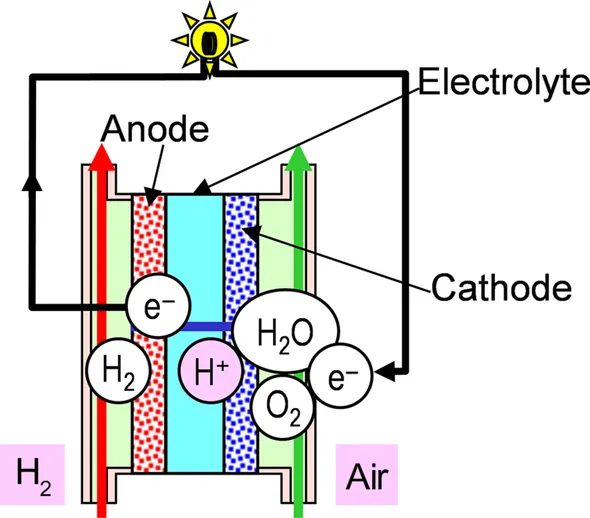
One of the two electrodes is called an “anode.” The anode is the negative electrode of the system, where the reactant (fuel) is oxidized. During the electrochemical reaction, electrons are released from the reactant and are utilized in an external load. The oxidized (anode) reactant, i.e. cations, are transported away from the anode through the electrolyte to the second electrode called “cathode” due to the potential gradient (migration) and the concentration gradient (diffusion). The cathode is the positive electrode in the electrochemical system, where the oxidant is reduced. The electrons required for this reduction are supplied from the external circuit and originate from the charge separation at the anode. During its reduction at the cathode the oxidant reacts with the cations from the anode and forms the respective product. The separator ensures separation of the anode and cathode reactants to avoid direct chemical reaction and further prevent a direct electronic contact between the anode and cathode.
Typically, hydrogen is the anode reactant, or fuel; whereas oxygen is the cathode reactant or oxidant. The corresponding product of the reaction of hydrogen and oxygen is water. In order to enable an electrochemical reaction, the electrolyte must be ionically conductive. In Fig. 1.1, a schematic drawing of a hydrogen-oxygen electrochemical system with a proton conductive electrolyte is shown. Such a system is generally known as a fuel cell – more specifically as an acidic fuel cell, because acids are typically used as proton conductive electrolytes.
Electrochemical and total reactions are as follows:


Hydrogen (H2) is supplied to the fuel cell, where it is oxidized, forming cations (H3O+, hydrated proton...
Table of contents
- Cover image
- Title page
- Table of Contents
- Copyright
- Contributors
- Preface
- Nomenclature
- Chapter 1: Introduction
- Chapter 2: Irreversible Losses in Fuel Cells
- Chapter 3: Modeling of Polymer Electrolyte Fuel Cells
- Chapter 4: Polymer Electrolyte Fuel Cells
- Chapter 5: Other Polymer Electrolyte Fuel Cells
- Chapter 6: Preparation of MEA
- Chapter 7: Degradation Mechanisms and Their Lifetime
- Chapter 8: Characterization Methods for Components and Materials
- Chapter 9: Electrochemical Measurement Methods and Characterization on the Cell Level
- Chapter 10: Hydrogen Production
- Chapter 11: Role of Hydrogen Energy Carriers
- Chapter 12: Environmental Impact Factors Associated with Hydrogen Energy
- Index
Trusted by 375,005 students
Access to over 1.5 million titles for a fair monthly price.
Study more efficiently using our study tools.
Frequently asked questions
Yes, you can cancel anytime from the Subscription tab in your account settings on the Perlego website. Your subscription will stay active until the end of your current billing period. Learn how to cancel your subscription
No, books cannot be downloaded as external files, such as PDFs, for use outside of Perlego. However, you can download books within the Perlego app for offline reading on mobile or tablet. Learn how to download books offline
Perlego offers two plans: Essential and Complete
- Essential is ideal for learners and professionals who enjoy exploring a wide range of subjects. Access the Essential Library with 800,000+ trusted titles and best-sellers across business, personal growth, and the humanities. Includes unlimited reading time and Standard Read Aloud voice.
- Complete: Perfect for advanced learners and researchers needing full, unrestricted access. Unlock 1.5M+ books across hundreds of subjects, including academic and specialized titles. The Complete Plan also includes advanced features like Premium Read Aloud and Research Assistant.
We are an online textbook subscription service, where you can get access to an entire online library for less than the price of a single book per month. With over 1.5 million books across 990+ topics, we’ve got you covered! Learn about our mission
Look out for the read-aloud symbol on your next book to see if you can listen to it. The read-aloud tool reads text aloud for you, highlighting the text as it is being read. You can pause it, speed it up and slow it down. Learn more about Read Aloud
Yes! You can use the Perlego app on both iOS and Android devices to read anytime, anywhere — even offline. Perfect for commutes or when you’re on the go.
Please note we cannot support devices running on iOS 13 and Android 7 or earlier. Learn more about using the app
Please note we cannot support devices running on iOS 13 and Android 7 or earlier. Learn more about using the app
Yes, you can access Fuel Cells and Hydrogen by Viktor Hacker,Shigenori Mitsushima in PDF and/or ePUB format, as well as other popular books in Technology & Engineering & Chemical & Biochemical Engineering. We have over 1.5 million books available in our catalogue for you to explore.