- 214 pages
- English
- ePUB (mobile friendly)
- Available on iOS & Android
eBook - ePub
About this book
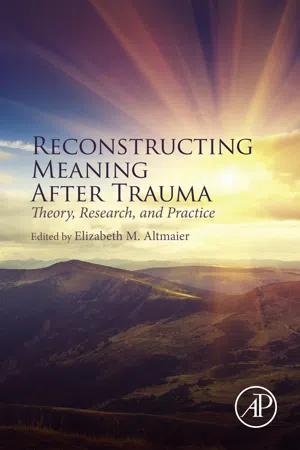
Reconstructing Meaning After Trauma: Theory, Research, and Practice informs actual therapeutic work with clients who present with traumas or other life disruptions by providing clinicians with information on the construction of meaning. It includes material on diverse mechanisms of clinical change and positive-promoting processes.
The book covers identifiable treatments and specific lines of research in assisting clients in developing new meaning, such as posttraumatic growth (after sexual assault, diagnosis, and treatment of cancer, destructive natural phenomena, such as hurricanes, and refugee experiences), and finding benefit (in the context of loss—loss of health, or loss of a loved one).
- Addresses a specific treatment or line of research
- Includes extended case vignettes at the beginning of each chapter
- Describes the associated theoretical background for each method
- Summarizes the research supporting each mechanism
- Concludes with a discussion of future directions for treatment, research, and theory
Information
Part 1
Foundations of Meaning and Trauma
Chapter 1
Making Meaning in the Wake of Trauma
Resilience and Redemption
D.P. McAdams, and B.K. Jones Northwestern University, Evanston, IL, United States
Abstract
The chapter introduces some of the central themes in the empirical and clinical literature on reconstructing meaning after trauma. A certain number of especially resilient people may adjust almost seamlessly to extremely negative events in their lives, whereas many others find that the presuppositions about self and world that sustained them in the past have now been undermined. Their efforts to make new meanings in the wake of trauma involve a wide range of interpretive and strategic operations, from trying to explain how and why the trauma occurred (sense making) to construing personal benefits from adversity. In the most successful outcomes, posttraumatic growth entails constructing a redemptive story around personal trauma and integrating that story within a broader, self-defining life narrative. Making meaning out of trauma through life narration is as much a social phenomenon as a personal one, and it is decisively shaped by culture.
Keywords
Meaning making; Redemptive life narratives; Resilience; Trauma
Shortly after his release from a Nazi concentration camp, Viktor Frankl spent nine fevered days composing an account of the harrowing experiences he endured in Dachau and Auschwitz. What he first conceived to be an anonymous report eventually became the basis for one of the most celebrated books of the 20th century. In Man’s Search for Meaning, Frankl (1959/1992) forged an immutable link between trauma and meaning. The quest for meaning is a fundamental human propensity, Frankl argued. And traumatic events in life—even the horrific suffering that Frankl and countless others experienced in the Holocaust—invoke the search for meaning in two ways. First, trauma violently shakes people out of their conventions and their comfort zones, refocusing their consciousness on existential questions of life. You do not have to suffer greatly to reflect upon the meaning of your life, but suffering can jump-start or accelerate the process. Second, trauma can violate or undermine sacrosanct assumptions about human life, challenging the victim or survivor to formulate new meanings. Under extreme conditions, the failure to sustain old meanings or create new ones in the wake of trauma can threaten survival. Prisoners who lost meaning simply gave up and died at Auschwitz.
Beyond the unspeakable physical privations and losses that Frankl suffered in the camps, his bedrock presuppositions about human nature and the world were obliterated. A well-educated Jew who figured to find a productive niche one day in a highly civilized society, Frankl came to witness instead unmitigated evil and a devastating meltdown of the social order. In the terms of one contemporary expert on trauma and meaning, Frankl experienced the shattering of two of three fundamental assumptions about life: (1) that the world is benevolent and (2) that justice or fairness prevails (Janoff-Bulman, 1992). He seemed even to question the third assumption—that the self is worthy—although perhaps not to the extent of ever completely losing hope in his own agency. Like many Holocaust survivors, Frankl struggled to rebuild his assumptive world after the war.
Frankl’s ideas derived from a singular historical moment involving countless perpetrators and millions of victims, whereas there is a sense in which psychologists’ thinking about the reconstruction of meaning after trauma resembles, for each individual life, the Holocaust writ small. Whether the trauma is sexual assault, the death of a child, or a paralyzing combat wound, the expectation is that the survivor will, like Frankl, confront a crisis in meaning. The survivor may struggle to make sense of the traumatic event. Although the pain may never go away, the survivor may ultimately derive some modicum of benefit from the trauma, or from the struggle to cope with the trauma. Posttraumatic growth (PTG) may even occur (Tedeschi & Calhoun, 2004). In the wake of trauma, newfound personal strengths or enhanced interpersonal relationships or a renewed sense of spirituality may arise, suggesting that positive, growth-inducing meanings have been made. There remains the hope for redemption, albeit in an attenuated form, for the trauma itself—the disability, the assault, the murder, the nearly unbearable loss—can never be undone.
How do people make meaning in the wake of trauma? There are surely many viable answers to this question, but behind many of them is the supposition that meaning is made, in large part, through narrative. Coming from a humanistic/existentialist perspective, Neimeyer (2006) urges clinicians to help trauma victims “re-story” their lives (p. 68). Adopting the frame of cognitive behavioral therapy, Meichenbaum (2006) has developed a “constructive narrative model of posttraumatic reactions” (p. 356). He explicitly identifies story themes and plots that either promote or undermine PTG. Calhoun and Tedeschi (2001) write: “A primary task of the clinician working with people who have experienced significant loss is to assist in the process of rebuilding the damaged or shattered worldview, to help the client develop a new life narrative that incorporates the loss in a helpful way” (p. 166). Outside the clinical realm, a growing number of personality and developmental psychologists contend that human beings are storytellers by nature and that successful adaptation to negative events in life involves creating new personal narratives that affirm positive meaning in adversity (McAdams, 2006; McAdams & McLean, 2013). Pals and McAdams (2004) assert that PTG may best be understood as a process of constructing a narrative understanding of how the self has been positively transformed by the traumatic event and then integrating this transformed sense of self into an identity-defining life story.
Creating positive posttraumatic meanings through the construction of new life stories that affirm growth and human redemption would seem to resonate with Frankl’s message. New stories may help to rebuild the narrator’s assumptive world. The victim of a violent crime, for example, may have to abandon forever the belief that the world is benevolent, but renarrating the trauma with a focus on the people who came to his or her aid may result in a new faith in the power of human beings to support, care for, and heal one another. Clinicians may assist in the meaning reconstruction by listening carefully to their clients’ stories and helping them reframe narratives in more life-affirming ways (Sheikh, 2008). But when it comes to trauma, things do not always play out in this manner. Most notably, for some people who have experienced potentially traumatic events, world assumptions may not be shattered, or even shaken, and life may proceed in a more-or-less adaptive manner. For these especially resilient people, there may indeed be no need to make new meanings.
When New Stories Are Not Needed: The (Surprisingly Common) Case of Resilience
This chapter’s first author has a friend—let us call her Laura—who, at age 32, experienced a stillborn birth and, in her early 50s, lost her husband to cancer. One of the most youthful and dashing midlife men one could ever know, Laura’s husband seemed to be recovering well from his illness when she reached for him in bed one morning, and found him to be dead. On the death of her baby, Laura reported to her friends that she felt great sadness but that she refused to dwell on it. She and her husband found solace, they both reported, in reading Kushner’s (1981) book, When Bad Things Happen to Good People. Laura got pregnant again soon after. Eventually she had three healthy children. Her husband’s death, two decades later, was a shock to everybody in Laura’s social circle. But Laura seemed almost unfazed. Her grieving was private and seemed relatively brief. Rather than change her life in any dramatic way after her husband died, Laura doubled down on the roles and commitments that had sustained her throughout her adult life. She drew even closer to her husband’s family. She continued to care for her children. She continued to pursue the same professional, personal, and community involvements that she had enjoyed during her marriage. Nearly a decade hence, she has not dated other men, even though she has ample opportunity to do so.
We cannot be sure, of course, but Laura’s case seems to defy expectations regarding (1) shattered world assumptions in the wake of trauma and (2) the subsequent construction of new, redemptive stories to promote PTG. Instead, she seems to exhibit cardinal features of what Bonanno (2004) describes as resilience. Reviewing a broad swath of research, Bonanno (2004) argues that many people who experience extremely negative events continue on with their lives in a more-or-less adaptive manner, exhibiting only minor and fleeting disruptions in their ability to function. He writes: “Resilient individuals may experience transient perturbations in normal functioning (e.g., several weeks of sporadic preoccupation or restless sleep) but generally exhibit a stable trajectory of healthy functioning across time, as well as the capacity for generative experiences and positive emotions” (Bonanno, 2004, p. 21).
Resilient people rarely consult clinicians because they rarely suffer the kind of psychopathology states—depression, high levels of anxiety, dissociation and psychic numbing, and other symptoms associated with posttraumatic stress disorder—that require treatment. As such, resilient individuals fly under the radar. Although exact figures are not known, Bonanno (2004) speculates that as many as 40–50% of trauma survivors may exhibit a resilience trajectory. Some skeptics might argue that resilient survivors are failing to come to terms with the trauma in their lives, boding ill for long-term adaptation, whereas Bonanno (2004) and others (e.g., Silver & Updegraff, 2013) argue the reverse. They contend that traumatic events often do not shatter assumptions, that many people do not, and need not, endure prolonged and intense grieving or distress in the wake of trauma, and that for many people t...
Table of contents
- Cover image
- Title page
- Table of Contents
- Copyright
- List of Contributors
- Introduction
- Part 1. Foundations of Meaning and Trauma
- Part 2. Mechanisms of Meaning Loss and Restoration
- Part 3. Population Specific Applications
- Part 4. Conclusion
- Index
Trusted by 375,005 students
Access to over 1.5 million titles for a fair monthly price.
Study more efficiently using our study tools.
Frequently asked questions
Yes, you can cancel anytime from the Subscription tab in your account settings on the Perlego website. Your subscription will stay active until the end of your current billing period. Learn how to cancel your subscription
No, books cannot be downloaded as external files, such as PDFs, for use outside of Perlego. However, you can download books within the Perlego app for offline reading on mobile or tablet. Learn how to download books offline
We are an online textbook subscription service, where you can get access to an entire online library for less than the price of a single book per month. With over 1.5 million books across 990+ topics, we’ve got you covered! Learn about our mission
Look out for the read-aloud symbol on your next book to see if you can listen to it. The read-aloud tool reads text aloud for you, highlighting the text as it is being read. You can pause it, speed it up and slow it down. Learn more about Read Aloud
Yes! You can use the Perlego app on both iOS and Android devices to read anytime, anywhere — even offline. Perfect for commutes or when you’re on the go.
Please note we cannot support devices running on iOS 13 and Android 7 or earlier. Learn more about using the app
Please note we cannot support devices running on iOS 13 and Android 7 or earlier. Learn more about using the app
Yes, you can access Reconstructing Meaning After Trauma by Elizabeth M. Altmaier in PDF and/or ePUB format, as well as other popular books in Psychology & Clinical Psychology. We have over 1.5 million books available in our catalogue for you to explore.