
- 290 pages
- English
- ePUB (mobile friendly)
- Available on iOS & Android
eBook - ePub
About this book
Renewable Heating and Cooling: Technologies and Applications presents the latest information on the generation of heat for industry and domestic purposes, an area where a significant proportion of total energy is consumed. In Europe, this figure is estimated to be almost 50%, with the majority of heat generated by the consumption of fossil fuels. As there is a pressing need to increase the uptake of renewable heating and cooling (RHC) to reduce greenhouse gas emissions, this book provides a comprehensive and authoritative overview on the topic.
Part One introduces key RHC technologies and discusses RHC in the context of global heating and cooling demand, featuring chapters on solar thermal process heat generation, deep geothermal energy, and solar cooling technologies. Part Two explores enabling technologies, special applications, and case studies with detailed coverage of thermal energy storage, hybrid systems, and renewable heating for RHC, along with case studies in China and Sweden.
Users will find this book to be an essential resource for lead engineers and engineering consultants working on renewable heating and cooling in engineering companies, as well as academics and R&D professionals in private research institutes who have a particular interest in the subject matter.
- Includes coverage on biomass, solar thermal, and geothermal renewable heating and cooling technologies
- Features chapters on solar thermal process heat generation, deep geothermal energy, solar cooling technologies, and special applications
- Presents case studies with detailed coverage of thermal energy storage, hybrid systems, and renewable heating for RHC
- Explores enabling technologies and special applications
Information
1
Introduction to renewable heating and cooling
Gerhard Stryi-Hipp Fraunhofer Institute for Solar Energy Systems, Freiburg, Germany
Abstract
G7 and a growing number of other countries globally are aiming to decarbonize the energy sector. Decarbonization is especially needed in the heating and cooling sector, since it is responsible for 50.6% of the final energy demand today, mainly using fossil fuels. Renewable heating and cooling technologies are the key decarbonization technologies with the potential to meet 100% of the heating and cooling demand. They are already available on the market, but due to several barriers, the market share of sustainable renewable energy sources in the heating and cooling sector is only 7% today. Therefore, it is necessary to unlock their potential by intensified research and development and improved market deployment policies.
Keywords
Heating and cooling technologies; Market barriers; Market deployment; Renewable heating and coolingOur present energy system, constructed during the past century, will be radically transformed in the twenty-first century according the Group of Seven (G7) industrial nations, which ended their summit in June 2015 by talking of the “decarbonization of the global economy over the course of this century.” They promised to cut greenhouse-gas emissions by the “upper end” of a range between 40 and 70% of 2010 levels by 2050 (ECO, 2015).
Usually politicians mean only electricity when they talk about “energy,” besides the fact that the production of heat accounts for around one-third of global energy-related carbon dioxide (CO2) emissions and half of the final energy demand (IEA, 2014). One reason for that is the traditional centralized electricity system in which most of the generators and consumers are connected to the electrical grid, at least in industrialized countries. The collectively used electrical grid and the need for a secure electrical supply force the governments to regulate and control the electrical system. Another reason is that building up the electrical system by electrifying street lighting, factories, households, rural areas, and railways was controlled from the beginning in the 1880s on by the individual states (NEA, 2015).
In contrast, heating is traditionally decentralized because humans learned to use, preserve, and make fire more than 30,000 years ago. Heat for cooking, domestic hot water, and space heating, as well as for industrial processes is traditionally produced individually in buildings or close to the places of use. An important difference to electricity is that there is the possibility, but not the need, of a centralized heat supply by using a heating grid. Centralized heat supply is well known and was used for the first time by the Romans 3000 years ago. The first district heating system to supply a city was already built in 1332 in the French village of Chaudes-Aigues, where 82 °C thermal water was delivered to buildings by wooden pipes (Geo, 2015). However, only a small share of heat demand is supplied by district heating systems today.
In recent years, the awareness of governments and institutions of the importance of the heating sector is rising, due to strong fossil fuel price increases during the past decade, the growing fossil fuel import dependency of most countries, and the growing need of decarbonization, which is impossible without a strong contribution of the heating sector. In 2011, final energy heat consumption accounted for 171.5 EJ globally, which corresponds to 50.6% of the total final energy use of 339 EJ, whereas 65.1 EJ (19.2%) was used as electricity and 102.4 EJ (30.2%) in the transport sector (Figure 1.1). Global energy use for heat of 129 EJ (75.2%) is met with fossil fuels. Forty percent of the primary energy supply of natural gas, as well as 20% each of oil and coal are being used for heat production, with important impacts on energy security (IEA, 2014).
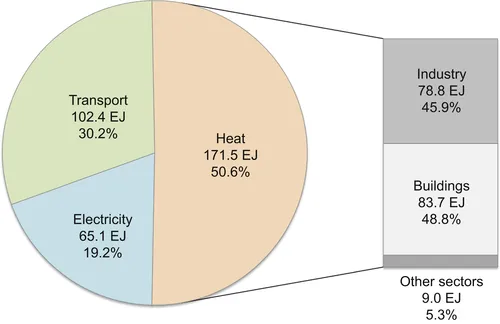
Figure 1.1 Final energy demand globally, distribution of heat use by sectors. Source: IEA (2014).
Renewable energy accounts for 43% (36 EJ) of total energy use for heat in buildings. However, most of this comes from the traditional use of biomass for cooking and space heating in developing and emerging economies. Such fuel use is usually unsustainable and is a cause of deforestation and health problems linked to indoor smoke pollution, among other disadvantages. Only 4 EJ are currently produced by more sustainable renewable energy technologies. This so-called modern bioenergy makes the largest contribution (3 EJ), whereas the use of solar thermal (0.7 EJ) and geothermal energy (0.3 EJ) for heat in buildings is small by comparison. In the industry sector, which consumes 78.8 EJ for heating, renewable energy use for heat accounts for 10% of the total, of which 99% is bioenergy based. Because buildings use 83.7 EJ, industry 78.8 EJ, and other sectors 9.0 EJ for heat, only 7% (12 EJ) of the final energy consumption for heat is provided by sustainable renewable energy sources, of which 92% is bioenergy based (IEA, 2014).
Today's use of sustainable renewable energy for heating and cooling is very low in comparison to its high potential. According to the European Technology Platform for Renewable Heating and Cooling, renewable energy sources could meet the overall heating and cooling demand in Europe already by 2040 (RHC, 2013). The strengths of renewable energy sources for heating are sustainability and local availability. They are available in each country in an individual country mix and can be harvested close to the point of heat demand. In addition, heating technologies differ a lot from region to region and are adapted to local conditions. Unfortunately, the local diversity of sources and of technologies used hamper the deployment of renewable heating and cooling (RHC) technologies, because it is impossible to build up RHC mass markets with standardized solutions to bring down costs and allow a fast diffusion of the technology. This is also the reason why simple policy instruments are not sufficient to stimulate market deployment of the manifold RHC technologies.
There are a large number of reasons why the deployment of RHC technologies is much lower than the market success of renewable electrical technologies. Because most heating systems are not connected to a heating network, thermal storage tanks are needed to compensate the mismatch between heat generation and consumption, especially if the RHC source is not storable as it is, for example, for the case in solar thermal systems for space heating at higher latitudes. In contradiction, each kWh of generated electricity by renewable energy can be fed into the grid and be directly used. This is at least the case in the beginning of the deployment phase with a low share of renewable electricity generation. RHC systems usually need storage capacities, which lead to additional costs in comparison with electrical generation systems.
There is a high diversity of heating and cooling technologies due to the high diversity of heat demand types according size and temperature. Heat is used for cooking, domestic hot water heating, space heating, and industrial processes in a broad temperature range from 30 °C up to above 1000 °C. The demand differs a lot between countries and regions depending on local climates. Space heating is needed only in cold and moderate climates, and cooling is obligatory in hot climates if people can afford it. But heat demand is not only affected by climatic conditions but also by the typical thermal comfort based on local traditions and cultural distinctions. It should be noted in addition that the level of heat demand is the result of the expected thermal comfort and the efficiency standard of a building, but the primary energy demand is additionally determined by the efficiency of the heating technology used.
Heating and cooling technologies depend also on the size of the buildings, the number of people, or the size of the industry supplied with heat and cold. Heating boilers for single-family homes and big combined heat and power plants for district heating systems, as well as split systems for air conditioning and big absorption chillers differ greatly. In addition, the type of distribution system influences the heat and cold generation technology. Single-room heating with stoves placed in the rooms to be heated is mainly used in small buildings. Water-based central heating systems for apartments, small and large apartment buildings, or building complexes require central boilers with adapted capacities. In air heating systems specific air heaters or heat exchangers are used. District heating systems can be supplied by large combined heat and power plants in combination with peak load boilers. And for all applications different types of solar thermal, biomass, geothermal, and heat pump systems are available as well.
RHC technologies must not only be adapted to the demand side and its diversity of heat distribution technologies, but also to the resource side, because solar thermal systems depend on the intensity and variability of solar radiation and geothermal systems on the local conditions of the ground or the water. Biomass benefits from its flexibility because it can be transported and stored; however, costs and CO2 emissions are increasing with the distance between the place of growth and the place of use of biomass, and therefore the availability of biomass in the region around the user is a limiting factor for the use of biomass.
The heating and cooling sector shows also a higher diversity on investors and type of investments in comparison with the electricity sector. Building owners and companies investing in stoves, boilers, or electrical heaters and buying primary energy sources to generate heat. Only a minor share is buying heat from district heating systems. The investment motivation and therefore investment decisions differ a lot with the types of building owners, housing companies, and investors. Private residential home owners, private landlords, cooperative and commercial housing companies, as well as enterprises and district heating companies are characterized by different investment needs and investment criteria. Therefore, several separated heating and cooling technology markets result and must be addressed individually by the manufacturers and distributors.
The specific conditions of the heating and cooling markets described are significant challenges for RHC technologies to enter these markets. However, the main barrier is the price of fossil fuels and the often missing competitiveness. Usually RHC technologies have higher investment co...
Table of contents
- Cover image
- Title page
- Table of Contents
- Related titles
- Copyright
- List of contributors
- Woodhead Publishing Series in Energy
- 1. Introduction to renewable heating and cooling
- Part One. Key technologies for renewable heating andcooling and their applications
- Part Two. Enabling technologies, special applicationsand case studies
- Index
Trusted by 375,005 students
Access to over 1.5 million titles for a fair monthly price.
Study more efficiently using our study tools.
Frequently asked questions
Yes, you can cancel anytime from the Subscription tab in your account settings on the Perlego website. Your subscription will stay active until the end of your current billing period. Learn how to cancel your subscription
No, books cannot be downloaded as external files, such as PDFs, for use outside of Perlego. However, you can download books within the Perlego app for offline reading on mobile or tablet. Learn how to download books offline
Perlego offers two plans: Essential and Complete
- Essential is ideal for learners and professionals who enjoy exploring a wide range of subjects. Access the Essential Library with 800,000+ trusted titles and best-sellers across business, personal growth, and the humanities. Includes unlimited reading time and Standard Read Aloud voice.
- Complete: Perfect for advanced learners and researchers needing full, unrestricted access. Unlock 1.5M+ books across hundreds of subjects, including academic and specialized titles. The Complete Plan also includes advanced features like Premium Read Aloud and Research Assistant.
We are an online textbook subscription service, where you can get access to an entire online library for less than the price of a single book per month. With over 1.5 million books across 990+ topics, we’ve got you covered! Learn about our mission
Look out for the read-aloud symbol on your next book to see if you can listen to it. The read-aloud tool reads text aloud for you, highlighting the text as it is being read. You can pause it, speed it up and slow it down. Learn more about Read Aloud
Yes! You can use the Perlego app on both iOS and Android devices to read anytime, anywhere — even offline. Perfect for commutes or when you’re on the go.
Please note we cannot support devices running on iOS 13 and Android 7 or earlier. Learn more about using the app
Please note we cannot support devices running on iOS 13 and Android 7 or earlier. Learn more about using the app
Yes, you can access Renewable Heating and Cooling by Gerhard Stryi-Hipp in PDF and/or ePUB format, as well as other popular books in Technology & Engineering & Chemical & Biochemical Engineering. We have over 1.5 million books available in our catalogue for you to explore.