- 410 pages
- English
- ePUB (mobile friendly)
- Available on iOS & Android
eBook - ePub
Handbook of Vascular Motion
About this book
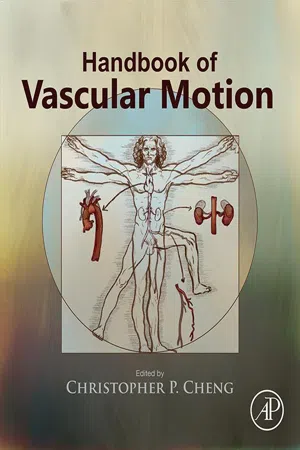
Handbook of Vascular Motion provides a comprehensive review of the strategies and methods to quantify vascular motion and deformations relevant for cardiovascular device design and mechanical durability evaluation. It also explains the current state of knowledge of vascular beds that are particularly important for the medical device industry. Finally, it explores the application of vascular motion to computational simulations, benchtop testing and fatigue analysis, as well as further implications on clinical outcomes, product development and business.
- PROSE Book Award Nominee in the "Single Volume Reference Book" category
- Describes methods to quantify vascular motion and deformations including choosing what data to collect, relevant medical imaging, image processing, geometric modeling, and deformation quantification techniques
- Includes deformations for vascular beds of particular importance in medical devices including the coronary arteries and heart, arteries of the head and neck, thoracic aorta and arch branches, abdominal aorta and visceral branches, lower extremity arteries, inferior vena cava, and lower extremity veins
- Explains how to convert raw deformations into boundary conditions suitable for durability evaluation, provides examples of using this information for computational simulations, benchtop testing, and fatigue analysis, and illustrates examples of how vascular motion affect clinical outcomes, product development, and business
Information
Part I
Tools for Quantifying Vascular Motion
Outline
Chapter 1
Introduction
Christopher P. Cheng, Division of Vascular Surgery, Stanford University, Stanford, CA, United States
Abstract
Very little work has been done on understanding vascular motion to improve the mechanical durability of cardiovascular devices. Vascular motion tends to be an afterthought because it is often not related to the primary function of the device. Experts once believed that blood vessels had no significant movement, when in reality it is a critical consideration for medical device development. Since long-term implant durability came to the forefront of concern in the early 2000s, it is now integral to device design, regulation, product positioning, marketing, sales, and corporate strategy. Studying vascular motion also helps to elucidate the fundamentals of cardiovascular biomechanics, which can impact education, diagnostics, and other medical therapies.
Keywords
Cardiovascular; biomechanics; motion; deformation; boundary conditions; mechanical durability; medical devices; stents; fracture
Do Blood Vessels Move?
The following scenes are based on real events …
- When: Sometime in 2000.
- Where: In a large, upscale conference room at a prestigious US university medical school.
- Who: Clinical specialists from a multinational, publicly traded medical device company and 15 of the world’s most prominent vascular surgeons, interventional radiologists, and interventional cardiologists.
- What: Meeting in preparation to launch a clinical trial for femoral artery stents.
- Why: The medical device company wanted to make sure they knew what to expect from the clinical trial before launching the resource-intensive study.
- Mood: Businesslike, but light-hearted with positive excitement.
Company Clinical Specialist: Thank you all for taking time out of your very busy schedules to join us today. We are truly appreciative to those of you who have signed on as investigators and advisors to the trial. As you know, we have been very busy preparing for this upcoming clinical trial and have every reason to believe that we are on to something big. If the results in the superficial femoral artery (SFA) look anywhere near as good as what we are seeing in the coronaries, this could be a game changer for the industry and the treatment of peripheral vascular disease. Today we’d like to briefly review our preclinical benchtop, animal, and biocompatibility work on the product and then launch into a deeper discussion about what to expect from the trial. This is where your expertise is invaluable.
Two hours of discussion about technical data and expectation of clinical outcomes followed …
Company Clinical Specialist: Thank you for that fruitful discussion! We are encouraged with your optimism for this new product. One last question here from a couple of our engineers back home. They suspect that there might be some motions in the superficial femoral artery based on some anecdotal observations in the cath lab. They are concerned that the movements would impact the mechanical durability of the stent. Do you think this is anything to worry about?
Prominent Physician #1: Hmmm, I don’t think I’ve seen any evidence to support that concern. So no, I don’t think so. What would even cause the motion? The superficial femoral artery should be pretty tightly constrained in the adductor canal, so I would not expect it to move.
Prominent Physician #2: The SFA should not experience any motion. The superficial femoral artery and vein are packed in the adductor canal between the vastus medialis, adductor longus, adductor magnus, and sartorius muscles. Perhaps I’d be more concerned if we were stenting at the hip or crossing the knee, but the SFA should stay straight and stable.
Prominent Physician #3: Absolutely. No question. The SFA is right in the middle of the thigh. Even during hip and knee flexion and extension, the SFA is nowhere near the joints, so it should be rock solid.
Prominent Physicians #4–15: Yes, agreed. The SFA definitely does not move.
Approximately 2 years later …
- When: Sometime in 2002.
- Where: In a large, upscale conference room at a prestigious East Coast university medical school.
- Who: Executives, design engineers, testing engineers, quality engineers, regulatory affairs, preclinical scientists, and clinical specialists from a multinational, publicly traded medical device company along with the same 15 prominent vascular surgeons, interventional radiologists, and interventional cardiologists.
- What: Meeting to discuss the 1-year results from the clinical trial for femoral artery stents.
- Why: The femoral artery stents were fracturing at an alarming rate and nobody knew why.
- Mood: Businesslike, with serious concentration and a little grim.
Company Executive: Thank you for accommodating this meeting on such short notice. We know you are all busy. I personally wanted to attend this meeting because the outcome of this clinical trial is very important to our company, and most of all, the safety of the patients involved. We want to make sure we are doing everything in our power to protect the patients and to understand whether the stent fractures are of any clinical concern.
Company Regulatory Affairs: To be clear, the majority of patients with stent fracture have not experienced clinical sequelae. While some have experienced lumen narrowing and reocclusion, we have not determined if this was caused by stent fracture and have not found a statistically significant correlation.
Prominent Physician #1: Okay, but you’re at only 1 year. If there are clinical sequelae at this point, then you can be sure more will pop up at 2, 3, 5 years. We see clinical durability issues 5 years after open surgery all the time.
Prominent Physician #2: Yeah, and what’s going to happen when we try to treat patients with more severe disease? The parameters of this trial were relatively constrained. In the real world, as the product is pushed to tougher cases, will the fracture issue get worse?
Company Clinical Specialist: That’s a good point. We wanted to discuss the more real-world use cases and get your input on whether we should limit the treatment population further.
Company Regulatory Affairs: Wait, hold on. We shouldn’t restrict the patients we can treat and help clinically without first understanding the underlying issue. Do we think the stent fractures have to do with vessel deformations?
Company Testing Engineer: We tested the mechanical durability of the product per the FDA guidance documents based on scientific literature data on radial pulsatility. In fact, we actually performed extra conservative tests where we took worst case deformations. We did not observe any fractures on the benchtop or predict any in the computer simulations. Are there nonpulsatile deformations in the SFA?
Prominent Physician #1: Hmmm, I don’t think I’ve seen any evidence to support that the artery doesn’t move. So yes, it seems that might be the case. The superficial femoral artery is in the leg, and the leg moves with every step you take, so the SFA probably moves along with it.
Prominent Physician #2: The SFA definitely experiences motion. The superficial femoral artery and vein are packed in the adductor canal between the vastus medialis, adductor longus, adductor magnus, and sartorius muscles. Since all those muscles contract with walking, the SFA will experience dramatic deformation.
Prominent Physician #3: Absolutely. No question. The femoral artery is incredibly dynamic with leg motion, as proven in this trial. Clearly, the stents would not be fracturing at this rate if the SFA wasn’t moving.
Prominent Physicians #4–15: Yes, agreed. The SFA definitely moves.
Absence of Evidence is Not Evidence of Absence
The preceding fictional conversations are shockingly close to what actually happened in the early 2000s. Commercial peripheral vascular stenting was still in its relative infancy, having been around for less than a decade, and the products on the market were the so-called “first-generation” peripheral stents. At that time, vascular motion was mainly considered in the context of radial deformation from cardiac pulsatility, so device engineers, clinicians, and regulators primarily focused on that mode of vascular mot...
Table of contents
- Cover image
- Title page
- Table of Contents
- Copyright
- Dedication
- List of Contributors
- Foreword
- Endorsements
- Part I: Tools for Quantifying Vascular Motion
- Part II: How the Blood Vessels Move
- Part III: Utilizing Vascular Motion Data and Implications
- Acknowledgments
- About the Author
- Index
Trusted by 375,005 students
Access to over 1.5 million titles for a fair monthly price.
Study more efficiently using our study tools.
Frequently asked questions
Yes, you can cancel anytime from the Subscription tab in your account settings on the Perlego website. Your subscription will stay active until the end of your current billing period. Learn how to cancel your subscription
No, books cannot be downloaded as external files, such as PDFs, for use outside of Perlego. However, you can download books within the Perlego app for offline reading on mobile or tablet. Learn how to download books offline
Perlego offers two plans: Essential and Complete
- Essential is ideal for learners and professionals who enjoy exploring a wide range of subjects. Access the Essential Library with 800,000+ trusted titles and best-sellers across business, personal growth, and the humanities. Includes unlimited reading time and Standard Read Aloud voice.
- Complete: Perfect for advanced learners and researchers needing full, unrestricted access. Unlock 1.5M+ books across hundreds of subjects, including academic and specialized titles. The Complete Plan also includes advanced features like Premium Read Aloud and Research Assistant.
We are an online textbook subscription service, where you can get access to an entire online library for less than the price of a single book per month. With over 1.5 million books across 990+ topics, we’ve got you covered! Learn about our mission
Look out for the read-aloud symbol on your next book to see if you can listen to it. The read-aloud tool reads text aloud for you, highlighting the text as it is being read. You can pause it, speed it up and slow it down. Learn more about Read Aloud
Yes! You can use the Perlego app on both iOS and Android devices to read anytime, anywhere — even offline. Perfect for commutes or when you’re on the go.
Please note we cannot support devices running on iOS 13 and Android 7 or earlier. Learn more about using the app
Please note we cannot support devices running on iOS 13 and Android 7 or earlier. Learn more about using the app
Yes, you can access Handbook of Vascular Motion by Christopher Cheng in PDF and/or ePUB format, as well as other popular books in Biological Sciences & Biotechnology. We have over 1.5 million books available in our catalogue for you to explore.