
- 370 pages
- English
- ePUB (mobile friendly)
- Available on iOS & Android
eBook - ePub
Fatigue and Tribological Properties of Plastics and Elastomers
About this book
Part of a series of data-rich handbooks within the Plastics Design Library, Fatigue and Tribological Properties of Plastics and Elastomers provides a comprehensive collection of graphical multipoint data and tabular data covering the fatigue and tribological performance of plastics.
The handbook is structured by grouping together plastics of similar polymer types into ten chapters. Each of these chapters is split into two sections: Fatigue Properties and Tribological Properties, and together they provide a compendium of several hundred graphs and charts, supplying the core data needed by engineers and scientists on a day-to-day basis.
The data for this third edition has been updated to cover upwards of five years since the previous edition was published, and also includes an entirely new chapter covering sustainable and biodegradable polymers. The book also includes an extensive introductory section covering fatigue, what it is and how it is measured; the fundamentals of tribology; polymer chemistry and plastics composition. These chapters also provide readers with a full understanding of the data section, and how to put it to use as a hard-working information tool.
Information
1
Introduction to Fatigue of Plastics and Elastomers
Abstract
This chapter is an introduction to fatigue as it occurs in plastic materials. It is an introductory tutorial. It starts with an explanation of the types of stress. Then follows the section on fatigue testing. This includes the types of coupons used along with many types of testing machines. An explanation of the analysis of the fatigue-testing data is included. A section covers the fatigue process that includes crack growth and propagation. External factors, those not directly about plastic composition, that affect fatigue performance are summarized.
Keywords
stress
tensile
compressive
torsional
flexural
bending
hoop
fatigue coupons
eccentric fatigue
cantilevered
flex life
MIT Flex
Ross Flex
DeMattia Flex
crack initiation
crack growth
crack propagation
monotonic
stress–strain
strain–life
stress–life
There are two recently published books on the properties of engineering plastics in this series. The Effect of Temperature and Other Factors on Plastics, Plastics Design Library [1] discusses the general mechanical properties of plastics. The mechanical properties as a function of temperature, humidity, and other factors are presented in graphs or tables. That work includes hundreds of graphs of stress versus strain, modulus versus temperature, impact strength versus temperature, etc. Time was not a factor in that book. The Effect of Creep and Other Time Related Factors on Plastics, Plastics Design Library [2] discusses the long-term behavior of plastics when exposed to constant stresses or strains for long periods of time. This book adds another two layers of plastics performance criteria, fatigue and tribology.
This book provides graphical multipoint data and tabular data on fatigue and tribological properties of plastics and elastomers along with introductory background to help in understanding those data. This chapter deals with the types of stress and an introduction to fatigue. Tribology is discussed in chapter: Introduction to the Tribology of Plastics and Elastomers. The chemistry of plastics follows in chapter: Introduction to Plastics and Polymers. The remaining chapters contain the data.
The idea of fatigue is very simple. If an object is subjected to a stress or deformation, and it is repeated, the object becomes weaker. This weakening of plastic material is called fatigue and occurs when the material is subject to alternating stresses, over a long period of time.
1.1. Types of Stress
Fatigue occurs as a result of rapidly changing stress or strain. Stress and strain can be applied in a number of ways. Normal stress (σ) is the ratio of the applied force (F) over the cross-sectional area (A) as shown in Eq. (1.1) and Fig. 1.1:

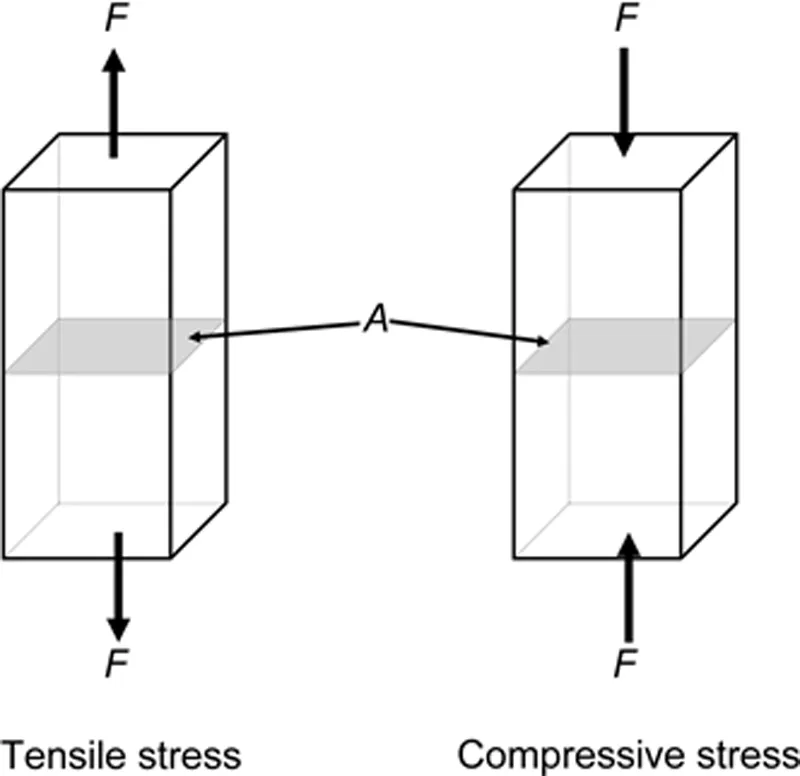
Figure 1.1 Illustration of tensile stress and compressive stress.
1.1.1. Tensile and Compressive Stress
When the applied force is directed away from the part, as shown in Fig. 1.1, it is a tensile force inducing ...
Table of contents
- Cover
- Title page
- Table of Contents
- Copyright
- Foreword
- Acknowledgments
- 1: Introduction to Fatigue of Plastics and Elastomers
- 2: Introduction to the Tribology of Plastics and Elastomers
- 3: Introduction to Plastics and Polymers
- 4: Styrenic Plastics
- 5: Polyether Plastics
- 6: Polyester Plastics
- 7: Polyimide Plastics
- 8: Polyamide Plastics (Nylons)
- 9: Polyolefins and Acrylics
- 10: Thermoplastic Elastomers
- 11: Fluoropolymers
- 12: High-Temperature Polymers
- Subject Index
Trusted by 375,005 students
Access to over 1.5 million titles for a fair monthly price.
Study more efficiently using our study tools.
Frequently asked questions
Yes, you can cancel anytime from the Subscription tab in your account settings on the Perlego website. Your subscription will stay active until the end of your current billing period. Learn how to cancel your subscription
No, books cannot be downloaded as external files, such as PDFs, for use outside of Perlego. However, you can download books within the Perlego app for offline reading on mobile or tablet. Learn how to download books offline
Perlego offers two plans: Essential and Complete
- Essential is ideal for learners and professionals who enjoy exploring a wide range of subjects. Access the Essential Library with 800,000+ trusted titles and best-sellers across business, personal growth, and the humanities. Includes unlimited reading time and Standard Read Aloud voice.
- Complete: Perfect for advanced learners and researchers needing full, unrestricted access. Unlock 1.5M+ books across hundreds of subjects, including academic and specialized titles. The Complete Plan also includes advanced features like Premium Read Aloud and Research Assistant.
We are an online textbook subscription service, where you can get access to an entire online library for less than the price of a single book per month. With over 1.5 million books across 990+ topics, we’ve got you covered! Learn about our mission
Look out for the read-aloud symbol on your next book to see if you can listen to it. The read-aloud tool reads text aloud for you, highlighting the text as it is being read. You can pause it, speed it up and slow it down. Learn more about Read Aloud
Yes! You can use the Perlego app on both iOS and Android devices to read anytime, anywhere — even offline. Perfect for commutes or when you’re on the go.
Please note we cannot support devices running on iOS 13 and Android 7 or earlier. Learn more about using the app
Please note we cannot support devices running on iOS 13 and Android 7 or earlier. Learn more about using the app
Yes, you can access Fatigue and Tribological Properties of Plastics and Elastomers by Laurence W. McKeen in PDF and/or ePUB format, as well as other popular books in Technology & Engineering & Mechanical Engineering. We have over 1.5 million books available in our catalogue for you to explore.