eBook - ePub
Electrical Drives for Direct Drive Renewable Energy Systems
- 280 pages
- English
- ePUB (mobile friendly)
- Available on iOS & Android
eBook - ePub
Electrical Drives for Direct Drive Renewable Energy Systems
About this book
Wind turbine gearboxes present major reliability issues, leading to great interest in the current development of gearless direct-drive wind energy systems. Offering high reliability, high efficiency and low maintenance, developments in these direct-drive systems point the way to the next generation of wind power, and Electrical drives for direct drive renewable energy systems is an authoritative guide to their design, development and operation.Part one outlines electrical drive technology, beginning with an overview of electrical generators for direct drive systems. Principles of electrical design for permanent magnet generators are discussed, followed by electrical, thermal and structural generator design and systems integration. A review of power electronic converter technology and power electronic converter systems for direct drive renewable energy applications is then conducted. Part two then focuses on wind and marine applications, beginning with a commercial overview of wind turbine drive systems and an introduction to direct drive wave energy conversion systems. The commercial application of these technologies is investigated via case studies on the permanent magnet direct drive generator in the Zephyros wind turbine, and the Archimedes Wave Swing (AWS) direct drive wave energy pilot plant. Finally, the book concludes by exploring the application of high-temperature superconducting machines to direct drive renewable energy systems.With its distinguished editors and international team of expert contributors, Electrical drives for direct drive renewable energy systems provides a comprehensive review of key technologies for anyone involved with or interested in the design, construction, operation, development and optimisation of direct drive wind and marine energy systems.
- An authorative guide to the design, development and operation of gearless direct drives
- Discusses the principles of electrical design for permanent magnet generators and electrical, thermal and structural generator design and systems integration
- Investigates the commercial applications of wind turbine drive systems
Information
Part I
Electrical drive technology
Outline
1
Electrical generators for direct drive systems: a technology overview
M. Mueller and A. Zavvos, University of Edinburgh, UK
Abstract:
This chapter gives an overview of the various direct drive generator technologies for wind turbines and focuses on the different permanent magnet generator topologies. Their advanced characteristics have drawn a number of manufacturers towards this system which now represents 20% of the sold wind turbines worldwide. However, in order to attain high torque levels they require an increased airgap diameter. This chapter will guide the reader through the various direct drive generator topologies for wind turbines that have been suggested in the literature and outline the ones with the highest potential to produce large power output with the least possible weight.
Key words
direct drive; permanent magnet generator; transverse flux machines; switched reluctance generator; radial flux; axial flux
1.1 Introduction
In recent years, large-scale direct drive generators have attracted the attention of wind turbine manufacturers as an alternative to geared systems. In a direct drive system the gearbox is removed from the drive train and the generator is directly coupled to the hub of the wind turbine (Fig. 1.1). They both rotate at the same speed which typically varies between 8 and 15 rpm depending upon the power rating.
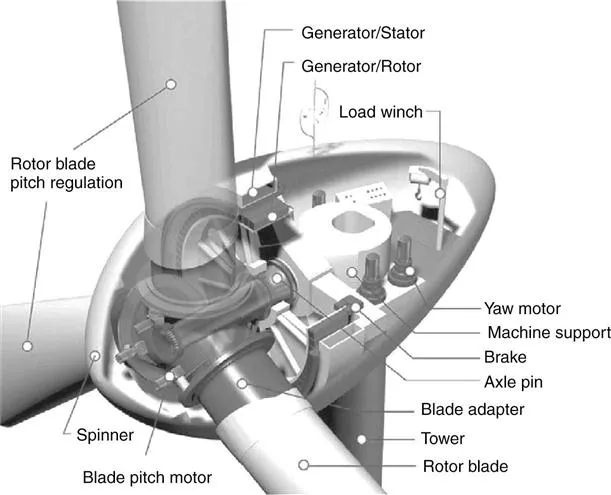
Elimination of the gearbox has several benefits, including reduced noise levels, simplification of the drive train, which increases reliability, reduced losses due to fewer energy conversion steps, and lower maintenance cost.1,2 Costly gearbox maintenance issues that can cause long downtime periods, such as oil replacement, gearbox failures or gearbox replacement, are avoided.3–5 Furthermore, the reduction in the number of bearings and moving parts required for direct drive systems results in Reference 6. These advanced characteristics have attracted a number of manufacturers to this system, which now represents 20% of the wind turbines sold worldwide.7
In order to compete with high-speed geared generators, direct drive machines need to attain high torque levels. Equation [1.1] gives the power output of a rotating machine.

where P, the power output (W), ω, the angular velocity (rad/s) and T, the rated torque of the machine (Nm). When ω is low, T needs to increase to create the same power output. Equation [1.2] gives the torque of a rotating machine.

where R, the radius of the machine (m), l, the axial length (m) and Fd (Pa), the shear stress applied on the machine’s structure due to the interaction of the machine’s magnetic field and the currents generated (Fig. 1.2).
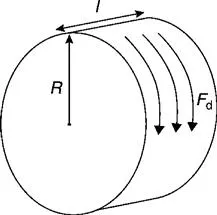
The combination of Equations [1.1] and [1.2] leads to the conclusion that since direct drive machines operate at a low rotational speed, given a fixed axial length and shear stress, it is necessary to increase the machine’s diameter in order to achieve the required torque levels. The large diameters required to achieve high power outputs in direct drive machines need large amounts of expensive raw materials. Their very large size also makes them heavy and difficult to build, transport and install.
Although the structural loads applied to these machines do not differ from those of conventional wind turbine generators, it is their size that increases the magnitude of these forces and makes them so structurally demanding. The structure has to be stiff and robust in order to maintain the small airgap clearance between the rotor and the stator against the various structural forces and at the same time hold the electromagnetically active materials in place against the attraction forces and gravity.8 McDonald showed that the structural mass for a direct drive generator with nominal output of 5 MW can reach up to 80% of its total weight.9
Different direct drive configurations have been suggested in the literature in an attempt to produce a highly efficient machine with reduced structural mass. The aim of this chapter is to present the proposed direct drive generator topologies for wind turbines and describe those with the highest potential to produce large power outputs at the least possible weight.
1.2 Excitation methods
An AC synchronous machine can be electrically excited or permanent magnet excited. A switched reluctance generator (SRG) has single electrical excitation on the stator without any excitation on its rotor.
1.2.1 Electrically excited direct drive (EEDD) generators
Magnetization of the rotor poles of an electrically excited direct drive (EEDD) generator is provided by a DC source. DC excitation is usually provided via slip rings and brushes. Brushless DC excitation is also possible...
Table of contents
- Cover image
- Title page
- Table of Contents
- Copyright
- Contributor contact details
- Woodhead Publishing Series in Energy
- Part I: Electrical drive technology
- Part II: Applications: wind and marine
- Index
Trusted by 375,005 students
Access to over 1.5 million titles for a fair monthly price.
Study more efficiently using our study tools.
Frequently asked questions
Yes, you can cancel anytime from the Subscription tab in your account settings on the Perlego website. Your subscription will stay active until the end of your current billing period. Learn how to cancel your subscription
No, books cannot be downloaded as external files, such as PDFs, for use outside of Perlego. However, you can download books within the Perlego app for offline reading on mobile or tablet. Learn how to download books offline
Perlego offers two plans: Essential and Complete
- Essential is ideal for learners and professionals who enjoy exploring a wide range of subjects. Access the Essential Library with 800,000+ trusted titles and best-sellers across business, personal growth, and the humanities. Includes unlimited reading time and Standard Read Aloud voice.
- Complete: Perfect for advanced learners and researchers needing full, unrestricted access. Unlock 1.5M+ books across hundreds of subjects, including academic and specialized titles. The Complete Plan also includes advanced features like Premium Read Aloud and Research Assistant.
We are an online textbook subscription service, where you can get access to an entire online library for less than the price of a single book per month. With over 1.5 million books across 990+ topics, we’ve got you covered! Learn about our mission
Look out for the read-aloud symbol on your next book to see if you can listen to it. The read-aloud tool reads text aloud for you, highlighting the text as it is being read. You can pause it, speed it up and slow it down. Learn more about Read Aloud
Yes! You can use the Perlego app on both iOS and Android devices to read anytime, anywhere — even offline. Perfect for commutes or when you’re on the go.
Please note we cannot support devices running on iOS 13 and Android 7 or earlier. Learn more about using the app
Please note we cannot support devices running on iOS 13 and Android 7 or earlier. Learn more about using the app
Yes, you can access Electrical Drives for Direct Drive Renewable Energy Systems by Markus Mueller,Henk Polinder in PDF and/or ePUB format, as well as other popular books in Technology & Engineering & Renewable Power Resources. We have over 1.5 million books available in our catalogue for you to explore.