- 346 pages
- English
- ePUB (mobile friendly)
- Available on iOS & Android
eBook - ePub
Spinal Cord Injury (SCI) Repair Strategies
About this book
Spinal Cord Injury (SCI) Repair Strategies provides researchers the latest information on potential regenerative approaches to spinal cord injury, specifically focusing on therapeutic approaches that target regeneration, including cell therapies, controlled drug delivery systems, and biomaterials. Dr. Giuseppe Perale and Dr. Filippo Rossi lead a team of authoritative authors in academia and industry in this innovative reference on the field of regenerative medicine and tissue engineering. This book presents all the information readers need to understand the current and potential array of techniques, materials, applications and their benefits for spinal cord repair.
- Covers current and future repair strategies for spinal cord injury repair
- Focuses on key research trends, clinics, biology and engineering
- Provides fundamentals on regenerative engineering and tissue engineering
Information
Subtopic
Biotecnologia in medicinaChapter 1
Introduction to spinal cord injury as clinical pathology
Simonetta Papa, PhD 1 , Emanuele Mauri, PhD 2 , Filippo Rossi, PhD 1 , 3 , Giuseppe Perale, PhD 1 , 4 , 5 , and Pietro Veglianese, PhD 1 1 Department of Neuroscience, IRCCS Istituto di Ricerche Farmacologiche “Mario Negri”, Milan, Italy 2 Department of Engineering, Tissue Engineering and Chemistry for Engineering Unit, Università Campus Bio-Medico di Roma, Rome, Italy 3 Department of Chemistry, Materials and Chemical Engineering “Giulio Natta”, Milan, Italy 4 Faculty of Biomedical Sciences of the University of Southern Switzerland, Lugano, Switzerland 5 Ludwig Boltzmann Institute for Experimental and Clinical Traumatology, Vienna, Austria
Abstract
Spinal cord injury (SCI) remains one of the most devastating conditions among neurological diseases due to its pathologic consequences. It is estimated that this lesion affects about 330,000 European people as trauma from an incident (for example, a motor vehicle accident or a sport injury), or by violence such as gunshot wound, or because of medical treatments or diseases such as polio and split spine (http://www.eurostemcell.org). SCI effects can be classified as “primary injury” including the interruption of ascending and descending pathways due to a contusive, compressive, or stretch injury of the spinal cord, and as “secondary injury” that is related to posttraumatic degeneration of the tissue and leading to severe motor or sensory disabilities, often accompanied by paralysis of the arms or legs.
Keywords
Neuroinflammation; Neuroregeneration; Spinal cord; Spinal cord injury
Spinal cord anatomy
The central nervous system, formed by brain and spinal cord, is the center in charge of reception, elaboration, and information transmission. The spinal cord comprises a bundle of neurons and has its place in the spinal canal that protects it. In humans, it has a cylindrical form, with 8–10 mm of medium diameter, starts at the base of the skull, but does not occupy the vertebral canal for his entire length, ending in the firsts lumbar vertebras. The spinal column and the spinal cord are divided into five regions: cervical, thoracic, lumbar, sacral, and coccyx (Fig. 1.1). From the spinal cord start the peripheral nerves, responsible for motor and sensory capabilities of the entire body. An external stimulus detected, for example, by the skin, is converted into chemical signals that are transported along the axons to the dorsal side of spinal cord and finally to the brain. In the brain, they are elaborated and the responsive motor signal goes back to the ventral side of the spinal cord and to the region that perceived the stimulus.
Three membranes, called meninges, of protective tissue cover the entire spinal cord. The external membrane has been named dura mater because of this strength, the intermediate one is the delicate arachnoid, which is thin and with web-like filaments, and the inner membrane is called pia mater. Between arachnoid and pia mater, there is a space filled with cerebrospinal liquid, and this gap contains arteries that supply blood to the spinal tissue: in case of trauma, there will be hemorrhaging.
Internal organization
The spinal cord is composed of two different types of tissue: the inner part appears grayish and is called gray matter; the outer instead is white and is called white matter (Fig. 1.2). White matter is subdivided into columns, each one containing neurons related to specific functions. The lateral columns include axons that travel from the cerebral cortex to contact spinal motor neurons. In the dorsal zone, sensibility information are carried up way to the brain. The ventral columns carry both ascending information about pain and temperature and descending motor information. Gray matter is divided into dorsal and ventral horns. The dorsal ones are for skin stimulus reception; the ventral ones receive proprioceptive fibers, and the middle part receives sensorial inputs from muscles and viscera. The muscle's motor activity is the result of the cooperation that takes place between different groups of neurons put in series: if one of them is damaged, the information circuit would be broken and the movement results impeded.
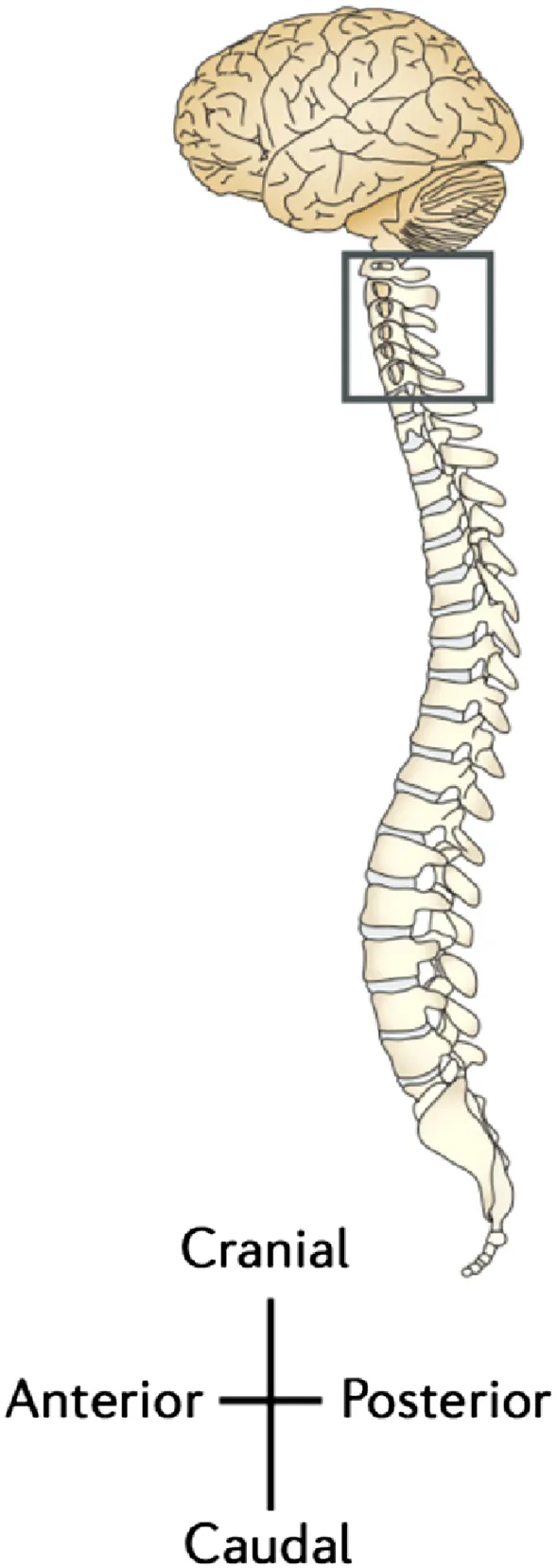
Reprinted with permission from Thuret S, Moon LDF, Gage FH. Therapeutic interventions after spinal cord injury. Nat Rev Neurosci 2006;7:628–43.
Spinal cord injuries
Spinal cord injury (SCI) is a condition that implies a loss of motor abilities and results to be one of the first causes of noncongenic disability in the world, with an annual incidence between 40 and 80 cases per million people. About two and a half millions of the people worldwide are affected by SCI [2–4]. Most of them are male (82% in the United States, 72.7% in India), and the mean age is 33 years, with a tendency to rise. The causes vary in the world differently from country to country and are mostly related to vehicular accidents, falls, violence, or sport activities. In addition, t...
Table of contents
- Cover image
- Title page
- Table of Contents
- Copyright
- Dedication
- Contributors
- Foreword
- Chapter 1. Introduction to spinal cord injury as clinical pathology
- Chapter 2. Spinal cord injury: Role of neurophysiology
- Chapter 3. Conventional treatments and surgical margins of maneuvering for spinal cord injury management
- Chapter 4. MRI as an imaging tool for in vivo noninvasive morphological and (partially) functional examination of injured spinal cord
- Chapter 5. Spinal cord injury: Ethical issues
- Chapter 6. Elements of material science and polymeric biomaterials
- Chapter 7. Soft and rigid scaffolds for spinal cord injury regeneration
- Chapter 8. Nanomaterials for spinal cord injury (SCI) regeneration
- Chapter 9. Cell therapies for spinal cord injury regeneration
- Chapter 10. Functional properties of progenitor-like cells in the spinal cord: Implications for self-repair
- Chapter 11. Paracrine effects for spinal cord injury regeneration
- Chapter 12. Pharmacological therapies and factors delivery for spinal cord injury regeneration
- Chapter 13. Reliability on animal models
- Chapter 14. Fundamentals and application of modeling in support of spinal cord injury repair strategies
- Conclusions. Trends in regenerative therapies, combination approaches, and clinical highlights for spinal cord injury (SCI) regeneration
- Index
Trusted by 375,005 students
Access to over 1.5 million titles for a fair monthly price.
Study more efficiently using our study tools.
Frequently asked questions
Yes, you can cancel anytime from the Subscription tab in your account settings on the Perlego website. Your subscription will stay active until the end of your current billing period. Learn how to cancel your subscription
No, books cannot be downloaded as external files, such as PDFs, for use outside of Perlego. However, you can download books within the Perlego app for offline reading on mobile or tablet. Learn how to download books offline
Perlego offers two plans: Essential and Complete
- Essential is ideal for learners and professionals who enjoy exploring a wide range of subjects. Access the Essential Library with 800,000+ trusted titles and best-sellers across business, personal growth, and the humanities. Includes unlimited reading time and Standard Read Aloud voice.
- Complete: Perfect for advanced learners and researchers needing full, unrestricted access. Unlock 1.5M+ books across hundreds of subjects, including academic and specialized titles. The Complete Plan also includes advanced features like Premium Read Aloud and Research Assistant.
We are an online textbook subscription service, where you can get access to an entire online library for less than the price of a single book per month. With over 1.5 million books across 990+ topics, we’ve got you covered! Learn about our mission
Look out for the read-aloud symbol on your next book to see if you can listen to it. The read-aloud tool reads text aloud for you, highlighting the text as it is being read. You can pause it, speed it up and slow it down. Learn more about Read Aloud
Yes! You can use the Perlego app on both iOS and Android devices to read anytime, anywhere — even offline. Perfect for commutes or when you’re on the go.
Please note we cannot support devices running on iOS 13 and Android 7 or earlier. Learn more about using the app
Please note we cannot support devices running on iOS 13 and Android 7 or earlier. Learn more about using the app
Yes, you can access Spinal Cord Injury (SCI) Repair Strategies by Giuseppe Perale,Filippo Rossi in PDF and/or ePUB format, as well as other popular books in Tecnologia e ingegneria & Biotecnologia in medicina. We have over 1.5 million books available in our catalogue for you to explore.