- 448 pages
- English
- ePUB (mobile friendly)
- Available on iOS & Android
eBook - ePub
Welding and Joining of Aerospace Materials
About this book
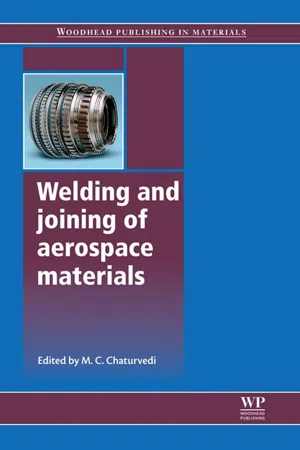
Welding and joining techniques play an essential role in both the manufacture and in-service repair of aerospace structures and components, and these techniques become more advanced as new, complex materials are developed. Welding and joining of aerospace materials provides an in-depth review of different techniques for joining metallic and non-metallic aerospace materials.Part one opens with a chapter on recently developed welding techniques for aerospace materials. The next few chapters focus on different types of welding such as inertia friction, laser and hybrid laser-arc welding. The final chapter in part one discusses the important issue of heat affected zone cracking in welded superalloys. Part two covers other joining techniques, including chapters on riveting, composite-to-metal bonding, diffusion bonding and recent improvements in bonding metals. Part two concludes with a chapter focusing on the use of high-temperature brazing in aerospace engineering. Finally, an appendix to the book covers the important issue of linear friction welding.With its distinguished editor and international team of contributors, Welding and joining of aerospace materials is an essential reference for engineers and designers in the aerospace, materials and welding and joining industries, as well as companies and other organisations operating in these sectors and all those with an academic research interest in the subject.
- Provides an in-depth review of different techniques for joining metallic and non-metallic aerospace materials
- Discusses the important issue of heat affected zone cracking in welded superalloys
- Covers many joining techniques, including riveting, composite-to-metal bonding and diffusion bonding
Information
Subtopic
Industrial EngineeringPart I
Welding techniques
1
New welding techniques for aerospace engineering
R. Freeman, TWI Ltd, UK
Abstract:
Aircraft have been manufactured for decades using a wide variety of welding and joining techniques. There have been significant developments in techniques over the last 15–20 years, and this has also led to the adoption of even more appropriate and stringent non destructive inspection methods. This chapter will focus on examples of how three different welding and joining technologies (friction stir welding, laser-beam welding and laser direct-metal deposition) were developed by large aerospace companies, and approved by the regulatory authorities. The importance of improved non-destructive inspection techniques and the development of international welding standards in maintaining the excellent safety record in the industry will also be highlighted.
Key words
TIG welding
MIG welding
laser-beam welding
friction stir welding
electron-beam welding
direct laser deposition
non-destructive testing
aluminium alloys
titanium alloys
nickel alloys
1.1 Introduction
Aircraft have been manufactured for decades using a wide variety of welding and joining techniques. There have been significant developments in techniques over the last 15–20 years, and this has also led to the adoption of even more appropriate and stringent non-destructive inspection methods.
This chapter will focus on examples of how three different welding and joining technologies were developed by large aerospace companies, and approved by the regulatory authorities. The differing qualification criterion used to develop friction stir welding (FSW), laser-beam welding and laser direct-metal deposition will be referenced. This will be followed by examples of welding and joining technologies that are under development for use in the manufacture of future aircraft. This will include the further development of the FSW of aluminium alloys, linear friction welding and stationary-shoulder FSW of titanium alloys, hybrid laser/arc welding of aluminium alloys, reduced-pressure electron-beam welding (RPEBW) and electron-beam texturing (EBT), reduced-spatter metal inert gas (MIG) welding and further developments in arc welding. A review of some joint failures in the history of aircraft manufacture and the implications on quality control will also be discussed. Finally the importance of improved nondestructive inspection techniques and the development of international welding standards in maintaining the excellent safety record in the industry will be highlighted.
1.2 Airworthiness implications of new welding and joining technologies
To enable a new welding and joining process to be approved for use in the manufacture of parts for a civil aircraft, it is necessary for an Original Equipment Manufacturer (OEM) with a Part 21 approval in Europe ‘Certification of aircraft and related products, parts and appliances and of design and product organisations’ to work with the European Aviation Safety Agency (EASA) to qualify this procedure to the satisfaction of the regulatory authority. In the USA the company would work with the Federal Aviation Administration (FAA) in an identical manner, in accordance with the appropriate specification. The major regulatory authorities have agreements with each other, to allow information on the approval of new designs and manufacturing processes to be shared, so that identical qualification approval tests are not carried out in several different countries.
1.2.1 The use of friction stir welding (FSW) in the Eclipse 500 aircraft
The Eclipse Aviation 500 was a small six-seat business jet aircraft manufactured by Eclipse Aviation, based in Albuquerque, New Mexico, USA. The Eclipse 500 became the first of a new class of very light jets (VLJ) when the first jet was delivered in late 2006. Production of the Eclipse 500 was halted in mid-2008 owing to lack of funding after the delivery of 260 aircraft. The company entered Chapter 11 bankruptcy protection on 25 November 2008, and was then forced into Chapter 7 liquidation on 24 February 2009. The demise of the company was caused by a number of issues, not least of which was the collapse of DayJet, who had 1400 aircraft on order out of a claimed order book of about 2500, representing 58% of all Eclipses ordered. Eclipse Aerospace opened for business in the old Eclipse Aviation facilities on 1 September 2009 with private finance, and is building up towards the production of aircraft again in the near future. Friction stir welding was initially approved by the FAA for the Eclipse 500 aircraft in March 2002, and it was the first civil aircraft to use this technology. Embraer announced in 2010 that they will use FSW to manufacture the forward fuselage panels for the Legacy 500 and 450 aircraft, with an entry into service of 2012.
The Eclipse design was based on the use of FSW to join thin stringers (7055 aluminium alloy) to skin material (2024 aluminium alloy) in a lap configuration, with the main challenges being corrosion protection of the mating surfaces, control of distortion in the thin sheet material and control of interface deformation. Working closely with FAA officers and the South West Research Institute facility, both based in San Antonio, Texas, and the NASA Langley facility in Hampton, Virginia, Eclipse designed a comprehensive test programme to evaluate FSW against riveted aluminium to generate data on static FSW allowables (type I and II), S/N curves (type I, II and III), crack growth (da/dn), corrosion and barrel panel testing (Masefield, 2006,2008).
The tensile strength results of 7055-T76 friction stir welded to 2024-T3 material of 470–480 MPa proved to be higher than the 2024-T3 riveted equivalent of 440 MPa. The fatigue results were also excellent, with tests running to over 4 million cycles without failure at the aircraft operating load levels. A large number of barrel samples were also tested to 8.33 psi simulating cabin pressure at 41 000 feet altitude. Artificially induced cracks of 50.8 mm (2 inches) in length were introduced into certain test panels to look at crack-growth behaviour. The results showed that the first naturally occurring fatigue cracks were detected at 371 000 cycles or 18.5 lifetimes, and the cracks did not stay in the welds and propagated to machined pockets, which was a desirable outcome. The FSW joint performance exceeded design requirements with considerable margin. In addition, a fluorine-based sealant was used between the stringer and skin to protect against crevice corrosion. Trials were carried out to ensure it was possible to friction stir weld through this sealant when making the lap-joint welds.
Welds of 128 m (5040 inches) (263 welds in total) were made per aircraft in the production of the cabin, aft fuselage and wing sections, replacing 6982 rivets. The FSW tools were routinely replaced after 77 m (3000 inches) of welding as part of the total preventative maintenance (TPM) system, even though they were capable of more work. Twenty percent of the welds were inspected by an eddy-current phased-array system, as part of the production process.
1.2.2 The use of laser-beam welding for Airbus aircraft
Initial development work in the early 1990s concentrated on the laser welding of ...
Table of contents
- Cover image
- Title page
- Table of Contents
- Frontmatter
- Copyright
- Contributor contact details
- Preface
- Part I: Welding techniques
- Part II: Other joining techniques
- Appendix: Linear friction welding in aerospace engineering
- Index
Trusted by 375,005 students
Access to over 1.5 million titles for a fair monthly price.
Study more efficiently using our study tools.
Frequently asked questions
Yes, you can cancel anytime from the Subscription tab in your account settings on the Perlego website. Your subscription will stay active until the end of your current billing period. Learn how to cancel your subscription
No, books cannot be downloaded as external files, such as PDFs, for use outside of Perlego. However, you can download books within the Perlego app for offline reading on mobile or tablet. Learn how to download books offline
Perlego offers two plans: Essential and Complete
- Essential is ideal for learners and professionals who enjoy exploring a wide range of subjects. Access the Essential Library with 800,000+ trusted titles and best-sellers across business, personal growth, and the humanities. Includes unlimited reading time and Standard Read Aloud voice.
- Complete: Perfect for advanced learners and researchers needing full, unrestricted access. Unlock 1.5M+ books across hundreds of subjects, including academic and specialized titles. The Complete Plan also includes advanced features like Premium Read Aloud and Research Assistant.
We are an online textbook subscription service, where you can get access to an entire online library for less than the price of a single book per month. With over 1.5 million books across 990+ topics, we’ve got you covered! Learn about our mission
Look out for the read-aloud symbol on your next book to see if you can listen to it. The read-aloud tool reads text aloud for you, highlighting the text as it is being read. You can pause it, speed it up and slow it down. Learn more about Read Aloud
Yes! You can use the Perlego app on both iOS and Android devices to read anytime, anywhere — even offline. Perfect for commutes or when you’re on the go.
Please note we cannot support devices running on iOS 13 and Android 7 or earlier. Learn more about using the app
Please note we cannot support devices running on iOS 13 and Android 7 or earlier. Learn more about using the app
Yes, you can access Welding and Joining of Aerospace Materials by Mahesh Chaturvedi in PDF and/or ePUB format, as well as other popular books in Technology & Engineering & Industrial Engineering. We have over 1.5 million books available in our catalogue for you to explore.