- 440 pages
- English
- ePUB (mobile friendly)
- Available on iOS & Android
eBook - ePub
Building Materials in Civil Engineering
About this book
The construction of buildings and structures relies on having a thorough understanding of building materials. Without this knowledge it would not be possible to build safe, efficient and long-lasting buildings, structures and dwellings. Building materials in civil engineering provides an overview of the complete range of building materials available to civil engineers and all those involved in the building and construction industries.The book begins with an introductory chapter describing the basic properties of building materials. Further chapters cover the basic properties of building materials, air hardening cement materials, cement, concrete, building mortar, wall and roof materials, construction steel, wood, waterproof materials, building plastics, heat-insulating materials and sound-absorbing materials and finishing materials. Each chapter includes a series of questions, allowing readers to test the knowledge they have gained. A detailed appendix gives information on the testing of building materials.With its distinguished editor and eminent editorial committee, Building materials in civil engineering is a standard introductory reference book on the complete range of building materials. It is aimed at students of civil engineering, construction engineering and allied courses including water supply and drainage engineering. It also serves as a source of essential background information for engineers and professionals in the civil engineering and construction sector.
- Provides an overview of the complete range of building materials available to civil engineers and all those involved in the building and construction industries
- Explores the basic properties of building materials featuring air hardening cement materials, wall and roof materials and sound-absorbing materials
- Each chapter includes a series of questions, allowing readers to test the knowledge they have gained
Information
Subtopic
Civil Engineering1
Introduction
This chapter focuses on the classifications and the technical standards of building materials; it summarizes the characteristics of building materials and their status in construction engineering briefly; and also it introduces the development of building materials.
1.1 Definitions and Classifications of Building Materials
In the general environment for humans’ survival, all the materials or products used in structures or buildings are called building materials which are the material foundation for all the construction engineering. The building materials discussed in this course are all the materials used in building foundations, bases, floors, walls, beams, plates, roofs and architectural decoration.
There is a wide variety of building materials. They are usually classified from different angles for the sake of study, application and description. The most common classifications are based on their chemical components and functions.
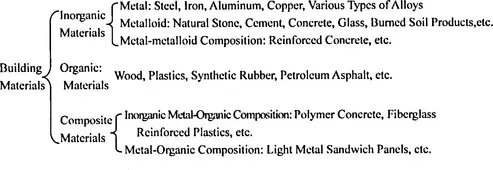
1) According to the chemical components of building materials, they can be classified into inorganic materials, organic materials and composite materials, as follows:
2) According to the functions of materials, they can be divided into structural materials and functional materials:
Structural Materials: mainly used as load-bearing members, such as the materials used for beams, plates and columns.
Functional Materials: mainly possessing some special functions in construction, such as waterproof, ornamental and heat-insulating functions, etc.
1.2 Characteristics of Building Materials and Their Status in Architecture
Building materials are the material foundation for all the construction engineering. Building materials industry which is one of the important basic industries of national economy promotes the development of the construction industry.
Various buildings and structures are constructed by all kinds of building materials on the basis of reasonable design. The varieties, specifications and qualities of building materials are directly related to the applicability, artistry and durability of buildings and also to the cost of projects. A large number of high-quality industrial and civil buildings need to be built for the development of society. Meanwhile, a great deal of water conservancy projects, traffic engineering and port projects need to be built to adapt to the rapid development of the national economy. It requires lots of high-quality building materials which accords with the application environment of projects. Therefore, building materials industry is usually considered as the basic industry for the construction engineering.
Building materials not only have a large consumption, but also are expensive. In the total cost of the construction, the cost of building materials often accounts for about 50 percent. Thus, it is significant to properly choose and reasonably utilize building materials in the construction for the reduction of costs and the improvement of investment benefits.
A large number of new building materials continue to emerge, often promoting the innovation and development of construction techniques. For example, the emergence of clay bricks contributes to the brick-timber structure; the reinforced concrete structure comes from concrete and steel bar; light high-strength materials promote the development of modern buildings and high-rise buildings; the application of various functional materials in the construction industry continues to create diversified comfortable living and production environment and to conserve energy.
In short, the application of building materials in the projects must possess the following characteristics: the function required by projects, the durability proper for the environmental conditions, the rich resources to meet the needs of construction, and low price.
In the building environment, the ideal building materials should be light, high-strength, aesthetic, heat-insulating, sound-absorbing, waterproof, shockproof, fireproof, non-toxic, and efficient, etc.
1.3 The Development of Building Materials
Various building materials form the living environment of human beings, which reflects the cultural and scientific features of each era, becoming an important symbol of humans’ material civilization.
Building materials develop with the improvement of the productivity and living standards. In the early age, human beings inhabited “cave dwelling”. After the Iron Age, they began digging, chipping and logging with simple tools to build shabby houses by natural materials; and with the use of fire, people learned how to burn bricks, tiles and limes, in which way building materials entered the artificial production stage. In 18th and 19th century, steel, cement, concrete and reinforced concrete continuously emerged with the rise of capitalism, the rapid development and the improve of traffic, which pushed building materials into a new stage of development.
Since the 20th century, the formation and development of material science and engineering had contributed to not only the improvement of building materials in function and quality, but also the varieties. Some new building materials with special functions came into being, such as heat-insulating materials, sound-absorbing materials, ornamental materials, heat-resistant and waterproof materials, impermeable materials and wear-resistant, corrosion-resistant, and explosion-proof, and anti-radiation materials, etc. In the second half of the 20th century, building materials evolved towards light, high-strength and functional direction.
In the new century, as humans’ awareness of environmental protection has been strengthened, non-toxic and pollution-free “Green Building Materials” are recommended increasingly and human beings can build their own “Green Home” with new building materials.
1.4 The Introduction of Building Materials’ Technical Standards
The implementing standards should be established for the various techniques of material products because of the scientific management of the modern material production.
Product Standards are the standards established for products to meet some or all the requirements in order to guarantee the applicability of products. They generally includes product specifications, classifications, technical functions, testing methods, rules of inspection and acceptance, packaging, storage, transport and others. For example, cement, ceramic and steel have their own product standards.
Building Material Standards are the technical foundations for the inspection of product quality and the bases for the acceptance of product quality referred to by both sides of supply and demand. The structure designs and construction techniques can be standardized accordingly by the reasonable selection of materials in the construction engineering, which will accelerate the construction and maximize the benefit of the engineering practice.
Recently, there are three categories used in China, as follows:
(1) National Standards
National Standards include mandatory standards (code-named GB), and recommendatory standards (code-named GB / T).
(2) Industry Standards
Industry Standards include the construction industry standards (code-named JGJ), building material industry standards (code-named JC), metallurgical industry standards (code-named YB) and transport industry standards (code-named JT) and so on.
(3) Regional Standards (code-named DBJ) and Enterprise Standards (code-named QB)
The expression of regional standards includes the standard name, the department code, the serial number and the year of approval. For example:
The National Standard (Mandatory), The Hot-rolled Ribbed Steel Bars for the Reinforced Concrete (GB 1499-1998).
The National Standard (Recommendatory), The Decarbonized Hot-rolled Round Coiled Bar (GB/T701-1997).
The Construction Industry Standard, The Design Regulation of Common Concrete Mix Proportion (JGJ55-2000).
The Construction Industry Standard, The Technical Specification of Concrete Structures with Cold-rolled Ribbed Steel Bars (JGJ95-2003).
The Regional Standard of Hebei Province, The Technical Specification for the Application of Modified Gypsum Heat-insulating Mortar [DB13/T(J) 25-2000].
The mandatory standards indicate that any technique (or product) should not fall below the requirements; the recommendatory standards indicate that other standa...
Table of contents
- Cover image
- Title page
- Table of Contents
- Copyright
- Preface
- Chapter 1: Introduction
- Chapter 2: The Basic Properties of Building Materials
- Chapter 3: Air Hardening Binding Materials
- Chapter 4: Cement
- Chapter 5: Concrete
- Chapter 6: Building Mortar
- Chapter 7: Wall and Roof Materials
- Chapter 8: Construction Steel
- Chapter 9: Wood
- Chapter 10: Waterproof Materials
- Chapter 11: Building Plastic
- Chapter 12: Heat-insulating Materials and Sound-absorbing Materials
- Chapter 13: Finishing Materials
- Tests of Building Materials
- Index
Trusted by 375,005 students
Access to over 1.5 million titles for a fair monthly price.
Study more efficiently using our study tools.
Frequently asked questions
Yes, you can cancel anytime from the Subscription tab in your account settings on the Perlego website. Your subscription will stay active until the end of your current billing period. Learn how to cancel your subscription
No, books cannot be downloaded as external files, such as PDFs, for use outside of Perlego. However, you can download books within the Perlego app for offline reading on mobile or tablet. Learn how to download books offline
Perlego offers two plans: Essential and Complete
- Essential is ideal for learners and professionals who enjoy exploring a wide range of subjects. Access the Essential Library with 800,000+ trusted titles and best-sellers across business, personal growth, and the humanities. Includes unlimited reading time and Standard Read Aloud voice.
- Complete: Perfect for advanced learners and researchers needing full, unrestricted access. Unlock 1.5M+ books across hundreds of subjects, including academic and specialized titles. The Complete Plan also includes advanced features like Premium Read Aloud and Research Assistant.
We are an online textbook subscription service, where you can get access to an entire online library for less than the price of a single book per month. With over 1.5 million books across 990+ topics, we’ve got you covered! Learn about our mission
Look out for the read-aloud symbol on your next book to see if you can listen to it. The read-aloud tool reads text aloud for you, highlighting the text as it is being read. You can pause it, speed it up and slow it down. Learn more about Read Aloud
Yes! You can use the Perlego app on both iOS and Android devices to read anytime, anywhere — even offline. Perfect for commutes or when you’re on the go.
Please note we cannot support devices running on iOS 13 and Android 7 or earlier. Learn more about using the app
Please note we cannot support devices running on iOS 13 and Android 7 or earlier. Learn more about using the app
Yes, you can access Building Materials in Civil Engineering by Haimei Zhang in PDF and/or ePUB format, as well as other popular books in Technology & Engineering & Civil Engineering. We have over 1.5 million books available in our catalogue for you to explore.