
- 106 pages
- English
- ePUB (mobile friendly)
- Available on iOS & Android
eBook - ePub
Healthcare Emergency Incident Management Operations Guide
About this book
Healthcare Emergency Incident Management Operations Guide offers healthcare personnel a quick and intuitive guide to preparing for, responding to and recovering from events which have the potential to impact their operations. The recently updated Centers for Medicaid & Medicare Services (CMS) rules for emergency preparedness added 10-15 new healthcare organizations into the mix that require emergency preparedness efforts.
The Hospital Incident Command System (HICS) is a good tool for event management but, like all tools, it requires practice. Many hospital personnel take online ICS courses and rarely practice enough to be proficient. This is a comprehensive guide to the HICS and can be referenced during initial and refresher training as well as during event management.
- Covers how to utilize the Hospital incident Command System (HICS) and Incident Action Planning (IAP) processes
- Includes Initial Incident Action Plan considerations for common disaster events
- Features exercises for initial and refresher training
Information
Print ISBN
9780128131992
Subtopic
Scienze ambientaliChapter 1
Overview of National Incident Management System and Hospital Incident Command System
Abstract
This chapter provides a high-level review of the evolution of the National Incident Management System (NIMS). Included with this review is a look at the requirements for healthcare organization to adopt and use NIMS and suggestions for compliance. The Hospital Incident Command System (HICS) is examined followed by the Incident Command System (ICS). Within the chapter the key characteristics and features of ICS are reviewed. Within the chapter a case for adopting ICS rather than HICS for healthcare organizations is explored.
Keywords
Incident Command System (ICS); National Incident Management System (NIMS); emergency management; Hospital Incident Command System (HICS)
National Incident Management System
On September 11, 2001, 19 militants associated with the Islamic extremist group al-Qaeda hijacked four airliners and carried out suicide attacks against targets in the United States. Within 2 weeks, Pennsylvania Governor Tom Ridge was appointed as the first Director of the Office of Homeland Security and brought the Department of Homeland Security (DHS) to life within a year. Today, there are over 240,000 DHS employees. The DHS trails only the Department of Defense and Department of Veteran Affairs in sheer size.
Director Ridge was tasked to develop, among other things, a National Incident Management System (NIMS). The goal was to provide a consistent nationwide approach for Federal, State, and local governments to prepare, respond, and recover from incidents impacting the homeland.
In 2005, to add some teeth into NIMS, Federal agencies made adoption of the NIMS a requirement for providing Federal preparedness assistance through grants or contracts. Organizations that accept Federal grants across the country officially adopted NIMS in some type of proclamation or declaration. No one wanted to lose the access to grant dollars. If only this new level of coordination was so simple.
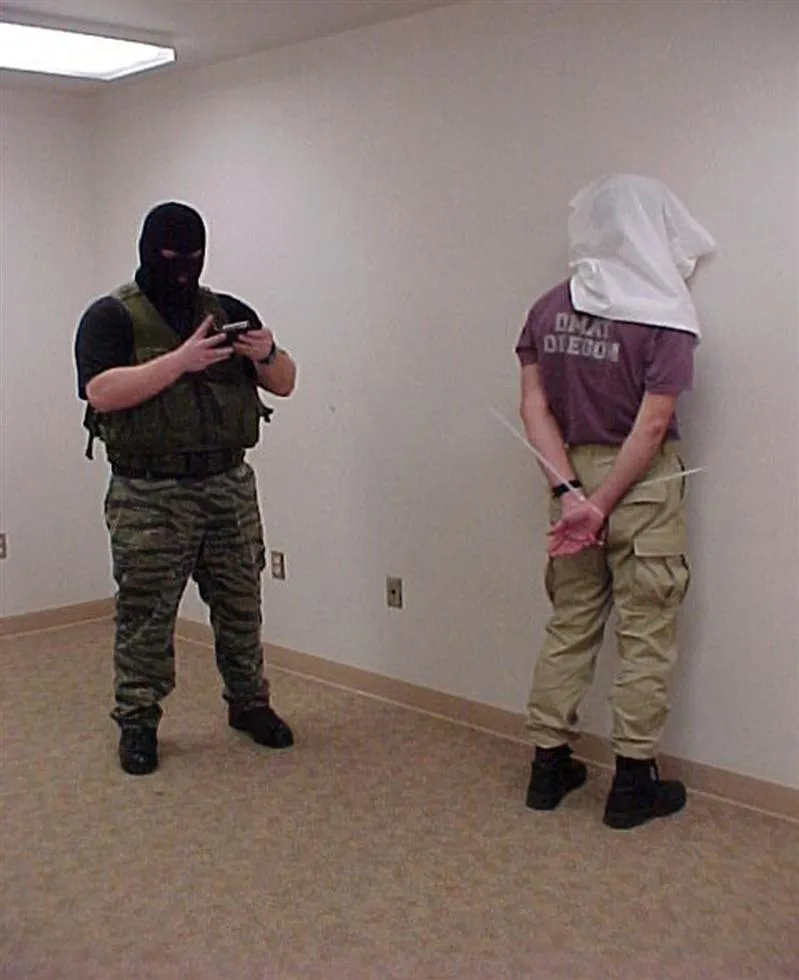
The first problem with NIMS resolution adoption activity? Agencies and organizations who claim to be NIMS compliant often fail to institutionalize the components of the NIMS much less use these components when they are needed. They set themselves up for a fall. NIMS implies that these organizations will use the Incident Command System (ICS) to manage a major event. If there is a bad outcome and it is determined that failure to use the ICS was a contributing factor, it may expose organizations to litigation, fines, and review of any federal funding that is been received (Fig. 1.1).
The second problem with NIMS is that the initial management of any event is handled at the local level where NIMS adoption is lower. When an event gets big enough to exceed local or even state capabilities and more assistance is needed, then the federal government comes into help using NIMS. Sometimes the arrival of the cavalry results in a local incident management system that faces a whole new set of challenges.
Incident Command System
The ICS is a key feature of the NIMS.
With every major event, we seem to have the same problems when it comes to managing the consequences. The 1993 World Trade Center attack, 1995 bombing at the Alfred P. Murrah Federal Building in Oklahoma City, 2001 World Trade Center attack, Hurricane Katrina in 2005, and Hurricane Sandy in 2012 each faced issues with:
• command and control
• communications
• resource management
It should come as no surprise that the ICS was selected to be a key component of NIMS. The ICS is all about command and control, communications, and resource management.
NIMS does not tell an Incident Commander (IC) what that the organizational structure should look like, what the IC should try to achieve, or how to go about it. But with preplanning, it is possible to develop a guide that will help an IC to get an event organized in the early, critical moments. If you are interested in these plans, flip ahead to Chapter 10, Hospital Incident Command System Initial Incident Action Plan Library for Common Events, to review a library of guides. These can be customized for use by your organization. The ICS is a management tool with some absolutes but a great deal of flexibility for events that are simple to complex, planned and unplanned, small or large (Fig. 1.2).
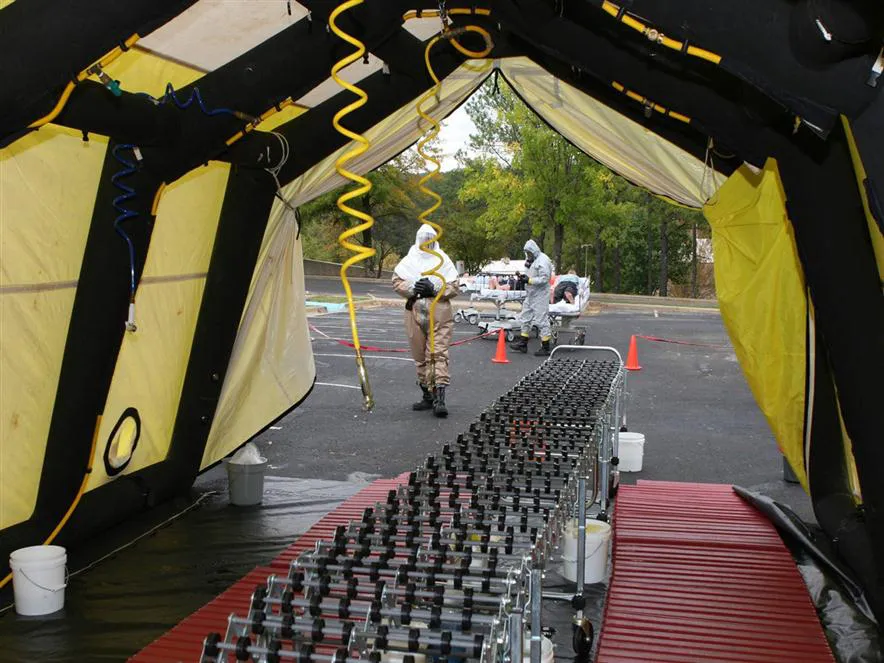
By using the ICS for scheduled events, you will gain the experience and skills needed to confront an emergency. Soon, you will quickly identify the best way to go about getting the first operational period organized and underway.
We are supposed to use the ICS in order to be NIMS compliant, but this does not mean everyone must operate under one massive umbrella. ICS is based on the premise that if the IC opens a new function, it needs to be staffed by someone trained and competent in carrying out the duties of that function. The larger you build your structure, the greater the need for trained incident management personnel.
So, who needs to be trained and how many people should be involved? A small organization might imagine that it can get by with minimal training. That is not quite the case. The following chart lists the baseline ICS courses up to the ICS 200. Advanced training is a term given to the ICS 800, ICS 300, and ICS 400 (Fig. 1.3).
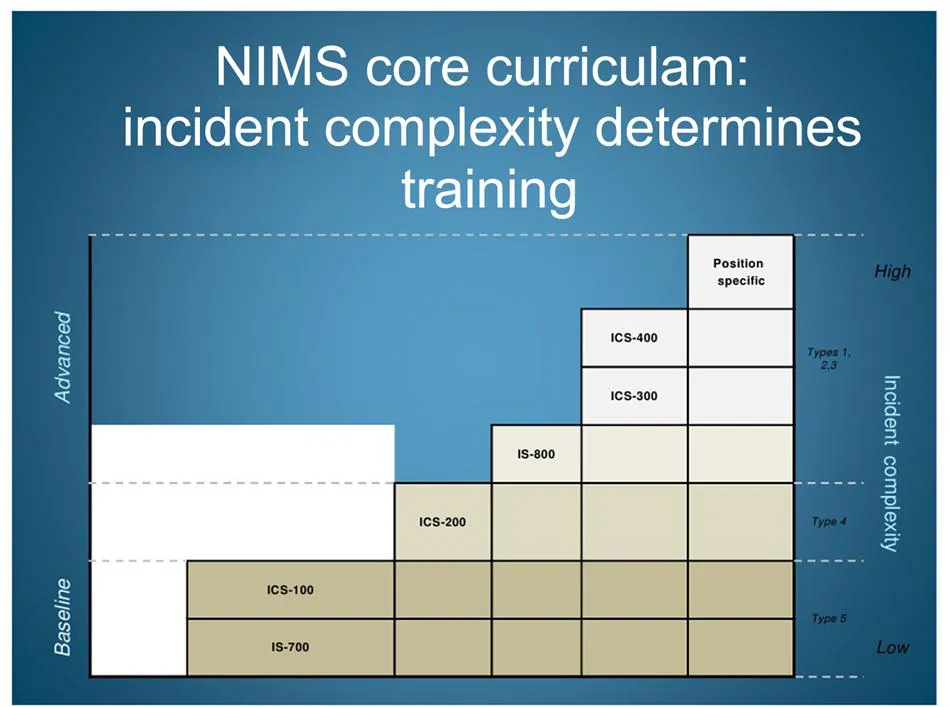
The need for the advanced training courses is based on the complexity of the incident an organization can reasonably expect to see. The next chart explains the different incident complexity levels. Even though you may have a small organization, if you are at risk for a Type 1, 2, or 3 event, you will need to obtain the more advanced ICS education (Fig. 1.4).

The incident complexity level is a great way for an organization to capture in policy when to expect the ICS to be used and to what extent, e.g., require a written Incident Action Plan (IAP) for any Type 3 event or higher in complexity. You can then go on to describe examples of each complexity level in your own words to make it easier to train personnel when to recognize each level. I always help my clients clearly articulate these levels and put it in policy that the ICS will be used. It helps ensure an organization will be NIMS compliant in deed and not just in words.
In addition to allowing a customized organizational structure to be built the ICS also guides the process of planning. One of the issues with the current ICS course objectives is that students do not receive any depth of information on the ICS planning process until the ICS 300 level. I introduced the planning process in my advanced Hospital Incident Command System (HICS) courses years ago to address this deficiency. In Chapter 9, Incident Action Planning Process, I will offer the reader everything you need to know to understand this key feature of the ICS.
The ICS can be used by all levels of government, public and private organizations, and any volunteer group that wants to be more efficient in their operations. The ICS has six functional areas: command, operations, planning, logistics, finance/administration, and intelligence/investigations. The Intelligence/Investigation section is a relatively new addition to the traditional ICS structure. This section has a good deal of flexibility in where it can be placed in the organizational chart—I will address that in more detail in Chapter 7, Intelligence/Investigations. There are no rules as to how many functions need to be open. The organizational structure should be tailored to the event.
Hospital Incident Command System
The ICS was developed in the 1970s following a series of catastrophic fires in California’s urban interface. Property damage ran into the millions, and many people died or were injured. The ICS met the needs of the fire-fighting community, which was reasonable. However, spreading the use of ICS outside of that application caused confusion. Initial ICS courses were taught by fire personnel since they had the most experience using the tool. Unfortunately the material was not always presented as discipline blind and was heavily skewed toward a fire or hazardous materials world. This created some doubt as to whether to use the ICS among nonfire organizations.
The California Emergency Medical Services Authority first released the Hospital Emergency Incident Command System (HEICS), in the late 1980s. The intent was to present the ICS with a hospital focus. They have revised this system a number of times—the latest in 2014. Job action sheets for every imaginable position that might be needed in the hospital environment were created. Part of the idea behind developing these job action sheets was to allow a just-in-time utilization by hospital staff as most do not use the ICS daily like fire service personnel do. While the job task sheets, along with the incident planning guides and incident response guides, that were developed can be useful tools, most will need to customize them for an organization.
The difficulty with the job action sheet concept is that the ICS is built on the premise that personnel assigned to any specific functional area have been trained in how to perform the duties associated with that function. Imagine a trauma team activation is called at your hospital. Instead of each person arriving to perform specific duties based upon their skill set, you hand out job action sheets based on the order they enter the Emergency Department. The first person to arrive will be the anesthesiologist, the second the trauma surgeon, followed by imaging, and then the trauma nurse. Instead of assigning everyone to known and understood responsibilities the attention is placed on unfamiliar job action sheets. Throw in foreign-looking HICS forms and make staff wear a colored vest so everyone by function, and you will have a recipe for chaos. I know a number of my readers are laughing—they have been there, done that. The point is that positions on your Incident Management Team are just as important as those on your...
Table of contents
- Cover image
- Title page
- Table of Contents
- Copyright
- Dedication
- Introduction
- Chapter 1. Overview of National Incident Management System and Hospital Incident Command System
- Chapter 2. Command and Unified Command
- Chapter 3. The Operations Section
- Chapter 4. The Planning Section
- Chapter 5. The Logistics Section
- Chapter 6. The Finance/Administration Section
- Chapter 7. Intelligence/Investigations
- Chapter 8. Area Command
- Chapter 9. Incident Action Planning Process
- Chapter 10. Hospital Incident Command System Initial Incident Action Plan Library for Common Events
- Additional Reading
Trusted by 375,005 students
Access to over 1.5 million titles for a fair monthly price.
Study more efficiently using our study tools.
Frequently asked questions
Yes, you can cancel anytime from the Subscription tab in your account settings on the Perlego website. Your subscription will stay active until the end of your current billing period. Learn how to cancel your subscription
No, books cannot be downloaded as external files, such as PDFs, for use outside of Perlego. However, you can download books within the Perlego app for offline reading on mobile or tablet. Learn how to download books offline
Perlego offers two plans: Essential and Complete
- Essential is ideal for learners and professionals who enjoy exploring a wide range of subjects. Access the Essential Library with 800,000+ trusted titles and best-sellers across business, personal growth, and the humanities. Includes unlimited reading time and Standard Read Aloud voice.
- Complete: Perfect for advanced learners and researchers needing full, unrestricted access. Unlock 1.5M+ books across hundreds of subjects, including academic and specialized titles. The Complete Plan also includes advanced features like Premium Read Aloud and Research Assistant.
We are an online textbook subscription service, where you can get access to an entire online library for less than the price of a single book per month. With over 1.5 million books across 990+ topics, we’ve got you covered! Learn about our mission
Look out for the read-aloud symbol on your next book to see if you can listen to it. The read-aloud tool reads text aloud for you, highlighting the text as it is being read. You can pause it, speed it up and slow it down. Learn more about Read Aloud
Yes! You can use the Perlego app on both iOS and Android devices to read anytime, anywhere — even offline. Perfect for commutes or when you’re on the go.
Please note we cannot support devices running on iOS 13 and Android 7 or earlier. Learn more about using the app
Please note we cannot support devices running on iOS 13 and Android 7 or earlier. Learn more about using the app
Yes, you can access Healthcare Emergency Incident Management Operations Guide by Jan Glarum in PDF and/or ePUB format. We have over 1.5 million books available in our catalogue for you to explore.