eBook - ePub
Postharvest Biology and Technology of Tropical and Subtropical Fruits
Fundamental Issues
- 534 pages
- English
- ePUB (mobile friendly)
- Available on iOS & Android
eBook - ePub
Postharvest Biology and Technology of Tropical and Subtropical Fruits
Fundamental Issues
About this book
Tropical and subtropical fruits are popular products, but are often highly perishable and need to be transported long distances for sale. The four volumes of Postharvest biology and technology of tropical fruits review essential aspects of postharvest biology, postharvest technologies, handling and processing technologies for both well-known and lesser-known fruits. Volume 1 contains chapters on general topics and issues, while Volumes 2, 3 and 4 contain chapters focused on individual fruits, organised alphabetically.Volume 1 provides an overview of key factors associated with the postharvest quality of tropical and subtropical fruits. Two introductory chapters cover the economic importance of these crops and their nutritional benefits. Chapters reviewing the postharvest biology of tropical and subtropical fruits and the impact of preharvest conditions, harvest circumstances and postharvest technologies on quality follow. Further authors review microbiological safety, the control of decay and quarantine pests and the role of biotechnology in the improvement of produce of this type. Two chapters on the processing of tropical and subtropical fruit complete the volume.With its distinguished editor and international team of contributors, Volume 1 of Postharvest biology and technology of tropical and subtropical fruits, along with the other volumes in the collection, will be an essential reference both for professionals involved in the postharvest handling and processing of tropical and subtropical fruits and for academics and researchers working in the area.
- Along with the other volumes in the collection, Volume 1 is an essential reference for professionals involved in the postharvest handling and processing of tropical and subtropical fruits and for academics and researchers working in the area
- Focuses on fundamental issues of fruit physiology, quality, safety and handling relevant to all those in the tropical and subtropical fruits supply chain
- Chapters include nutritional and health benefits, preharvest factors, food safety, and biotechnology and molecular biology
Information
Subtopic
Industria agricola1
Economic importance of tropical and subtropical fruits
Z. Mohamed, I. AbdLatif and A. Mahir Abdullah, University of Putra Malaysia, Malaysia
Abstract:
Asian countries are among the largest producers of tropical and subtropical fruits in the world. The top five tropical and subtropical fruits in terms of production volume are watermelon, orange, grape, banana and tangerine/mandarin. China is the largest producer of watermelon, Brazil of oranges, Italy of grapes and India of bananas. Most of the fruits are consumed as food in fresh and processed form. EU countries are the main destination for tropical and subtropical fruits, consuming nearly 50% of the total world export, while also supplying temperate and subtropical fruits to the global fruits market. The importance of fruit production for the economic development of a country can be seen in its contribution to the gross domestic product (GDP) and employment through agriculture. Most less-developed countries depend on agriculture as a major source of income and employment. Price demand elasticities for most fruits are elastic.
Key words
tropical
subtropical fruits
producers
GDP
employment
consumption
elasticities
prices
1.1 Introduction
There are a very large number of different tropical and subtropical fruits, yet only 50 or so are well known in most parts of the world (Martin et al., 1987). The estimated gap between world per capita consumption (54.9 kg per year) and estimated consumption saturation (100 to 120 kg per year) is considerable (TFNet, 2003). According to Galán Saúco (1996) and Katz et al. (2003), tropical and subtropical fruit can be divided into three groups based on production and trade figures, (with some overlap between categories). The first group, ‘major fruits’, include crops such as banana and plantain, citrus, coconut, mango and pineapple. These are cultivated in most tropical and subtropical countries and are found in international markets as well as local ones. The next group, ‘minor fruits’ (e.g. avocado, breadfruit, carambola, cashew nut, durian, guava, jackfruit, litchi, macadamia, mangosteen, papaya, passion fruit, sapodilla and soursop) are not cultivated as extensively. Trade in these crops (and therefore also consumption) is likely to be less widespread, both geographically and quantitatively. Nevertheless, some of these minor fruits, such as carambola, durian and mangosteen from South-East Asia are of considerable economic significance in regional markets (Anang and Chan, 1999). The last group, ‘wild fruits’, are not cultivated commercially. They come from various botanical families and have generally not been well characterized (Katz et al., 2003).
1.2 World fruit production and contribution to gross domestic product (GDP)
1.2.1 Global production of tropical and subtropical fruits
According to the world food balance sheets published by the Food and Agriculture Organization (FAO), the total world fruit supply in 2005 was 517 million tonnes. It comprised 514 million tonnes of fruit production, 107 million tonnes of imports and 106 million tonnes of exports (stock variations accounted for 2 million tonnes). Asia contributed 46% of the total world fruit production, while the Americas contributed 26%. Europe, Africa and Oceania held 14%, 13% and 1% of the share of world fruit production in 2005, respectively (Fig. 1.1) (FAOSTAT, 2008).
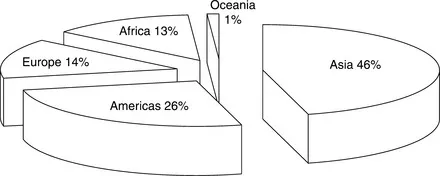
Fig. 1.1 World fruit production share by continent.
The total world production for the ten most popular fruit types in 2008 was over 431 million tonnes. As shown in Fig. 1.2, watermelons, bananas, grapes, oranges, mangoes and tangerines are among the most produced around the globe. Other important fruits include pineapples, papayas, other citrus fruits and dates (FAOSTAT 2008).
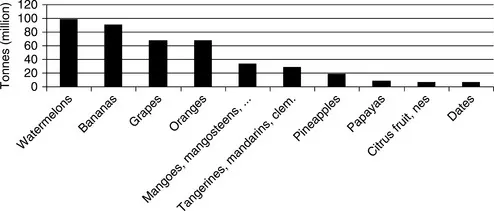
Fig. 1.2 World production of selected tropical fruits.
World fruit production has increased over the years. There has been an increase of 17% for the ten fruit types for the past five years, as shown in Table 1.1. The production increase was a response from producers to the general increase in demand for tropical and subtropical fruits worldwide. As illustrated in Fig. 1.3, higher production growth was observed for bananas and watermelons, in contrast to a lower growth rate for grapes and oranges from 2003 to 2008. The nature of the crops in question could account for this: short-term crops such as banana and watermelon can respond quickly to increased demand, while longer-term crops such as grapes and oranges cannot.
Table 1.1
World tropical and subtropical fruit production by fruit types (tonnes), 2003-2008
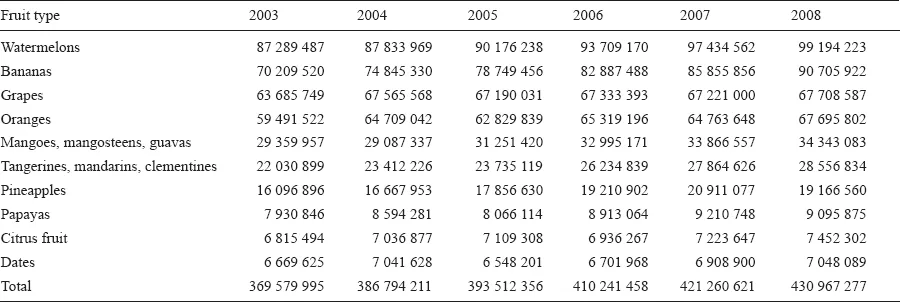
Source: FAOSTAT (2008)
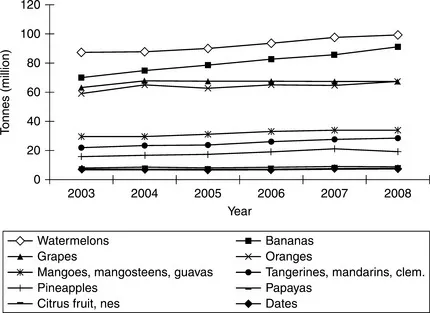
Fig. 1.3 Production trends for ten most popular fruits.
Tables 1.2 to 1.5 illustrate the main fruit producing countries by fruit types. The tables show that Chin...
Table of contents
- Cover image
- Title page
- Table of Contents
- Copyright
- Contributor contact details
- Woodhead Publishing Series in Food Science, Technology and Nutrition
- Dr Adel Kader
- Foreword
- Preface
- Chapter 1: Economic importance of tropical and subtropical fruits
- Chapter 2: Nutritional and health-promoting properties of tropical and subtropical fruits
- Chapter 3: Postharvest biology of tropical and subtropical fruits
- Chapter 4: Preharvest and harvest factors infl uencing the postharvest quality of tropical and subtropical fruits
- Chapter 5: Postharvest technologies to maintain the quality of tropical and subtropical fruits
- Chapter 6: Postharvest pathology of tropical and subtropical fruit and strategies for decay control
- Chapter 7: Quarantine pests of tropical and subtropical fruits and their control
- Chapter 8: Microbial safety of tropical and subtropical fruits
- Chapter 9: Biotechnology and molecular biology of tropical and subtropical fruits
- Chapter 10: Fresh-cut tropical and subtropical fruit products
- Chapter 11: Preservation and processing of tropical and subtropical fruits
- Index
Trusted by 375,005 students
Access to over 1.5 million titles for a fair monthly price.
Study more efficiently using our study tools.
Frequently asked questions
Yes, you can cancel anytime from the Subscription tab in your account settings on the Perlego website. Your subscription will stay active until the end of your current billing period. Learn how to cancel your subscription
No, books cannot be downloaded as external files, such as PDFs, for use outside of Perlego. However, you can download books within the Perlego app for offline reading on mobile or tablet. Learn how to download books offline
Perlego offers two plans: Essential and Complete
- Essential is ideal for learners and professionals who enjoy exploring a wide range of subjects. Access the Essential Library with 800,000+ trusted titles and best-sellers across business, personal growth, and the humanities. Includes unlimited reading time and Standard Read Aloud voice.
- Complete: Perfect for advanced learners and researchers needing full, unrestricted access. Unlock 1.5M+ books across hundreds of subjects, including academic and specialized titles. The Complete Plan also includes advanced features like Premium Read Aloud and Research Assistant.
We are an online textbook subscription service, where you can get access to an entire online library for less than the price of a single book per month. With over 1.5 million books across 990+ topics, we’ve got you covered! Learn about our mission
Look out for the read-aloud symbol on your next book to see if you can listen to it. The read-aloud tool reads text aloud for you, highlighting the text as it is being read. You can pause it, speed it up and slow it down. Learn more about Read Aloud
Yes! You can use the Perlego app on both iOS and Android devices to read anytime, anywhere — even offline. Perfect for commutes or when you’re on the go.
Please note we cannot support devices running on iOS 13 and Android 7 or earlier. Learn more about using the app
Please note we cannot support devices running on iOS 13 and Android 7 or earlier. Learn more about using the app
Yes, you can access Postharvest Biology and Technology of Tropical and Subtropical Fruits by Elhadi M. Yahia in PDF and/or ePUB format, as well as other popular books in Tecnologia e ingegneria & Industria agricola. We have over 1.5 million books available in our catalogue for you to explore.