eBook - ePub
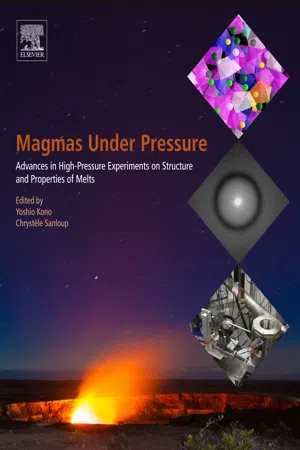
Magmas Under Pressure
Advances in High-Pressure Experiments on Structure and Properties of Melts
- 514 pages
- English
- ePUB (mobile friendly)
- Available on iOS & Android
eBook - ePub
Magmas Under Pressure
Advances in High-Pressure Experiments on Structure and Properties of Melts
About this book
Magmas under Pressure: Advances in High-Pressure Experiments on Structure and Properties of Melts summarizes recent advances in experimental technologies for studying magmas at high pressures. In the past decade, new developments in high-pressure experiments, particularly with synchrotron X-ray techniques, have advanced the study of magmas under pressure. These new experiments have revealed significant changes of structure and physical properties of magmas under pressure, which significantly improves our understanding of the behavior of magmas in the earth's interior.
This book is an important reference, not only in the earth and planetary sciences, but also in other scientific fields, such as physics, chemistry, material sciences, engineering and in industrial applications, such as glass formation and metallurgical processing.
- Includes research and examples of high-pressure technologies for studying the structure and properties of magma
- Summarizes the current knowledge on the structure and properties of high-pressure magma
- Highlights the importance of magma in understanding the evolution of the earth's interior
Information
Topic
Scienze fisicheSubtopic
Geologia e scienze della terraPart 1
Magmas in the Earth's Interior
Chapter 1
Primary Melt Compositions in the Earth's Mantle
Stephen F. Foley, and Zsanett Pintér Macquarie University, Sydney, NSW, Australia
Abstract
Primary melts are the melt compositions in equilibrium with their source at the time of extraction from that source. Many mantle-derived melts are derived chiefly from peridotite, but have additional components in the source that originate as recycled crust and sediments, or as ultramafic rocks formed by solidification of migrating mantle melts. Most melts originate between 40 and 120 km depth, with exceptions up to 250 km, particularly around and beneath cratons, where fluxed by volatile components. Melts of dry peridotite are varieties of basalt with increasing MgO and alkalies toward high pressures: they range from picrite and komatiite at high degrees of melting to basanite and nephelinite at small melt fractions. More alkaline compositions, including melilitite, kimberlite, lamprophyre, and carbonatite, require H2O and CO2 in the source. Water promotes melts richer in silica than basalt, whereas CO2 causes SiO2-poor melts. At high pressures, primary melts may be transitional between silicate and carbonate melt compositions. Volatile components depress the melting point of peridotite by 150–400°C relative to dry melting conditions, and melting in oxidized conditions occurs at lower temperatures than in reduced conditions or with H2O alone. Incipient melts are widespread, universal precursors to more voluminous melt production and cause modification and evolution of the lithosphere.
Keywords
CO2; H2O; Mantle; Primary melts; Redox; Volatile components
1. Introduction
The term primary magma has a long history that predates the advent of high-pressure equipment to study the melting of mantle rocks. At the time of the introduction of the end-loaded piston–cylinder apparatus (Boyd and England, 1958), which initiated abundant experimental studies of mantle melting, Turner and Verhoogen (1960) lamented that the term primary magma was “frequently used but seldom defined.” This haziness remained through the 1960s, with imprecise definitions such as “partial melting of the mantle, yielding primary magmas” (O'Hara, 1965), and “liquids formed by processes of partial melting or complete melting of mantle rock” (Green and Ringwood, 1967), which “moved to the surface without further modification” (Thompson, 1974). Presnall's (1979) simple formulation would be acceptable for almost all petrologists: “primary magma will refer to a magma as it exists immediately after separation from its source region.” Here, we refine this by explicitly including a requirement expedient for experimental petrologists, and which they have followed implicitly for years (Wyllie, 1987)—namely, equilibrium: a primary melt is the melt composition in equilibrium with its source at the time of extraction from that source. This is distinct from a parental melt, which is the starting point for an observed crystal fractionation series, but need not be primary, and from a primitive melt, which may have been modified since extraction from its source. Note that the emphasis of these definitions is on the melts' unmodified, pristine state rather than on the identity of the mantle rock that melts: most experimental studies assume the mantle to be a simple, four-phase peridotite consisting of olivine, orthopyroxene, clinopyroxene, and an aluminous phase: garnet, spinel, or plagioclase depending on pressure.
Partial melting on the modern Earth is almost entirely restricted to a magmatic zone between 40 and about 250 km depth. Most melting occurs in the uppermost 140 km, ranging from decompression melting beneath midocean ridges to picrites in large igneous provinces. Melting deeper than 140 km occurs only where promoted by volatile components. The scope of this chapter is restricted to melting of the mantle with and without volatile components: we do not consider melting deeper than 250 km (see Chapters 2 and 4), major melting on the hot early Earth, or details of melting in subduction zones (Chapter 3).
First H2O, and later CO2, were added to peridotite melting studies, whereas reduced conditions in which H2O + CH4 fluids are stable remain little studied. Volatiles have two important effects: firstly a strong depression of melting temperatures, which results in a broad incipient melting regime (Green and Falloon, 1998), ...
Table of contents
- Cover image
- Title page
- Table of Contents
- Copyright
- List of Contributors
- Preface
- Part 1. Magmas in the Earth's Interior
- Part 2. Advances in Experimental Studies of Melts at High Pressures
- Part 3. Current Knowledge on Structure and Properties of Magmas Under Pressure
- Author Index
- Subject Index
Trusted by 375,005 students
Access to over 1.5 million titles for a fair monthly price.
Study more efficiently using our study tools.
Frequently asked questions
Yes, you can cancel anytime from the Subscription tab in your account settings on the Perlego website. Your subscription will stay active until the end of your current billing period. Learn how to cancel your subscription
No, books cannot be downloaded as external files, such as PDFs, for use outside of Perlego. However, you can download books within the Perlego app for offline reading on mobile or tablet. Learn how to download books offline
Perlego offers two plans: Essential and Complete
- Essential is ideal for learners and professionals who enjoy exploring a wide range of subjects. Access the Essential Library with 800,000+ trusted titles and best-sellers across business, personal growth, and the humanities. Includes unlimited reading time and Standard Read Aloud voice.
- Complete: Perfect for advanced learners and researchers needing full, unrestricted access. Unlock 1.5M+ books across hundreds of subjects, including academic and specialized titles. The Complete Plan also includes advanced features like Premium Read Aloud and Research Assistant.
We are an online textbook subscription service, where you can get access to an entire online library for less than the price of a single book per month. With over 1.5 million books across 990+ topics, we’ve got you covered! Learn about our mission
Look out for the read-aloud symbol on your next book to see if you can listen to it. The read-aloud tool reads text aloud for you, highlighting the text as it is being read. You can pause it, speed it up and slow it down. Learn more about Read Aloud
Yes! You can use the Perlego app on both iOS and Android devices to read anytime, anywhere — even offline. Perfect for commutes or when you’re on the go.
Please note we cannot support devices running on iOS 13 and Android 7 or earlier. Learn more about using the app
Please note we cannot support devices running on iOS 13 and Android 7 or earlier. Learn more about using the app
Yes, you can access Magmas Under Pressure by Yoshio Kono,Chrystèle Sanloup in PDF and/or ePUB format, as well as other popular books in Scienze fisiche & Geologia e scienze della terra. We have over 1.5 million books available in our catalogue for you to explore.