eBook - ePub
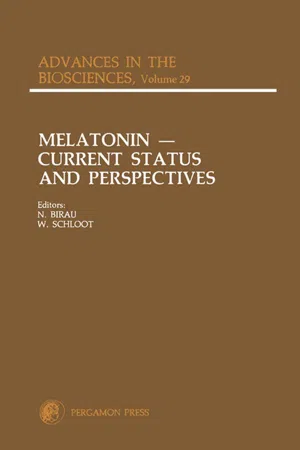
Melatonin: Current Status and Perspectives
Proceedings of an International Symposium on Melatonin, Held in Bremen, Federal Republic of Germany, September 28-30, 1980
- 420 pages
- English
- ePUB (mobile friendly)
- Available on iOS & Android
eBook - ePub
Melatonin: Current Status and Perspectives
Proceedings of an International Symposium on Melatonin, Held in Bremen, Federal Republic of Germany, September 28-30, 1980
About this book
Advances in the Biosciences, Volume 29: Melatonin – Current Status and Perspectives is a compilation of papers by different authors presented in the Proceedings of an International Symposium on Melatonin, held in Bremen, Federal Republic of Germany on September 28-30, 1980. This volume is divided into six parts, wherein the first part covers the testing methods of melatonin; the use of the status of assay methods of melatonin; and related studies. Part 2 tracks the developments in melatonin histophysiology, with attempts to clarify cytological aspects of the indoleamine secretory process in the pineal gland; melatonin production by extra-pineal tissues; and other relationships with the pineal gland. Part 3 focuses on advances in melatonin physiology from hypothetical evolutionary function; the biochemistry and pharmacology of melatonin; to melatonin and pigment cell rhythmicity. Part 4 shows the progress made in molecular endocrinology, while Part 5 presents the results of human melatonin research and covers melatonin serum in humans. The last part is comprised of additional papers that are not classified in the former categories: studies of the effects of light on human plasma melatonin; the role of the environmental factors; and the histology melatonin localized in the salivary glands of the rat palate. This compilation of papers is intended for biochemists, neuroscientists, and researchers in the fields of endocrinology, human genetics, and pharmaceutical chemistry.
Information
Evolution of Melatonin Function: A Hypothesis
W.A. Gern, Department of Zoology and Physiology, University of Wyoming, Laramie, Wyoming, USA
ABSTRACT
Melatonin has many ascribed functions, many of which are involved in the entraining or reinforcement of various rhythms in vertebrates. A hypothesis concerning the evolution of a biological timing function for melatonin is outlined as well as some background information supporting the hypothesis. Also presented are some avenues of investigation which may be used to test the hypothesis so that it may be either accepted and modified or rejected.
KEYWORDS
Evolution
melatonin
time keeping
INTRODUCTION
Discussing the evolution of melatonin function is a particularly difficult task because of the lack of data on the subject. In truth, very few reported studies have dealt with the evolutionary aspects of melatonin function in the Vertebrata. Although a careful accounting of these actions has not been made, it is probable that only prolactin has more ascribed functions (see Bern and Nicoll, 1968). Because of this, it would be difficult indeed to discuss the evoultion of more than a few of these functions. Therefore, this paper will examine known information about melatonin and the evolution of the cells which synthesize melatonin and present a hypothesis concerning the evolution of only one aspect of melatonin function, its role in timing various biological rhythms.
In many of the discussions concerning melatonin function, it was either demonstrated or implied that melatonin may be serving to either entrain or reinforce rhythmical physiological or behavioral phenomena (see Binkley, 1980). By examining the large amount of literature on melatonin and reproductive cyclicity, it becomes apparent that melatonin is somehow involved in the temporal arrangement of various reproductive events (see Reiter, 1978). Melatonin has been shown to be involved in rhythmical thermoregulatory events in some ectotherms (see Ralph et al., 1979) and in the nightly pallor response in amphibian larvae (Bagnara and Hadley, 1973) and some fish. Finally melatonin has been shown to affect the locomotor activity rhythms in sparrows (Turek et al. 1976).
Much of the research on melatonin and biological rhythms stems from the fact that melatonin synthesis is an extremely regular event in nearly all vertebrates. Many reports have now demonstrated that melatonin content of the pineal gland (see Ralph, 1976) and in circulation increases several fold at night. It is also known that the pineal gland is the chief secretory source of melatonin. The cell responsible for melatonin synthesis and secretion within the mammalian pineal gland is the pinealocyte. Work primarily from the laboratory of Collin (see Collin, 1971) has established that the pinealocyte was derived through the evolutionary process of rudimentation from secretory photoreceptor cells in the line of mammalian progenitors. Therefore in lower vertebrates (cyclostomes, fish, amphibians and some reptiles), pineal photoreceptor cells are both sensory and secretory. The transition from a sensory-secretory photoreceptor cell to a secretory rudimentary photoreceptor cell is quite evident in some reptiles and birds. Finally, only the secretory pinealocyte is present in adult mammals. Although it has not been unequivocally demonstrated, it is thought that the photoreceptor cells in the pineal organs of fish (Gern et al., 1978b) and amphibians (Gern and Norris, 1979) and the rudimentary secretory photoreceptor cells of reptiles (Firth et al., 1979) and birds (Ralph, 1976) synthesize melatonin. Retinal photoreceptor cells probably also synthesize melatonin (Bubenik et al., 1974) which indicates that melatonin synthesis is a biosynthetic pathway shared by the ciliate photoreceptor cells in general. Some support for this may be found in the very similar embryonic origins of the pineal organ and associated structures and the retina and pigmented-epithelium of the lateral eye (Eakin, 1973).
What function melatonin may have in photoreceptive tissue is not clearly understood. It is assumed that melatonin synthesis in general is a nightly event in ciliate photoreceptor cells or their derivatives. Furthermore, this nocturnal melatonin synthesis is assumed to be an evolutionarily conserved feature of these cells. Melatonin is detoxified or converted to other molecules within the liver, where it is hydroxylated at the 6 position. Most (70%) of the 6-hydroxymelatonin is then conjugated to sulfate while a much smaller fraction is conjugated with glucuronic acid (Kopin, et al. 1961). Both conjugates are released from the body in urine or feces. Another pathway for melatonin degradation is by deacetylation by the hepatic aryl acylamidase system (Rogawski et al., 1979), although only a small percentage of the circulating melatonin is converted to 5-methoxytrypamine and eventually to 5-methoxyindoleacetic acid by this system. As noted earlier, both systems are primarily present in the liver, with no reports as to their presence in photoreceptive tissue available. Neither have been found in nervous tissue (Kopin et al., 1961; Rogawski, et al., 1979).
With this background the following hypothesis is advanced as well as possible avenues to test the hypothesis. It is hypothesized that melatonin is a synthetic product of ciliate photoreceptor cells found in vertebrates. This melatonin has an action either within the photoreceptor cell or on cells closely associated with the photoreceptor cells such as pigmented-epithelium. Such actions may be to cause the photomechanical displacement of the photoreceptor outer segments or aggregation of melanosomes within the pigmented-epithelium. Both actions are consistent with the temporal occurrence of melatonin during any 24-h day, where melatonin would act to unmask the sensitive photoreceptor outer segment for greater light gathering activity at night. Whatever the action of melatonin is in photoreceptive tissue, it is assumed that it occurs primarily at night and that this action is the most primitive. It is probable that the enzymes necessary for conversion or detoxification of melatonin are not present at the site of melatonin synthesis and that this too is reflective of the primitive condition. Therefore, detoxification or conversion of this indoleamide must be done by the liver, requiring that melatonin be placed into circulation. In the most primitive vertebrates, melatonin synthesized by various photoreceptor cells was placed into circulation for detoxification, creating a pulse of melatonin in the plasma which could be used to determine either the onset or duration of the scotophase, an event which occurs in most modern vertebrates. Because of the regularity of this pulse, melatonin could be used to cue other rhythmical phenomena if the proper cellular receptor for the molcule was present. Furthermore, if melatonin was acting in some way on photoreceptive tissue, in primitive vertebrates, it implies that a cellular receptor for the molecule existed. Therefore, the genetic information necessary for melatonin receptor formation was present but repressed in most cells. It is hypothesized that either through mutation or through the derepression of that portion of the genome which contains the genetic information coding for the production of melatonin receptors were formed in cells at a new site. Animals possessing this adaptation functioned better in their environment because of their ability to use the melatonin pulse in a new way, as a biologica...
Table of contents
- Cover image
- Title page
- Table of Contents
- ADVANCES IN THE BIOSCIENCES
- Copyright
- Dedication
- ASSAY METHODS OF MELATONIN
- DEVELOPMENTS IN MELATONIN HISTOPHYSIOLOGY
- ADVANCES IN MELATONIN PHYSIOLOGY
- PROGRESS IN MOLECULAR ENDOCRINOLOGY OF MELATONIN
- NEW RESULTS IN HUMAN MELATONIN RESEARCH
- ADDITIONAL PAPERS
- AUTHOR INDEX
- SUBJECT INDEX
Trusted by 375,005 students
Access to over 1.5 million titles for a fair monthly price.
Study more efficiently using our study tools.
Frequently asked questions
Yes, you can cancel anytime from the Subscription tab in your account settings on the Perlego website. Your subscription will stay active until the end of your current billing period. Learn how to cancel your subscription
No, books cannot be downloaded as external files, such as PDFs, for use outside of Perlego. However, you can download books within the Perlego app for offline reading on mobile or tablet. Learn how to download books offline
Perlego offers two plans: Essential and Complete
- Essential is ideal for learners and professionals who enjoy exploring a wide range of subjects. Access the Essential Library with 800,000+ trusted titles and best-sellers across business, personal growth, and the humanities. Includes unlimited reading time and Standard Read Aloud voice.
- Complete: Perfect for advanced learners and researchers needing full, unrestricted access. Unlock 1.5M+ books across hundreds of subjects, including academic and specialized titles. The Complete Plan also includes advanced features like Premium Read Aloud and Research Assistant.
We are an online textbook subscription service, where you can get access to an entire online library for less than the price of a single book per month. With over 1.5 million books across 990+ topics, we’ve got you covered! Learn about our mission
Look out for the read-aloud symbol on your next book to see if you can listen to it. The read-aloud tool reads text aloud for you, highlighting the text as it is being read. You can pause it, speed it up and slow it down. Learn more about Read Aloud
Yes! You can use the Perlego app on both iOS and Android devices to read anytime, anywhere — even offline. Perfect for commutes or when you’re on the go.
Please note we cannot support devices running on iOS 13 and Android 7 or earlier. Learn more about using the app
Please note we cannot support devices running on iOS 13 and Android 7 or earlier. Learn more about using the app
Yes, you can access Melatonin: Current Status and Perspectives by N. Birau,W. Schloot in PDF and/or ePUB format, as well as other popular books in Biological Sciences & Zoology. We have over 1.5 million books available in our catalogue for you to explore.