- 334 pages
- English
- ePUB (mobile friendly)
- Available on iOS & Android
eBook - ePub
Clinical Applications for Next-Generation Sequencing
About this book
Clinical Applications for Next Generation Sequencing provides readers with an outstanding postgraduate resource to learn about the translational use of NGS in clinical environments.
Rooted in both medical genetics and clinical medicine, the book fills the gap between state-of-the-art technology and evidence-based practice, providing an educational opportunity for users to advance patient care by transferring NGS to the needs of real-world patients.
The book builds an interface between genetic laboratory staff and clinical health workers to not only improve communication, but also strengthen cooperation. Users will find valuable tactics they can use to build a systematic framework for understanding the role of NGS testing in both common and rare diseases and conditions, from prenatal care, like chromosomal abnormalities, up to advanced age problems like dementia.
- Fills the gap between state-of-the-art technology and evidence-based practice
- Provides an educational opportunity which advances patient care through the transfer of NGS to real-world patient assessment
- Promotes a practical tool that clinicians can apply directly to patient care
- Includes a systematic framework for understanding the role of NGS testing in many common and rare diseases
- Presents evidence regarding the important role of NGS in current diagnostic strategies
Information
Chapter 1
Next Generation Sequencing—General Information about the Technology, Possibilities, and Limitations
Rafał Płoski Department of Medical Genetics, Centre of Biostructure, Medical University of Warsaw, Warsaw, Poland
Abstract
The principle of next generation sequencing (NGS) is a massively multiparallel sequencing of DNA fragments. Existing NGS platforms differ significantly. The second generation instruments require clonal amplification of DNA molecules; the third generation technology enables sequencing at the single-molecule level. The prototypic instruments from the former category are the GS FLX+ (454, Roche), SOLiD and Ion PGM (Life Technologies), and HiSeq (Illumina), whereas instruments from Helicos and Pacific Biosciences represent the latter category. NGS platforms differ with regard to throughput, read length, and quality; number of reads in a single run; speed of sequencing; and paired versus single read approach. In parallel with a steady increase in throughput, a trend toward the development of small-scale machines for clinical use (“benchtop” sequencers) has opened prospects for NGS implementation in clinics. Benchtop sequencers usually require preselection (enrichment) of targets achieved by PCR and/or hybridization. Design and standardization of enrichment techniques are important aspects of NGS clinical use.
Keywords
Enrichment; Illumina; Next generation sequencing; NGS platforms; PacBio; PGM; Proton Ion; Whole exome sequencing; Whole genome sequencingNext generation sequencing (NGS) is defined as technology allowing one to determine in a single experiment the sequence of a DNA molecule(s) with total size significantly larger than 1 million base pairs (1 million bp or 1 Mb). From a clinical perspective the important feature of NGS is the possibility of sequencing hundreds/thousands of genes or even a whole genome in one experiment.
The high-throughput characteristic of NGS is achieved by a massively parallel approach allowing one to sequence, depending on the platform used, from tens of thousands to more than a billion molecules in a single experiment (Figure 1). This massively parallel analysis is achieved by the miniaturization of the volume of individual sequencing reactions, which limits the size of the instruments and reduces the cost of reagents per reaction. In the case of some platforms (referred to as third generation sequencers) the miniaturization has reached an extreme and allows sequencing of single DNA molecules.
An important characteristic of main NGS platforms used today is the limited length of sequence generated in individual reactions, that is, limited read length. Despite constant improvements the read length for the majority of platforms has stayed in the range of hundreds of base pairs. To sequence DNA longer than the feasible read length, the material is fragmented prior to analysis. After the sequencing, the reads are reassembled in silico to provide the information on the sequence of the whole target molecule.
NGS Versus Traditional (Sanger Sequencing)
The term NGS emphasizes an increase in output relative to traditional DNA sequencing developed by Sanger in 1975 [1], which, despite the improvements introduced since then, still has an output limited to ∼75,000 bp (75 kb). This increase in output translates to the possibility of genome-wide analyses, again contrasting with Sanger DNA sequencing, allowing in practice the analysis of single genes or parts thereof. Despite the spreading use of NGS, Sanger sequencing remains the method of choice for validation necessary for all clinically relevant NGS findings.
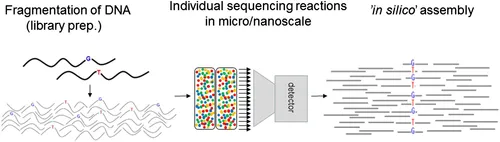
Figure 1 General principles of technical solutions for NGS. The central part of the process consists of a large number of sequencing reactions carried out in parallel on fragmented DNA in very small volumes (multicolored dots). The outcome of the individual reactions is read by an optical or electronic detector. The final step is the assembly of the thus-generated sequences (reads) allowing the determination of the sequence of the DNA molecule(s) before fragmentation.
Coverage
An important feature of NGS is multiple sequencing of each base of the target sequence. The number of times a given position has been sequenced in an NGS experiment (i.e., number of reads containing this position) is termed “coverage.” On one hand, multiple coverage is a consequence of the above-mentioned random target fragmentation necessitated by short read lengths. On the other hand, obtaining multiple reads covering the same target is necessary for eliminating random sequencing errors and, equally importantly, enabling the detection of individual components in DNA mixtures. The DNA mixtures that commonly need to be resolved in a clinical setting are those due to heterozygosity.
Sufficient coverage is important for good quality of an NGS experiment. Although the detection of heterozygosity may seem straightforward with a coverage of ∼10, it should be realized that the probability of obtaining all reads from the chromosome without the variant is 1 in 210 = 1/1024, meaning that in whole-genome sequencing (WGS) hundreds of heterozygous variants can be missed. Even more challenging is the detection of a variant present in a proportion smaller than 50%, which often is the case for somatic mutations in neoplastic tissue, chimerism, and mosaicism, or heteroplasmy in mitochondrial DNA.
Coverage, sometimes also called “sequencing depth” or “depth or coverage,” can be quantified by “mean coverage,” that is, the sum of coverage for all nucleotides in the target sequence divided by the number of nucleotides. Mean coverage gives a general idea about experiment design but it may be misleadingly high if some few regions are covered excessively and others poorly or not at all. A more informative way to characterize coverage is to calculate what percentage of the target has been sequenced with a specified (or higher) depth that is deemed satisfactory. A reasonable result when looking for germ-line variants (e.g., disease-causing mutations, expected to be present in 50% or 100% of appropriately positioned reads) is to have more than 80% of the target covered a minimum of 20 times.
From an economical perspective it is also desirable to obtain coverage that is maximally smooth, that is, there are no discrete regions that are covered excessively or insufficiently. Excessive coverage is unnecessary and it generates cost since it uses up expensive sequencing reagents. A pa...
Table of contents
- Cover image
- Title page
- Table of Contents
- Copyright
- List of Contributors
- Chapter 1. Next Generation Sequencing—General Information about the Technology, Possibilities, and Limitations
- Chapter 2. Basic Bioinformatic Analyses of NGS Data
- Chapter 3. Analysis of Structural Chromosome Variants by Next Generation Sequencing Methods
- Chapter 4. Next Generation Sequencing in Oncology
- Chapter 5. Next Generation Sequencing in Hematological Disorders
- Chapter 6. Next Generation Sequencing in Neurology and Psychiatry
- Chapter 7. Next Generation Sequencing in Dysmorphology
- Chapter 8. Next Generation Sequencing in Vision and Hearing Impairment
- Chapter 9. Next Generation Sequencing as a Tool for Noninvasive Prenatal Tests
- Chapter 10. Clinical Applications for Next Generation Sequencing in Cardiology
- Chapter 11. Next Generation Sequencing in Pharmacogenomics
- Chapter 12. The Role of Next Generation Sequencing in Genetic Counseling
- Chapter 13. Next Generation Sequencing in Undiagnosed Diseases
- Chapter 14. Organizational and Financing Challenges
- Chapter 15. Future Directions
- Chapter 16. Ethical and Psychosocial Issues in Whole-Genome Sequencing for Newborns
- Chapter 17. Next Generation Sequencing—Ethical and Social Issues
- Index
Trusted by 375,005 students
Access to over 1.5 million titles for a fair monthly price.
Study more efficiently using our study tools.
Frequently asked questions
Yes, you can cancel anytime from the Subscription tab in your account settings on the Perlego website. Your subscription will stay active until the end of your current billing period. Learn how to cancel your subscription
No, books cannot be downloaded as external files, such as PDFs, for use outside of Perlego. However, you can download books within the Perlego app for offline reading on mobile or tablet. Learn how to download books offline
Perlego offers two plans: Essential and Complete
- Essential is ideal for learners and professionals who enjoy exploring a wide range of subjects. Access the Essential Library with 800,000+ trusted titles and best-sellers across business, personal growth, and the humanities. Includes unlimited reading time and Standard Read Aloud voice.
- Complete: Perfect for advanced learners and researchers needing full, unrestricted access. Unlock 1.5M+ books across hundreds of subjects, including academic and specialized titles. The Complete Plan also includes advanced features like Premium Read Aloud and Research Assistant.
We are an online textbook subscription service, where you can get access to an entire online library for less than the price of a single book per month. With over 1.5 million books across 990+ topics, we’ve got you covered! Learn about our mission
Look out for the read-aloud symbol on your next book to see if you can listen to it. The read-aloud tool reads text aloud for you, highlighting the text as it is being read. You can pause it, speed it up and slow it down. Learn more about Read Aloud
Yes! You can use the Perlego app on both iOS and Android devices to read anytime, anywhere — even offline. Perfect for commutes or when you’re on the go.
Please note we cannot support devices running on iOS 13 and Android 7 or earlier. Learn more about using the app
Please note we cannot support devices running on iOS 13 and Android 7 or earlier. Learn more about using the app
Yes, you can access Clinical Applications for Next-Generation Sequencing by Urszula Demkow,Rafal Ploski in PDF and/or ePUB format, as well as other popular books in Biological Sciences & Genetics & Genomics. We have over 1.5 million books available in our catalogue for you to explore.