- 320 pages
- English
- ePUB (mobile friendly)
- Available on iOS & Android
eBook - ePub
About this book
Spintronic 2D Materials: Fundamentals and Applications provides an overview of the fundamental theory of 2D electronic systems that includes a selection of the most intensively investigated 2D materials. The book tells the story of 2D spintronics in a systematic and comprehensive way, providing the growing community of spintronics researchers with a key reference. Part One addresses the fundamental theoretical aspects of 2D materials and spin transport, while Parts Two through Four explore 2D material systems, including graphene, topological insulators, and transition metal dichalcogenides. Each section discusses properties, key issues and recent developments.
In addition, the material growth method (from lab to mass production), device fabrication and characterization techniques are included throughout the book.
- Discusses the fundamentals and applications of spintronics of 2D materials, such as graphene, topological insulators and transition metal dichalcogenides
- Includes an in-depth look at each materials system, from material growth, device fabrication and characterization techniques
- Presents the latest solutions on key challenges, such as the spin lifetime of 2D materials, spin-injection efficiency, the potential proximity effects, and much more
Information
Subtopic
Science des matériauxChapter 1
Introduction to spintronics and 2D materials
Wenqing Liu1, Matthew T. Bryan1 and Yongbing Xu2,3, 1Department of Electronic Engineering, Royal Holloway, University of London, Egham, United Kingdom, 2Spintronics and Nanodevice Laboratory, Department of Electronic Engineering, University of York, York, United Kingdom, 3Nanjing-York Joint Center in Spintronics, Nanjing University, Nanjing, China
Abstract
Spin-based technologies, in the form of magnetic compasses, have existed for thousands of years. However, it is only in the last century that the concept of spin, as a pure quantum phenomenon, was established, paving the way for new applications exploiting its quantum mechanical properties. This chapter introduces the underlying mechanisms behind spin ordering in magnetic materials, particularly in two-dimensional (2D) limit, and reviews historical milestones in the development of “spintronics” and electronic devices utilizing spin. Initially studied for fundamental physical interest, spintronic applications quickly came to prominence following the discovery of giant magnetoresistance and the rediscovery of tunneling magnetoresistance in metallic architectures. The desire to integrate these phenomena with the existing semiconductor-based technologies used in the computing industry has inspired intensive study of spintronics within semiconductor materials. Notable developments include the spin field-effect transistor and nonlocal device geometries. Following the discovery of novel electronic properties of graphene, there has been a drive to harness similar properties–with the addition of spin-control–in van der Waals or 2D materials, resulting in several families of 2D magnetic materials known today.
Keywords
Spintronics; 2D materials; 2D magnetism
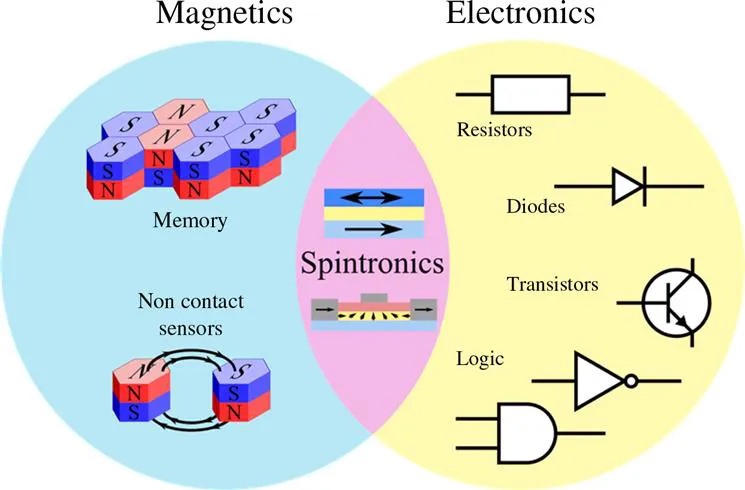
Spin-based phenomena are rich in fundamental physics and important to information technology. Many aspects of electron spin dynamics remain open questions, including spin–orbital coupling, spin–photon interaction, spin ordering at low dimensions, and spin-wave transmission to name a few. Since the discovery of the giant magnetoresistance effect (GMR), celebrated by the 2007 Nobel Prize in Physics, spin-based electronics—or “spintronics” as it quickly became known—has developed into an interdisciplinary field dedicated to the study of spin-based effects rather than purely charge-based physical phenomena previously associated with electronic systems (Fig. 1.1). This eventually led to a revolutionary impact on device concepts, particularly in data storage technologies where the introduction of spintronic technologies enabled a rapid increase in the capacity of hard drives.
In parallel with the development of spintronics research, new two-dimensional (2D) materials have become available. Beginning with the discovery of graphene, acknowledged by the 2010 Nobel Prize in Physics, a number of 2D materials have been produced with unique properties not seen elsewhere, even in bulk (three-dimensional) analogs of the same materials, due to confinement of their electronic band structure. Combining these properties with spintronics could produce the next revolution in electronics technology, with potential for minimal power dissipation or extreme sensitivity to magnetic fields. This book covers recent advances in spintronic 2D materials, showing how magnetism and low-dimensional electronics can be coupled to produce new device concepts and novel applications.
1.1 Spin and spin ordering
Spin is an intrinsic form of angular momentum universally carried by elementary particles, composite particles and atomic nuclei. It is a solely quantum phenomenon and has no counterpart in classical mechanics. The earliest sign of “spin” can be traced back to the 1880s, when Albert A. Michelson observed closely-spaced, but discrete, lines in the emission spectra of sodium gas. When atomic spectra were first discovered, the sodium spectrum was thought to be dominated by a bright line known as the sodium D-line at wavelength λD=589.3 nm. However Michelson was able to resolve the spectrum in finer detail and found that the D-line was in fact split into two lines, namely λD1=589.6 nm and λD2=589.0 nm, called the fine structure. Today, we know that the sodium D-line arises from the transition from the 3p to the 3s levels, with the fine structure caused by slight differences in energy levels of opposite spins due to the spin–orbit interaction.
While Michelson did not recognize spin as the origin of the fine structure, his observations mark the beginning of the study of spin-based phenomena. Following Joseph J. Thomson’s discovery of the electron as a particle in 1897, next experimental hint of spin came in 1912, when Friedrich Paschen and Ernst E. A. Back observed that in the presence of a strong magnetic field the sodium D1- and D2-lines further split into four and six lines, respectively. This field-induced splitting of fine structure spectra due to spin–orbit effects is sometimes referred to as the anomalous Zeeman effect (or the Paschen—Back effect at high fields). In the following year, Niels Bohr published his atom theory, which included quantized energy shells and electron orbital momentum. It provided a framework to understand many of the new quantum phenomena being discovered at the time, but still lacked a spin angular momentum term. Quantization of angular momentum was demonstrated by Otto Stern and Walther Gerlach in 1922, by measuring the deflection of a collimated beam of gaseous, electrically neutral silver atoms passing through a nonhomogeneous magnetic field into two distinct bands (rather than the single, broad band expected from a classical distribution of angular momentum). However it was not until 1925, when Samuel Goudsmit and George Uhlenbeck suggested that the electron had an intrinsic quantized angular momentum, that the concept of spin was grasped and used to explain the fine structure, and anomalous Zeeman effect. By 1929, Paul A.M. Dirac had developed his theory of relativistic quantum mechanics, demonstrating that unlike orbital angular momentum, electronic spin was restricted to just two quantized values: S=±1/2.
In explaining the anomalous Zeeman effect, electronic spin is directly linked to the magnetic moment of each atom. Indeed, spin is responsible for magnetic ordering within a crystal via a quantum mechanical interaction, called exchange. Fundamentally, the exchange interaction manifests as an electrostatic interaction between neighboring spins: by the Pauli exclusion principle, particles in identical quantum states cannot occupy the same position, so electrons in the same band are repelled if they have aligned spins. Therefore the spatial distribution of charge within the crystal is dependent on the alignment of neighboring spins. Naturally, the interaction is reciprocal; the charge distribution determined by the crystal lattice influences spin direction giving rise to magneto-crystalline anisotropy (having a preferred magnetization “easy” axis or axes) and mechanical distortions in the lattice may cause, or be caused by, changes in the spin direction (an effect called magnetostriction). Strong interaction between an electron’s spin and the magnetic field it experiences due to its orbit around a charged nucleus (the “spin–orbit interaction”) can create an additional exchange term, called the Dzyaloshinskii–Moriya interaction (DMI), which acts to align spins perpendicular to each other. Since it competes with normal exchange, DMI tends to introduce a topological chirality to a magnet, favoring a particular sense of spin rotation whenever magnetization becomes nonuniform.
Each interaction ...
Table of contents
- Cover image
- Title page
- Table of Contents
- Copyright
- List of contributors
- Preface
- Chapter 1. Introduction to spintronics and 2D materials
- Chapter 2. Rashba spin–orbit coupling in two-dimensional systems
- Chapter 3. Two-dimensional ferrovalley materials
- Chapter 4. Ferromagnetism in two-dimensional materials via doping and defect engineering
- Chapter 5. Charge-spin conversion in 2D systems
- Chapter 6. Magnetic properties of graphene
- Chapter 7. Experimental observation of low-dimensional magnetism in graphene nanostructures
- Chapter 8. Magnetic topological insulators: growth, structure, and properties
- Chapter 9. Growth and properties of magnetic two-dimensional transition-metal chalcogenides
- Chapter 10. Spin-valve effect of 2D-materials based magnetic junctions
- Chapter 11. Layered topological semimetals for spintronics
- Index
Trusted by 375,005 students
Access to over 1.5 million titles for a fair monthly price.
Study more efficiently using our study tools.
Frequently asked questions
Yes, you can cancel anytime from the Subscription tab in your account settings on the Perlego website. Your subscription will stay active until the end of your current billing period. Learn how to cancel your subscription
No, books cannot be downloaded as external files, such as PDFs, for use outside of Perlego. However, you can download books within the Perlego app for offline reading on mobile or tablet. Learn how to download books offline
Perlego offers two plans: Essential and Complete
- Essential is ideal for learners and professionals who enjoy exploring a wide range of subjects. Access the Essential Library with 800,000+ trusted titles and best-sellers across business, personal growth, and the humanities. Includes unlimited reading time and Standard Read Aloud voice.
- Complete: Perfect for advanced learners and researchers needing full, unrestricted access. Unlock 1.5M+ books across hundreds of subjects, including academic and specialized titles. The Complete Plan also includes advanced features like Premium Read Aloud and Research Assistant.
We are an online textbook subscription service, where you can get access to an entire online library for less than the price of a single book per month. With over 1.5 million books across 990+ topics, we’ve got you covered! Learn about our mission
Look out for the read-aloud symbol on your next book to see if you can listen to it. The read-aloud tool reads text aloud for you, highlighting the text as it is being read. You can pause it, speed it up and slow it down. Learn more about Read Aloud
Yes! You can use the Perlego app on both iOS and Android devices to read anytime, anywhere — even offline. Perfect for commutes or when you’re on the go.
Please note we cannot support devices running on iOS 13 and Android 7 or earlier. Learn more about using the app
Please note we cannot support devices running on iOS 13 and Android 7 or earlier. Learn more about using the app
Yes, you can access Spintronic 2D Materials by Wenqing Liu,Yongbing Xu in PDF and/or ePUB format, as well as other popular books in Technologie et ingénierie & Science des matériaux. We have over 1.5 million books available in our catalogue for you to explore.