eBook - ePub
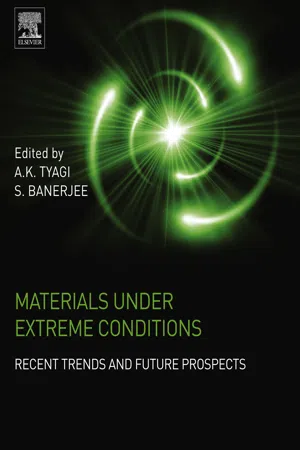
Materials Under Extreme Conditions
Recent Trends and Future Prospects
- 870 pages
- English
- ePUB (mobile friendly)
- Available on iOS & Android
eBook - ePub
Materials Under Extreme Conditions
Recent Trends and Future Prospects
About this book
Materials Under Extreme Conditions: Recent Trends and Future Prospects analyzes the chemical transformation and decomposition of materials exposed to extreme conditions, such as high temperature, high pressure, hostile chemical environments, high radiation fields, high vacuum, high magnetic and electric fields, wear and abrasion related to chemical bonding, special crystallographic features, and microstructures.
The materials covered in this work encompass oxides, non-oxides, alloys and intermetallics, glasses, and carbon-based materials. The book is written for researchers in academia and industry, and technologists in chemical engineering, materials chemistry, chemistry, and condensed matter physics.
- Describes and analyzes the chemical transformation and decomposition of a wide range of materials exposed to extreme conditions
- Brings together information currently scattered across the Internet or incoherently dispersed amongst journals and proceedings
- Presents chapters on phenomena, materials synthesis, and processing, characterization and properties, and applications
- Written by established researchers in the field
Information
Chapter 1
Material Studies at High Pressure
Surinder M. Sharma, and Nandini Garg Bhabha Atomic Research Centre, Mumbai, India
Abstract
Subjecting materials to very high pressures is one of the well-established methods to study condensed matter under extreme conditions. Application of pressure can bring about significant changes in the bonding character and consequently in the structural and physicochemical properties of the materials. High-pressure and high-temperature conditions can help simulate the physical conditions inside the earth, planets, and super-earth, synthesize new materials with exotic properties, etc. Even food preservation and successful preservation of organs for transplant can be carried out by application of pressure. This chapter deals with several aspects of high-pressure science, methods of pressure generation, different diagnostic methods employed for studying high-pressure phenomena, and a few studies elucidating the exciting changes in the materials brought about by its application.
Keywords
Amorphization; Diamond anvil cell; High pressure; Negative thermal expansion; Phase transitions; Raman spectroscopy; Recrystallization; X-ray diffraction
1. Introduction
Pressure and temperature are two important thermodynamic variables that can bring about several changes in condensed matter. Application of pressure brings about larger changes at very low pressures compared to temperatures as the change in Gibbs free energy of elements on application of pressure is ∼10 kJ/mol/GPa, much larger compared to 0.1 kJ/mol/°C as a function of temperature [1]. (Commonly used units of pressure are related to each other as: atmospheric pressure: bar = 750.064 mm of Hg = 105 Pa = 0.986923 atm = 1 kg/cm2, psi = 14.50373 bar, 1 GPa = 10 kbar and 1 Mbar = 100 GPa.) In nature pressures vary over almost 63 orders of magnitude, i.e., from that of hydrogen in intergalactic space (∼10−32 bar) to that at the center of neutron stars (∼1031 bar). Further, in nature pressures could be static like the pressure at the center of the earth or at the bottom of an ocean, or dynamic like that caused by meteoric impacts witnessed recently in Russia or an earthquake causing the disastrous tsunami. Study of matter at extreme conditions helps in understanding several natural phenomena, synthesize new materials, has applications for energy [2] and defense technologies, provides insights into reaction chemistry of energetic materials, etc. Therefore high pressure investigations span a broad range of scientific disciplines (e.g., material science chemistry, physics, biology, and earth and planetary sciences, etc.).
When a material is compressed, its constituent atoms are brought closer, causing an increase in the overlap of electronic orbitals, resulting in changes in the hybridization of the outer electronic orbitals, bringing about the modifications in the nature of interatomic bonding and band structure. Significant increase in overlap of orbitals also manifests itself in terms of stronger repulsive forces, particularly between the nonbonded atoms. These changes propel the materials to evolve to new states having different physical properties, including structure, modifications occurring continuously or discontinuously. Understanding these alterations at extreme conditions provides insight into the nature of phase transformations, molecular to nonmolecular transitions [3], crystal to amorphous transitions [4], amorphous to amorphous transitions [5], chemical changes [6], increasing/lowering of melting temperature [7], insulator to metal transitions [8], valence transitions [9], Lifshitz transitions [10], changes in the dielectric function [11], refractive index [12–14] determination of the equation of state etc. [15,16] High-pressure studies also help to understand how the micro- and nanostructural aspects, such as crystallite size, dislocations, voids, and grain boundaries evolve on application of pressure [17].
Knowledge of high-pressure behavior of minerals like zircon can be very useful in determining peak pressures of meteoric impacts [18]. In fact, high-pressure studies of many minerals like pyrochlores, zircons, or glasses can throw light on their usefulness as nuclear encapsulants [19]. Application of pressure has also found its use in the chemical industry as there are several reactions that are accelerated on application of pressure, for example, the production of ammonia by the Habers process. Pressure plays an important role even in the food preservation industry and the health sector. Calcium hydroxyapatite is an important bioceramic and is the main constituent of teeth and bone tissues of human beings. Also, monocalcium monohydrate is widely used in bone and teeth cements, and it is known that masticatory stresses can ...
Table of contents
- Cover image
- Title page
- Table of Contents
- Copyright
- List of Contributors
- About the Editors
- Preface
- Chapter 1. Material Studies at High Pressure
- Chapter 2. Materials Under Shock Waves
- Chapter 3. Materials for Hostile Corrosive Environments
- Chapter 4. Materials for Hostile Chemical Environments
- Chapter 5. High Performance Polymer Nanocomposites for Structural Applications
- Chapter 6. Glasses and Glass-Ceramics for Vacuum and High-Temperature Applications
- Chapter 7. Natural Glasses Under Extreme Conditions
- Chapter 8. Protective Hard Coatings for Tribological Applications
- Chapter 9. Intermetallics and Alloys for High Temperature Applications
- Chapter 10. Synthesis and Characterization of Borides, Carbides, and Nitrides and Their Applications
- Chapter 11. High-Temperature Ceramics
- Chapter 12. Cold Plasma Processing of Materials for Extreme Conditions
- Chapter 13. Tailored Thermal Expansion Material for High-Temperature Applications
- Chapter 14. Materials Under Intense Laser Irradiation
- Chapter 15. Laser-Induced Vaporization–Mass Spectrometry Studies on Refractory Materials at Ultrahigh Temperatures
- Chapter 16. Nanoclusters Under Extreme Ionization Conditions
- Chapter 17. Materials Response Under Irradiation
- Chapter 18. Radiation–Matter Interaction and Radiation-Tolerant Oxides
- Chapter 19. Diamond-Based Radiation Detectors for Applications in Highly Corrosive Solutions and High-Radiation Fields
- Chapter 20. Severe Plastic Deformation of Materials
- Chapter 21. Materials in a High Magnetic Field
- Chapter 22. Properties of Materials Under High Electric Field
- Index
Trusted by 375,005 students
Access to over 1.5 million titles for a fair monthly price.
Study more efficiently using our study tools.
Frequently asked questions
Yes, you can cancel anytime from the Subscription tab in your account settings on the Perlego website. Your subscription will stay active until the end of your current billing period. Learn how to cancel your subscription
No, books cannot be downloaded as external files, such as PDFs, for use outside of Perlego. However, you can download books within the Perlego app for offline reading on mobile or tablet. Learn how to download books offline
Perlego offers two plans: Essential and Complete
- Essential is ideal for learners and professionals who enjoy exploring a wide range of subjects. Access the Essential Library with 800,000+ trusted titles and best-sellers across business, personal growth, and the humanities. Includes unlimited reading time and Standard Read Aloud voice.
- Complete: Perfect for advanced learners and researchers needing full, unrestricted access. Unlock 1.5M+ books across hundreds of subjects, including academic and specialized titles. The Complete Plan also includes advanced features like Premium Read Aloud and Research Assistant.
We are an online textbook subscription service, where you can get access to an entire online library for less than the price of a single book per month. With over 1.5 million books across 990+ topics, we’ve got you covered! Learn about our mission
Look out for the read-aloud symbol on your next book to see if you can listen to it. The read-aloud tool reads text aloud for you, highlighting the text as it is being read. You can pause it, speed it up and slow it down. Learn more about Read Aloud
Yes! You can use the Perlego app on both iOS and Android devices to read anytime, anywhere — even offline. Perfect for commutes or when you’re on the go.
Please note we cannot support devices running on iOS 13 and Android 7 or earlier. Learn more about using the app
Please note we cannot support devices running on iOS 13 and Android 7 or earlier. Learn more about using the app
Yes, you can access Materials Under Extreme Conditions by A.K. Tyagi,S. Banerjee,A. K. Tyagi in PDF and/or ePUB format, as well as other popular books in Technology & Engineering & Industrial Design. We have over 1.5 million books available in our catalogue for you to explore.