eBook - ePub
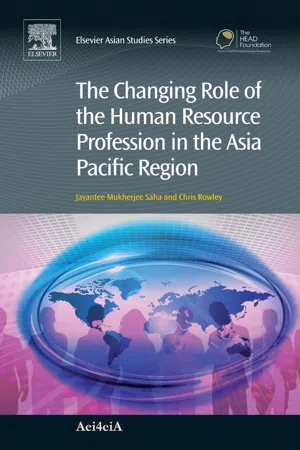
The Changing Role of the Human Resource Profession in the Asia Pacific Region
- 156 pages
- English
- ePUB (mobile friendly)
- Available on iOS & Android
eBook - ePub
The Changing Role of the Human Resource Profession in the Asia Pacific Region
About this book
The human resource (HR) profession has been on a long and challenging journey. Globalisation and sweeping policy changes have re-defined and re-aligned HR and its role. It is important for HR professionals to develop and become innovators in their respective industries. The Changing Role of the Human Resource Profession in the Asia Pacific Region is based on case-studies of retail, tourism, healthcare, security, education, and energy, spread across the greater Asia Pacific (AP) region. The book rests on the principle of the laws of attraction, that 'thoughts become things' and argues that acknowledging good human resource policies and practices can be a key influence on all aspects of an organisation. After an introduction, five chapters cover key topics: six major industries; changing HR practices across the AP; an insider's view on best practices; the role of HR in sustaining growth across the AP; and a conclusion looking towards the future of HR in the Asian Pacific Region.
- Based on real and contemporary case studies with a focus on six industries (Retail, Tourism, Healthcare, Security, Education and Energy) spread across the Greater AP region
- Highlights industry specific key HR challenges and suggests ways forward
- Records recent developments
Information
1
Introduction
As a result of globalisation and the evolving focus on business and organisations in the greater Asia Pacific (GAPAC) region, the human resource (HR) profession and practices in this part of the world have been undergoing change. The HR profession is perceived as being more strategic than merely administrative. Moreover, HR challenges and practices may be universal or industry specific. Given each industry has its own complexities, we examine the specific HR challenges that they bring and look at whether HR professionals can impact them in some way. This chapter provides the basic information needed to understand the book. This covers the background and rationale of HR, its significance, how it relates to readers and other related stakeholders, the kind of general principles and methodologies used to research the topic, and finally an overview of benefits that readers and stakeholders may draw from the book.
Keywords
Asia Pacific; human resources; management; policies; practices; profession
Introduction
The human resource (HR) profession has been on a long and challenging journey. Globalisation and sweeping policy changes are factors that have redefined and realigned HR and its role in the organisation. The HR function may be seen as having evolved not only over time, but content. There are many typologies and frameworks showing this such as those proposed by Tyson and Fell (1986). Others like Ulrich (1997), Ulrich, Younger, Brockbank, and Ulrich (2012) and Welch and Welch (2012) present different types of framework. What these convey is that the title of HR manager covers a wide range in terms of the content of the job, with greater or fewer levels on reactive – proactive or operational – strategic spectrums (Rowley & Jackson, 2011).
While explaining the business partner model, Ulrich and Brockbank (2008) pointed out that HR plays a significant role in the creation and maintenance of capabilities an organisation must have in order to deliver value to its customers, shareholders, employees and communities. Generally speaking, HR has evolved from just being transactional to being a strategic business partner, from being a cost centre to profit centre partnering business growth (Moore & Furlong, 2012). The post-2008 global financial crisis made it clear that economies were not just facing another cyclical economic downturn but in its wake came impactful, structural, demographic and mindset changes across various industries. Business leaders could not afford to respond with anything less than a major overhaul of the HR management (HRM) system to survive and sustain – HR as a practice and profession needs to ‘transmute’ (Mukherjee Saha, 2010, p. 21).
Our book addresses a set of interrelated questions. What are the principal challenges HR is facing? Given each industry has its own complexities, is it not a necessity to assess and analyse industry-specific HR challenges and best practices? Can HR take on the responsibility of increasing productivity in industries? With the rapid changes going on in workplaces and economies, is it not a prerequisite for HR professionals to develop competencies and enhance knowledge and by so doing have an effect on their respective industries (Ulrich et al., 2012)?
The premise of our book rests on the principle of laws of attraction, which claims that ‘thoughts become things’. In this world of business uncertainties and corporate fragilities, acknowledging good HR policies and practices can certainly influence the economic, societal and environmental aspects of an organisation. It may further trigger collective thinking on the part of the HR and business community, economies and societies at large for transmutation to take place for the common good (Mukherjee Saha, 2010, p. 21).
The book covers the following six key industries: (1) tourism and hospitality, (2) retail, (3) healthcare, (4) education, (5) security; (6) energy (including oil, gas and renewables). There is copious evidence that these industries play major roles in economies (as explained in Chapter 2). A closer look reveals the interdependence of these, something that will be elaborated in the following chapters. Industry-level analysis backed up by case studies of organisations from specific industries and operating in the region has been included to further elaborate the concept.
Why focus on the region?
The greater Asia Pacific (GAPAC) is that part of the world in or near the western Pacific Ocean. We take its main economies to include Australia, Cambodia, China, Hong Kong, India, Indonesia, Japan, South Korea, Malaysia, Myanmar, New Z...
Table of contents
- Cover image
- Title page
- Table of Contents
- Copyright
- Foreword by Dave Ulrich
- Foreword by Peter Cappelli
- Foreword by Prabir Jha
- Acknowledgements
- About the author
- 1. Introduction
- 2. Six major industries: An overview
- 3. Changing HR landscapes across the region
- 4. Best HR practices: Insider view
- 5. The role of human resources in sustaining the growth of industries
- 6. Conclusion
- Index
Trusted by 375,005 students
Access to over 1.5 million titles for a fair monthly price.
Study more efficiently using our study tools.
Frequently asked questions
Yes, you can cancel anytime from the Subscription tab in your account settings on the Perlego website. Your subscription will stay active until the end of your current billing period. Learn how to cancel your subscription
No, books cannot be downloaded as external files, such as PDFs, for use outside of Perlego. However, you can download books within the Perlego app for offline reading on mobile or tablet. Learn how to download books offline
Perlego offers two plans: Essential and Complete
- Essential is ideal for learners and professionals who enjoy exploring a wide range of subjects. Access the Essential Library with 800,000+ trusted titles and best-sellers across business, personal growth, and the humanities. Includes unlimited reading time and Standard Read Aloud voice.
- Complete: Perfect for advanced learners and researchers needing full, unrestricted access. Unlock 1.5M+ books across hundreds of subjects, including academic and specialized titles. The Complete Plan also includes advanced features like Premium Read Aloud and Research Assistant.
We are an online textbook subscription service, where you can get access to an entire online library for less than the price of a single book per month. With over 1.5 million books across 990+ topics, we’ve got you covered! Learn about our mission
Look out for the read-aloud symbol on your next book to see if you can listen to it. The read-aloud tool reads text aloud for you, highlighting the text as it is being read. You can pause it, speed it up and slow it down. Learn more about Read Aloud
Yes! You can use the Perlego app on both iOS and Android devices to read anytime, anywhere — even offline. Perfect for commutes or when you’re on the go.
Please note we cannot support devices running on iOS 13 and Android 7 or earlier. Learn more about using the app
Please note we cannot support devices running on iOS 13 and Android 7 or earlier. Learn more about using the app
Yes, you can access The Changing Role of the Human Resource Profession in the Asia Pacific Region by Jayantee Saha,Chris Rowley in PDF and/or ePUB format, as well as other popular books in Business & Human Resource Management. We have over 1.5 million books available in our catalogue for you to explore.