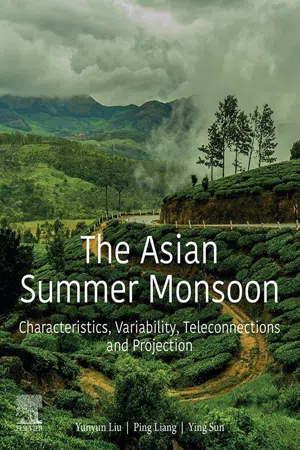
The Asian Summer Monsoon: Characteristics, Variability, Teleconnections and Projection focuses on the connections between the Indian Summer and East Asian Summer Monsoons, also including the South China Sea Summer Monsoon. While these systems have profound differences, their interactions have significant impacts on the climatic regimes in the region and throughout the world. In summer, the ASM engine pumps moisture transported across thousands of miles from the Indian and Pacific Oceans to the monsoon regions, producing heavy rains over south and east Asia and its adjacent marginal seas. This book reviews the different subsystems and their impact, providing guidance to enhance prediction models.
- Synthesizes the connections between the East Asian Summer Monsoon, the Indian Summer Monsoon and the Asian Summer Monsoon system
- Includes subsections on holistic characteristics, sub-seasonal and interannual variability, teleconnection patterns, and projections of future change
- Connects current theory and practice on Asian Monsoon forecasting, providing researchers with new skills and information to use in climate and weather forecasting
Trusted by 375,005 students
Access to over 1.5 million titles for a fair monthly price.
Holistic Characteristics of the Asian Summer Monsoon (ASM) System
Outline
Chapter 1
Basic Features of the Asian Summer Monsoon System
Abstract
The interactions among the Asian monsoon subsystems have significant impacts on the climatic regimes in the monsoon region and the world. The basic modes of the Asian summer monsoon (ASM) and common features of the ASM subsystems at interannual and interdecadal timescales are discussed in this chapter from an overall perspective. The ASM system is controlled by the huge divergent circulation system which is divergent at the upper level and convergent at the lower level. Three branches of air flows from the divergent center at the upper level play significant roles in the promotion of the Indian summer monsoon, the East Asian subtropical summer monsoon, and the South China Sea summer monsoon, respectively. It is one of the perfect performances of the holistic characteristics of the ASM system. The leading modes of several meteorological elements in the Asian monsoon region have shown more consistent characteristics on the interdecadal and interannual timescales; the weakening tendency of ASM emerges at the interdecadal timescale, and synchronous variations with the tropospheric biennial oscillation (TBO) at the interannual timescale. The TBO may be an inherent cycle in the ASM system at the interannual timescale, which reflects the significant holistic characteristics of the ASM under the response of the tropical Pacific and Indian sea surface temperature forcing.
Keywords
Asian summer monsoon; Indian summer monsoon; East Asian summer monsoon; tropospheric biennial oscillation
1.1 Introduction
The Asian summer monsoon (ASM) is the largest and strongest monsoon system in the world. Although a monsoon is a regional phenomenon driven by the heat contrast between the continent and the ocean, it is so large that its behavior exerts a significant influence on the global climate. The ASM system includes two monsoon subsystems in classic monsoon theory, namely the Indian summer monsoon (ISM) and the East Asian summer monsoon (EASM). They are both interrelated and independent (Tao and Chen, 1987; Chen et al., 1991; Ding, 1994). The South China Sea summer monsoon (SCSSM) belongs to the EASM as the tropical part. The western North Pacific summer monsoon (WNPSM), which has been studied in recent years, is another monsoon subsystem, and belongs to the ASM system (Wang and Lin, 2002; Liu and Ding, 2009). The ASM plays a very important role in global climate change. It carries abundant moisture from the Pacific or Indian oceans into the mainland and forms precipitation. The nonuniform distribution of precipitation can cause widespread droughts and floods and, thus has a significant impact on the economy and people’s lives in monsoon regions. Ye et al. (1958) pointed out that there is a sudden change in the planetary scale circulation over East Asia in mid-June, which leads to the outbreak of the EASM in the Yangtze and Huaihe river basins. More in-depth studies and summaries of the structure and nature of the EASM have been undertaken in recent years (Wang and Lin, 2002; Wang et al., 2003a,b). Moreover, further systematic analyses have been made on the expression and changes of the summer monsoon, especially the intraseasonal, interannual, and decadal variations of monsoon subsystems and their impacts on the East Asian climate (Ding, 2007; He et al., 2008; Wang and Ding, 2008; Zhang et al., 2008; Wang et al., 2009). On the other hand, the ISM is referred to as the lifeline of India, as variability in any of its aspects (onset, withdrawal, and quantum of rainfall) greatly influences the agricultural yield, economy, water resources, power generation, and ecosystems (Parthasarathy et al., 1994). Hence, if the variations in monsoon rainfall are known well in advance, it would be possible to reduce the adverse impacts related to excess or deficient rainfall, providing the prior information about droughts and floods.
The close connections between the ISM and EASM are reflected in multi-timescales and multi-subregions. Some studies have suggested that there are two kinds of teleconnections in the Asian monsoon region, namely the “Southern” and “Northern” teleconnections (Ding and Liu, 2008; Liu and Ding, 2008a,b, 2009). They clearly show the interactions among the ASM subsystems, but their connections present at different times and in different space. They will be described in detail in Chapter 8, “Northern Teleconnection” Between Indian Summer Monsoon and Rainfall Anomalies in North China, and Chapter 9, “Southern Teleconnection” Between the Indian Summer Monsoon Onset and Meiyu in China. In this chapter, the basic modes of the ASM and common features of the ASM subsystems on various timescales will be analyzed from an overall perspective. This will help us better understand the structure and nature of the summer monsoon and enable us to forecast the monsoon and the monsoon rainfall in a more objective and accurate manner so as to reduce the disastrous effect.
This chapter is organized as follows. Section 1.2 provides a description of the data and methods used in this chapter. Section 1.3 shows the climatological characteristics of the ASM based on the divergent circulation. Section 1.4 identifies the robust and consistent EOF modes of the ASM system according to the 850 hPa wind, moisture transport, sea-level pressure, and atmospheric-heat source, and examines their spatial and temporal variations. Section 1.5 verifies the authenticity and correctness of the results by using different reanalysis data. Section 1.6 discusses the effect of the tropical SST on interannual variations of the ASM. A “Summary and Discussion” are given in the concluding Section 1.7.
1.2 Data and Methods
Over recent years sets of reanalysis data from the National Centers for Environmental Prediction/National Center for Atmospheric Research (NCEP/NCAR) have been widely used in various climate change studies for a long historical time series (Kalnay et al., 1996). However, some meteorologists compared and analyzed the reliability of these sets of data with EAR40, an ECMWF reanalysis of the global atmosphere and surface conditions for 45 years, over the period from September 1957 through to August 2002 (Uppala et al., 2005), in the northern hemisphere, especially in Asia, and pointed out that there are differences between the two sets of data in some regions, although the differences in the middle and low latitudes are weaker than in other regions. Improper selection of data may lead to false results (Yang et al., 2002; Inoue and Matsumoto, 2004; Wu et al., 2005). In order to avoid false information, both sets of data are analyzed and compared with each other. The main variables used include: horizontal wind (u, v), vertical speed (w), geopotential height (h), specific humidity (q), surface pressure (ps), and surface temperature (T), with a horizontal resolution of 2.5°×2.5°. Moreover, the extended reconstructed sea surface temperature data (ERSSTv3) (Xue et al., 2003) from the National Oceanic and Atmospheric Administration (NOAA) is also used in this chapter, with a horizontal resolution of 2°×2°. According to classic monsoon theory, the Asian monsoon region mainly includes the Indian monsoon region (5°–27.5°N, 65°–105°E) and the East Asian monsoon region (5°–45°N, 105°–140°E), which includes the South China Sea (SCS) monsoon area (5°–20°N, 105°–120°E).
The total vertically integrated moisture flux vector,
, is calculated to indicate the Asian monsoon circulation. It can be expressed as:
Here,
is the acceleration due to gravity,
is special humidity,
is horizontal wind vector,
represents surface pressure, and
stands for the top pressure, which is chosen as 300 hP...
Table of contents
Cover image
Title page
Table of Contents
Copyright
Foreword
Preface
Introduction
Part I: Holistic Characteristics of the Asian Summer Monsoon (ASM) System
Part II: Variability and Predictability of East Asian Summer Monsoon (EASM) on Subseasonal Timescale
Part III: Interannual Variability of EASM System and Its Possible Mechanism
Part IV: Teleconnections in the Asian Monsoon Region in the Onset and Culmination Phases
Part V: Projection of the ASM system change in the future
Index
Frequently asked questions
Yes, you can cancel anytime from the Subscription tab in your account settings on the Perlego website. Your subscription will stay active until the end of your current billing period. Learn how to cancel your subscription
No, books cannot be downloaded as external files, such as PDFs, for use outside of Perlego. However, you can download books within the Perlego app for offline reading on mobile or tablet. Learn how to download books offline
Perlego offers two plans: Essential and Complete
Essential is ideal for learners and professionals who enjoy exploring a wide range of subjects. Access the Essential Library with 800,000+ trusted titles and best-sellers across business, personal growth, and the humanities. Includes unlimited reading time and Standard Read Aloud voice.
Complete: Perfect for advanced learners and researchers needing full, unrestricted access. Unlock 1.5M+ books across hundreds of subjects, including academic and specialized titles. The Complete Plan also includes advanced features like Premium Read Aloud and Research Assistant.
Both plans are available with monthly, semester, or annual billing cycles.
We are an online textbook subscription service, where you can get access to an entire online library for less than the price of a single book per month. With over 1.5 million books across 990+ topics, we’ve got you covered! Learn about our mission
Look out for the read-aloud symbol on your next book to see if you can listen to it. The read-aloud tool reads text aloud for you, highlighting the text as it is being read. You can pause it, speed it up and slow it down. Learn more about Read Aloud
Yes! You can use the Perlego app on both iOS and Android devices to read anytime, anywhere — even offline. Perfect for commutes or when you’re on the go. Please note we cannot support devices running on iOS 13 and Android 7 or earlier. Learn more about using the app
Yes, you can access The Asian Summer Monsoon by Yunyun Liu,Ping Liang,Ying Sun in PDF and/or ePUB format, as well as other popular books in Physical Sciences & Meteorology & Climatology. We have over 1.5 million books available in our catalogue for you to explore.