eBook - ePub
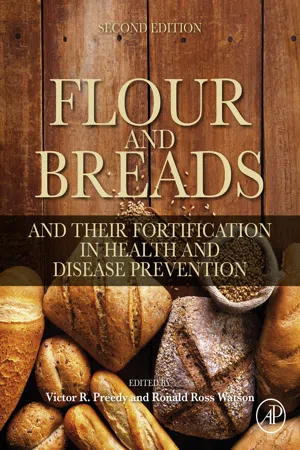
Flour and Breads and Their Fortification in Health and Disease Prevention
- 515 pages
- English
- ePUB (mobile friendly)
- Available on iOS & Android
eBook - ePub
Flour and Breads and Their Fortification in Health and Disease Prevention
About this book
Flour and Breads and Their Fortification in Health and Disease Prevention, Second Edition, presents the healthful benefits of flours and flour products and guides the reader on how to identify opportunities for improving health through the use of flour and fortified flour products. The book examines flour and bread related agents that affect metabolism and other health-related conditions, explores the impact of compositional differences between flours, including differences based on country of origin and processing technique, and includes methods for the analysis of flours and bread-related compounds in other foods.
This revised, updated edition contains new research on diverse flours with an emphasis on nutrients and nutraceuticals as supplements, thus making this content a timely reference for both nutritionists and food scientists.
- Presents the healthful benefits of flours and flour products
- Guides the reader in identifying opportunities for improving health through the use of flour and fortified flour products
- Examines flour and bread related agents that affect metabolism and other health-related conditions
- Explores the impact of compositional differences between flours, including differences based on country of origin and processing technique
Information
Section 1
Introductory Chapters
Chapter 1
Deamidation of Gluten Proteins as a Tool for Improving the Properties of Bread
Hitomi Kumagai⁎; Reiko Urade† * Department of Chemistry and Life Science, Nihon University, Fujisawa-shi, Japan
† Institute for Integrated Radiation and Nuclear Science, Kyoto University, Osaka, Japan
† Institute for Integrated Radiation and Nuclear Science, Kyoto University, Osaka, Japan
Abstract
The allergenicity of gluten proteins in foods made with wheat flour, including bread, is a serious public health concern. The deamidation of gluten proteins, a reaction that converts glutamine and asparagine residues to glutamic-acid and aspartic-acid residue, respectively, is an effective method for reducing allergenicity and improving physicochemical functions, including the solubility and surface properties of gluten proteins. The deamidation of gluten proteins following acid-, alkaline-, heat-, enzyme-, or cation-exchange-resin treatment yields increased solubility in aqueous solution and improved emulsifying, foaming, and gelation properties compared with untreated proteins. In addition, the deamidation of gliadin, a major allergenic protein in gluten, using carboxylated cation-exchange resin is reportedly effective at reducing its reactivity with the sera of patients that exhibit a positive radioallergosorbent test to wheat and oral allergenicity, including intestinal permeability, increased serum allergen, or allergen-specific immunoglobulin E (IgE) levels, FcɛRI expression on mast cell surfaces, and increased serum and intestinal histamine levels.
Keywords
Asparagine residue; Cationic resin; Deamidation; Emulsifying property; Food allergy; Gliadin; Glutamine residue; Gluten; Glutenin; Protein glutaminase
Abbreviations
HMG glutenin high-molecular-weight glutenin subunit
pI isoelectric point
RAST radioallergosorbent test
SDS sodium dodecyl sulphate
TGase transglutaminase
WDEIA wheat-dependent exercise-induced anaphylaxis
Introduction
Wheat gluten formed from gliadin and glutenin, two major types of protein, plays a critical role in bread-making.1–3 Regarding the rheological properties of bread dough, gliadin contributes to its viscosity, whereas glutenin contributes to its elasticity and strength. Gliadin is a typical monomeric prolamin protein that is soluble in 60%–90% aqueous alcohol, whereas glutenin is a large polymer comprised of high- and low-molecular weight subunits cross-linked with disulfide bonds that is alcohol-insoluble but soluble in diluted acid or alkaline solutions. The physical and chemical properties of gluten proteins, including molecular weight, gliadin:glutenin ratio, and degree of primary amidation, are reportedly factors that can affect baking quality.4–9 Furthermore, the poor solubility and emulsification of gluten proteins under most food-processing conditions often preclude the addition of these proteins to a variety of foods.
Physiologically, it is well known that gliadin is the principal allergen that induces serious allergic reactions in susceptible individuals. Allergic manifestations of reactions to gliadin include atopic eczema/dermatitis syndrome (AEDS), which often occurs in children,10–12 and wheat-dependent, exercise-induced anaphylaxis (WDEIA), which mainly occurs in adults.13,14 Certain tandem sequencing sites with glutamine residues of ω-5 gliadin and a high-molecular-weight glutenin subunit (HMW glutenin), which are the most potent antigens for WDEIA, have been identified as the primary structure of immunoglobulin E (IgE)-binding epitopes.15–17
One approach to mitigating the allergenicity of gluten proteins is to chemically modify the proteins by alkylation, acylation, or deamidation. Alkylation and acylation are sometimes used to change the functionality of proteins.18 However, these modifications require chemicals that are not allowed in food intended for human consumption. Conversely, deamidation, a reaction that converts glutamine and asparagine residue to glutamic-acid and aspartic-acid residue, respectively (Fig. 1), can be achieved under mild conditions that are approved for food processing. Consequently, protein deamidation is recognized in the food industry as a method to improve the functionality of proteins in food systems.19–21 Deamidation is often applied to cereal and pulse proteins because the percentage of glutamine and ...
Table of contents
- Cover image
- Title page
- Table of Contents
- Copyright
- Contributors
- Section 1: Introductory Chapters
- Section 2: Flours and Breads
- Section 3: Fortification of Flours and Breads
- Section 4: Metabolic Responses to Flour and Bread Fortification
- Index
Trusted by 375,005 students
Access to over 1.5 million titles for a fair monthly price.
Study more efficiently using our study tools.
Frequently asked questions
Yes, you can cancel anytime from the Subscription tab in your account settings on the Perlego website. Your subscription will stay active until the end of your current billing period. Learn how to cancel your subscription
No, books cannot be downloaded as external files, such as PDFs, for use outside of Perlego. However, you can download books within the Perlego app for offline reading on mobile or tablet. Learn how to download books offline
Perlego offers two plans: Essential and Complete
- Essential is ideal for learners and professionals who enjoy exploring a wide range of subjects. Access the Essential Library with 800,000+ trusted titles and best-sellers across business, personal growth, and the humanities. Includes unlimited reading time and Standard Read Aloud voice.
- Complete: Perfect for advanced learners and researchers needing full, unrestricted access. Unlock 1.5M+ books across hundreds of subjects, including academic and specialized titles. The Complete Plan also includes advanced features like Premium Read Aloud and Research Assistant.
We are an online textbook subscription service, where you can get access to an entire online library for less than the price of a single book per month. With over 1.5 million books across 990+ topics, we’ve got you covered! Learn about our mission
Look out for the read-aloud symbol on your next book to see if you can listen to it. The read-aloud tool reads text aloud for you, highlighting the text as it is being read. You can pause it, speed it up and slow it down. Learn more about Read Aloud
Yes! You can use the Perlego app on both iOS and Android devices to read anytime, anywhere — even offline. Perfect for commutes or when you’re on the go.
Please note we cannot support devices running on iOS 13 and Android 7 or earlier. Learn more about using the app
Please note we cannot support devices running on iOS 13 and Android 7 or earlier. Learn more about using the app
Yes, you can access Flour and Breads and Their Fortification in Health and Disease Prevention by Victor R Preedy,Ronald Ross Watson,Victor R. Preedy in PDF and/or ePUB format, as well as other popular books in Technology & Engineering & Nutrition, Dietics & Bariatrics. We have over 1.5 million books available in our catalogue for you to explore.