- 322 pages
- English
- ePUB (mobile friendly)
- Available on iOS & Android
eBook - ePub
About this book
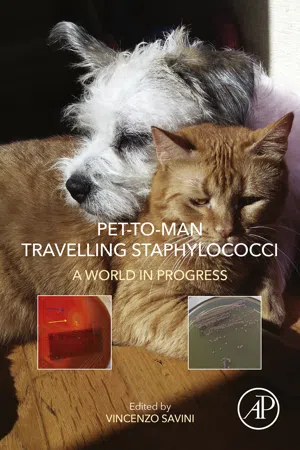
Pet-to-Man Travelling Staphylococci: A World in Progress explores Staphylococci, a dangerous pathogen that affects both humans and animals with a wide range of infection states. This bacteria can spread rapidly as a commensal organism in both humans and pets, and is an agent of disease. Staphylococci are potentially highly virulent pathogens which require urgent medical attention. In addition, Staphylococci remain a threat within hospital environments, where they can quickly spread across a patient population. This book explores the organisms' resistance to many compounds used to treat them, treatment failure and multidrug resistant staphylococci, amongst other related topics.
- Focuses not only on man and animal staphylococcal diseases, but on the role of shared household in man-to-pet (and vice versa) transmission
- Underlines the importance of professional exposure to mammals (i.e. veterinary and farm personnel) in the establishment of shared colonization's and related diseases
- Highlights the impact of shared staphylococci and virulence determinants in human and veterinary pathology
- Sheds light on the way staphylococci may be recognized in clinical laboratories
Information
Chapter 1
Staphylococcal Taxonomy
Giovanni Gherardi*; Giovanni Di Bonaventura†,‡; Vincenzo Savini§ * Integrated Research Centre (CIR), University Campus Biomedico, Rome, Italy
† Department of Experimental and Clinical Sciences, “G. D'Annunzio” University of Chieti-Pescara, Chieti, Italy
‡ Center of Excellence on Aging, “G. D'Annunzio” University Foundation, Chieti, Italy
§ Clinical Microbiology and Virology, Laboratory of Bacteriology and Mycology, Civic Hospital of Pescara, Pescara, Italy
† Department of Experimental and Clinical Sciences, “G. D'Annunzio” University of Chieti-Pescara, Chieti, Italy
‡ Center of Excellence on Aging, “G. D'Annunzio” University Foundation, Chieti, Italy
§ Clinical Microbiology and Virology, Laboratory of Bacteriology and Mycology, Civic Hospital of Pescara, Pescara, Italy
Abstract
Staphylococcus was initially believed to belong to the family Micrococcaceae. Later, molecular and phylogenetic analysis revealed that staphylococci are not closely related to Micrococci anymore, and are thus classified in a new family, named Staphylococcaceae. An accurate identification of staphylococcal species in microbial communities is highly recommended to ensure a detailed determination of the host-pathogen relationships of staphylococci. Since 1962, when only 3 staphylococcal species were identified, an extensive revision of staphylococcal taxonomy has been performed. Overall, 45 staphylococcal species and 24 subspecies have been described so far in the genus by using molecular methods to identify all different species. An accurate identification of staphylococci to the species level is quite laborious, with phenotypic methods that, in several cases, may fail. For this reason, various molecular biology methods have been introduced. These molecular techniques may include sequencing of specific genes, hybridization probes, and may necessitate the restriction of enzymes. Such is the case for PCR-restriction fragment length polymorphism analysis; otherwise it may be accomplished by the whole-genome DNA-DNA hybridization analysis, although this latter methodology has proved unsuitable for routine use at this time. In addition to the 16S rRNA gene, several other gene targets have proven to be useful markers for accurate identification of staphylococcal species, such as the heat shock protein 60 (hsp60) gene, the sodA gene, the tuf gene, the rpoB gene, and the gap gene. By DNA-DNA hybridization studies and by hsp60 and the sodA gene sequence analysis, the Staphylococcus species could be divided into eight distinct species groups. With rpoB-based data, nine clusters were found, and with the gap sequences, Staphylococcus species could be classified into four clusters. The gap sequence analysis proved to be useful for distinguishing the staphylococcal species, and more discriminative compared with the other genes. Therefore, the determination of the sequences of several genes is an important tool for pathogen identification and phylogenetic studies within staphylococci. Although all gene-derived data differs, it has been found that groups obtained with two different sequences with high similarity are stable and reliable.
Keywords
Staphylococci; Taxonomy; Classification; Phenotypic tests; Molecular tests; Sequencing
Conflict of Interest
None.
1.1 Introduction
Historically, the bacterial species belonging to the two related genera Staphylococcus and Micrococcus were considered, along with the species, to belong to the genera Stomatococcus and Planococcus as part of the family Micrococcaceae. Later, molecular analysis and phylogenetic and chemotaxonomic data have revealed that staphylococci and micrococci are not closely related [1]. The Staphylococcus genus belongs to the Bacillus-Lactobacillus-Streptococcus cluster, which consists of Gram-positive bacteria with a low G/C content in chromosomal DNA. The 2nd edition of Bergey's Manual of Systematic Bacteriology[2] updated in 2004 reclassified Staphylococcus genus in a new family, named Staphylococcaceae, together with the genera Jeotgalicoccus, Macrococcus, Salinicoccus, and Gemella[3]. The Staphylococcaceae family together with Bacillaceae, Planococcaceae, Listeriaceae, and other families are part of the order Bacillales[3].
In addition, some species previously belonging to the Micrococcus genus have been reclassified into the newly established genera Kocuria, Nesterenkonia, Kytococcus, and Dermacoccus. These genera were reclassified into two related families, the newly redefined Micrococcaceae and the newly established Dermacoccaceae, typically consisting of species of Gram-positive bacteria with DNA with a high G/C content [4–8]. Both families belong to the suborder Micrococcineae[1]. The Micrococcaceae family now consists of the genera Kocuria, Nesterenkonia, Acaricomes, Arthrobacter, Citricoccus, Renibacterium, Rothia; and Stomatococcus mucillaginosus, which is the only species belonging to the former genus Stomatococcus, has been reclassified as Rothia mucilaginosa[9]. The other family of the Micrococcineae, designated Dermacoccaceae, contains the genera Dermacoccus, Demetria, Kytococcus, Luteipulveratus, and Yimella, other than the previously species belonging to Micrococcus.
Staphylococci are Gram-positive, nonmotile cocci, that upon microscopic examination, appear as clusters, with a typical cell wall of Gram positive bacteria, containing teichoic acid and peptidoglycan [10]. Staphylococci are facultative anaerobes, with the exception of the anaerobic species S. saccharolyticus and S. aureus subsp. anaerobius. Although staphylococci are usually catalase positive, rare strains that are catalase-negative have been reported [11]. Most staphylococcal species are oxidase negative in the modified oxidase test, with the exception of S. fleurettii, S. lentus, S. sciuri, and S. vitulinus. Staphylococci are able to grow in the presence of 10% NaCl at a temperature ranging between 18°C and 40°C. They present a metabolism that is typically respiratory and fermentative. Moreover, a common characteristic of all staphylococcal species is that they are susceptible to lysostaphin, with only rare exceptions [6,12]. The percentage of G/C content in chromosomal DNA of staphylococcal species is approximately of 30%–40%. Coagulase-positive staphylococci (CoPS) represent the major pathogenic species within the genus, and possess coagulase, an enzyme able to coagulate rabbit plasma by converting fibrinogen into fibrin. Conversely, those lacking coagulase are classified as coagulase-negative staphylococci (CoNS), and are relatively minor pathogens that generally cause opportunistic infections in compromised hosts.
Staphylococci, including S. aureus, generally are opportunistic pathogens or commensals resident on host skin and mucosae in animals and humans. Staphylococci from carriage sites can spread and be transmitted into the environment where they are able to survive for a long time [13,14]. Staphylococci that are commensals may act as pathogens if they succeed in entering the host by several mechanisms, such as skin trauma, inoculation, device impl...
Table of contents
- Cover image
- Title page
- Table of Contents
- Copyright
- Dedication
- Contributors
- Preface
- Chapter 1: Staphylococcal Taxonomy
- Chapter 2: Staphylococcal Ecology and Epidemiology
- Chapter 3: Coagulase-Positive and Coagulase-Negative Staphylococci in Human Disease
- Chapter 4: Coagulase-Positive and Coagulase-Negative Staphylococci Animal Diseases
- Chapter 5: Transfer of Staphylococci and Related Genetic Elements
- Chapter 6: Food-Borne Transmission of Staphylococci
- Chapter 7: The Staphylococcal Coagulases
- Chapter 8: The Staphylococcal Hemolysins
- Chapter 9: The Staphylococcal Panton-Valentine Leukocidin (PVL)
- Chapter 10: The Staphylococcal Exfoliative Toxins
- Chapter 11: Extracellular Proteases of Staphylococcus spp.
- Chapter 12: Staphylococcal Lipases
- Chapter 13: Staphylococcal Bacteriocins
- Chapter 14: Phage-Associated Virulence Determinants of Staphylococcus aureus
- Chapter 15: Diagnostics: Routine Identification on Standard and Chromogenic Media, and Advanced Automated Methods
- Chapter 16: Molecular Identification and Genotyping of Staphylococci: Genus, Species, Strains, Clones, Lineages, and Interspecies Exchanges
- Chapter 17: Methicillin Resistance in Staphylococcus aureus
- Chapter 18: In Vivo Resistance Mechanisms: Staphylococcal Biofilms
- Chapter 19: Autovaccines in Individual Therapy of Staphylococcal Infections
- Chapter 20: Experimental Animal Models in Evaluation of Staphylococcal Pathogenicity
- Chapter 21: Application of Staphylococci in the Food Industry and Biotechnology
- Index
Trusted by 375,005 students
Access to over 1.5 million titles for a fair monthly price.
Study more efficiently using our study tools.
Frequently asked questions
Yes, you can cancel anytime from the Subscription tab in your account settings on the Perlego website. Your subscription will stay active until the end of your current billing period. Learn how to cancel your subscription
No, books cannot be downloaded as external files, such as PDFs, for use outside of Perlego. However, you can download books within the Perlego app for offline reading on mobile or tablet. Learn how to download books offline
Perlego offers two plans: Essential and Complete
- Essential is ideal for learners and professionals who enjoy exploring a wide range of subjects. Access the Essential Library with 800,000+ trusted titles and best-sellers across business, personal growth, and the humanities. Includes unlimited reading time and Standard Read Aloud voice.
- Complete: Perfect for advanced learners and researchers needing full, unrestricted access. Unlock 1.5M+ books across hundreds of subjects, including academic and specialized titles. The Complete Plan also includes advanced features like Premium Read Aloud and Research Assistant.
We are an online textbook subscription service, where you can get access to an entire online library for less than the price of a single book per month. With over 1.5 million books across 990+ topics, we’ve got you covered! Learn about our mission
Look out for the read-aloud symbol on your next book to see if you can listen to it. The read-aloud tool reads text aloud for you, highlighting the text as it is being read. You can pause it, speed it up and slow it down. Learn more about Read Aloud
Yes! You can use the Perlego app on both iOS and Android devices to read anytime, anywhere — even offline. Perfect for commutes or when you’re on the go.
Please note we cannot support devices running on iOS 13 and Android 7 or earlier. Learn more about using the app
Please note we cannot support devices running on iOS 13 and Android 7 or earlier. Learn more about using the app
Yes, you can access Pet-to-Man Travelling Staphylococci by Vincenzo Savini in PDF and/or ePUB format, as well as other popular books in Biological Sciences & Microbiology. We have over 1.5 million books available in our catalogue for you to explore.