- 386 pages
- English
- ePUB (mobile friendly)
- Available on iOS & Android
eBook - ePub
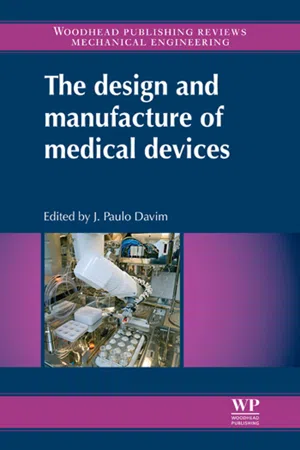
The Design and Manufacture of Medical Devices
About this book
Medical devices play an important role in the field of medical and health technology, and encompass a wide range of health care products. Directive 2007/47/EC defines a medical device as any instrument, apparatus, appliance, software, material or other article, whether used alone or in combination, including the software intended by its manufacturer to be used specifically for diagnostic and/or therapeutic purposes and necessary for its proper application, intended by the manufacturer to be used for human beings. The design and manufacture of medical devices brings together a range of articles and case studies dealing with medical device R&D. Chapters in the book cover materials used in medical implants, such as Titanium Oxide, polyurethane, and advanced polymers; devices for specific applications such as spinal and craniofacial implants, and other issues related to medical devices, such as precision machining and integrated telemedicine systems.
- Contains articles on a diverse range of subjects within the field, with internationally renowned specialists discussing each medical device
- Offers a practical approach to recent developments in the design and manufacture of medical devices
- Presents a topic that is the focus of research in many important universities and centres of research worldwide
Information
1
Characteristics and applications of titanium oxide as a biomaterial for medical implants
M.H. Ahmed and J.A. Byrne, University of Ulster, UK
T.E. Keyes, Dublin City University, Ireland,
W. Ahmed, A. Elhissi and M.J. Jackson, University of Central Lancashire, UK,
E. Ahmed, Bahauddin Zakariya University, Pakistan
Abstract:
There is considerable interest in TiO2 for a wide range of applications; however, this chapter focuses mainly on its uses as a biomaterial, particularly for biomedical implant devices. The main characteristics required for this application have been considered. Methods for producing TiO2 and Ag doped TiO2 films are summarized. The interactions of the films containing body fluids, mainly with blood components such as proteins, are discussed. Various techniques, including surface analysis methods, have been employed to characterize the undoped and Ag doped TiO2 films. Their behaviour under normal conditions inside the body, such as physiological pH, has been investigated and results presented.
Key words
titanium
biomaterials
titanium dioxide
medical devices
1.1 Introduction
Interest in biomaterials has increased at an accelerated rate since the beginning of this century. This is particularlyeVident from the rapid increase in the number of research publications, financial investment and applications of biomaterials worldwide. Biomaterials research is a multidisciplinary pursuit, involving biology, material science, chemistry, engineering, medicine and tissue engineering. According to Wikipedia: ‘a biomaterial is any matter, surface, or construct that interacts with biological systems.’ There are many other definitions within the scientific community. For example, Park and Lake defined biomaterials as ‘materials of synthetic, as well as of natural origin, in contact with tissue, blood and biological fluids and intended for use for prosthetic, diagnostic, therapeutic and storage applications without adversely affecting the living organism and its components’ (Park, 1999). However, Williams (1999) suggested a more general definition of a biomaterial as ‘a material (other than drug) or a combination of materials intended to interface with biological systems toeValuate, treat, augment, or replace any tissue, organ or function of the body.’ Hence, a biomaterial is a synthetic material used to replace a part of the body and is in contact with living tissue (Bhat, 2005).
Interest in the field of biomaterials has been increasing over the last three decades, because they are important for repair and replacement of diseased or damaged tissues in the body (Kawachi et al., 1998). Artificial joints have been researched in the field of medicine for many years. Over a million knee and hip replacements are implantedeVery year. In addition, the growth in the development of biomaterials has increased the possibility of new applications. Biomaterials need to provide functionality and to have desirable properties such as a low friction coefficient, corrosion resistance, infection resistance, biocompatibility, high density and wear resistance.
Novel ways to employ biomaterials have become possible due to enhanced surgical techniques and rapid development of new instruments (Nicholson, 1998). Replacement or augmentation of a tissue or an organ in the human body is ideally achieved by choosing a synthetic material with properties similar to those of the natural biological tissue. Clinical applications have been realized for a range of materials, including metals and metal alloys, bio-ceramics, composites and polymeric materials (Sivakumar et al., 1994).
Almoste everyone has a simple biomaterial inserted into the body. For example, a dental filling, according to the definitions already given, is a biomaterial. However, as the human population is ageing, there is a greater requirement for more complex implants. Implantable devices are often employed in order to modify the shape, appearance or structure of the body (Williams, 2003). These include replacement of joints and, recently, cardiovascular implants such as stents and artificial heart valves. With the next generation of implants, the long-term performance will be a critical issue (Bonfield and Tanner, 1998). It is highly desirable to ensure that the lifetime of the implanted device exceeds the life of the patient (Shi, 2006).
1.2 Classification of biomaterials
Biomaterials can be defined either as passive biomaterials and active biomaterials. As the term implies, passive biomaterials generally remain neutral in their biological environment and have no inherent power of action. However, active biomaterials are capable of interaction with their environment in some way and may even become an integral part of the body. Generally, a biomaterial should work in harmony with its new biological environment (Bronzino, 2000).
Artificial limbs and hearing aids are not normally considered as biomaterials, because they only come into contact with the skin and do not enter the internal environment or are not exposed to biological fluids. Further advances in biomaterials research will give rise to smart biomaterials that can interact with complex intelligent systems (Louise Cairns, 2006).
Biomaterials include a wide range of materials, including biopolymers or bioplastics, bioceramics, metals and metal alloys, hydrogels, bio-adhesives and controlled drug delivery systems.
Materials used for medical applications can be divided into four categories (Davis, 2003):
1. Metals
2. Polymers
3. Ceramics
4. Composites.
Metals are used widely for load bearing implants, such as a total hip prosthesis. In addition to orthopaedics, metallic implants are used in cardiovascular surgery and as dental materials. Iron-chromium-nickel alloys, cobalt-chromium alloys and titanium alloys (TiAlV), due to their corrosion resistance, are the most commonly used metals/metal alloys for implants (Tanja et al., 2006). Titanium was originally used for bone–implantation and is known for its high bonding strength between the bone and the implant. It has been reported that titanium integrates effectively with bone without the presence of fibrous tissue at the bone–implant interface (Cacciafesta et al., 2001).
Polymer materials are w...
Table of contents
- Cover image
- Title page
- Table of Contents
- Copyright
- List of figures
- List of tables
- Preface
- About the contributors
- Chapter 1: Characteristics and applications of titanium oxide as a biomaterial for medical implants
- Chapter 2: Precision machining of medical devices
- Chapter 3: Polyurethane for biomedical applications: A review of recent developments
- Chapter 4: Application of the finite element method in spinal implant design and manufacture
- Chapter 5: Design and manufacture of a novel dynamic spinal implant
- Chapter 6: Customized craniofacial implants: Design and manufacture
- Chapter 7: Technological advances for polymers in active implantable medical devices
- Chapter 8: Integrated telemedicine systems: Patient monitoring, in-time prognostics, and diagnostics at domicile
- Index
Trusted by 375,005 students
Access to over 1.5 million titles for a fair monthly price.
Study more efficiently using our study tools.
Frequently asked questions
Yes, you can cancel anytime from the Subscription tab in your account settings on the Perlego website. Your subscription will stay active until the end of your current billing period. Learn how to cancel your subscription
No, books cannot be downloaded as external files, such as PDFs, for use outside of Perlego. However, you can download books within the Perlego app for offline reading on mobile or tablet. Learn how to download books offline
Perlego offers two plans: Essential and Complete
- Essential is ideal for learners and professionals who enjoy exploring a wide range of subjects. Access the Essential Library with 800,000+ trusted titles and best-sellers across business, personal growth, and the humanities. Includes unlimited reading time and Standard Read Aloud voice.
- Complete: Perfect for advanced learners and researchers needing full, unrestricted access. Unlock 1.5M+ books across hundreds of subjects, including academic and specialized titles. The Complete Plan also includes advanced features like Premium Read Aloud and Research Assistant.
We are an online textbook subscription service, where you can get access to an entire online library for less than the price of a single book per month. With over 1.5 million books across 990+ topics, we’ve got you covered! Learn about our mission
Look out for the read-aloud symbol on your next book to see if you can listen to it. The read-aloud tool reads text aloud for you, highlighting the text as it is being read. You can pause it, speed it up and slow it down. Learn more about Read Aloud
Yes! You can use the Perlego app on both iOS and Android devices to read anytime, anywhere — even offline. Perfect for commutes or when you’re on the go.
Please note we cannot support devices running on iOS 13 and Android 7 or earlier. Learn more about using the app
Please note we cannot support devices running on iOS 13 and Android 7 or earlier. Learn more about using the app
Yes, you can access The Design and Manufacture of Medical Devices by J. Paulo Davim,J Paulo Davim in PDF and/or ePUB format, as well as other popular books in Tecnologia e ingegneria & Tecnologia e forniture mediche. We have over 1.5 million books available in our catalogue for you to explore.