eBook - ePub
Process Control in Textile Manufacturing
- 512 pages
- English
- ePUB (mobile friendly)
- Available on iOS & Android
eBook - ePub
Process Control in Textile Manufacturing
About this book
Complex raw materials and manufacturing processes mean the textile industry is particularly dependent on good process control to produce high and consistent product quality. Monitoring and controlling process variables during the textile manufacturing process also minimises waste, costs and environmental impact. Process control in textile manufacturing provides an important overview of the fundamentals and applications of process control methods.Part one introduces key issues associated with process control and principles of control systems in textile manufacturing. Testing and statistical quality control are also discussed before part two goes on to consider control in fibre production and yarn manufacture. Chapters review process and quality control in natural and synthetic textile fibre cultivation, blowroom, carding, drawing and combing. Process control in ring and rotor spinning and maintenance of yarn spinning machines are also discussed. Finally part three explores process control in the manufacture of knitted, woven, nonwoven textiles and colouration and finishing, with a final discussion of process control in apparel manufacturing.With its distinguished editors and international team of expert contributors, Process control in textile manufacturing is an essential guide for textile engineers and manufacturers involved in the processing of textiles, as well as academic researchers in this field.
- Provides an important overview of the fundamentals and applications of process control methods
- Discusses key issues associated with process control and principles of control systems in textile manufacturing, before addressing testing and statistical quality control
- Explores process control in the manufacture of knitted, woven, nonwoven textiles and colouration and finishing, with a discussion on process control in apparel manufacturing
Information
Part I
General issues
1
Basics of process control in textile manufacturing
Vedpal
V. Jain, Indian Institute of Technology Delhi, India
Abstract:
New technologies are constantly being developed and the service life of products is becoming shorter due to changes in customer taste. Statistical process control (SPC) methods for short production runs are therefore increasingly important. Multistage process surveillance and fault diagnosis have become a necessity. Process control incorporating SPC and hybrid approaches are discussed in this chapter. Overall the chapter helps in building a sound understanding about process control with a flavour of different approaches that are helpful in analysing a process which further helps in taking appropriate decisions.
Key words
statistical process control
control charts
manufacturing
quality
hybrid systems
1.1 Introduction
In today’s dynamic manufacturing environment there is a constant need for improvement in processes. A company cannot rest on past performance and expect to remain successful. Customers’ expectations change rapidly and manufacturing processes have become very demand-driven. More precise specifications present a new challenge that may require the upgrading of existing processes and modern technologies. As a result, process control has become more challenging. Pressure on time and resources, the need for faster delivery, defect-free products, and the reliability and durability of parts and processes, are some of the critical factors facing manufacturing enterprises. Process control plays a key role in building recognition in a competitive market.
Modern technology is capable of the simultaneous control of many variables and the collection of data may appear easy. However, process control also involves costs, for example:
• expenditure on initial analysis of the process,
• expenditure on implementation and integration.
It is important to be aware of the goals and benefits of process control at the outset. Process control can add value if used effectively in decision making, for example:
• If the process is under control, the desired product quality will be achieved.
• If process analysis shows a technology is not serving its purpose, it can be modified or replaced to improve product quality, save costs or improve productivity.
Some basic steps in process control are shown in Fig. 1.1. Some of the tools in process analysis, measurement and control are shown in Fig. 1.2. These techniques are discussed later in the chapter.
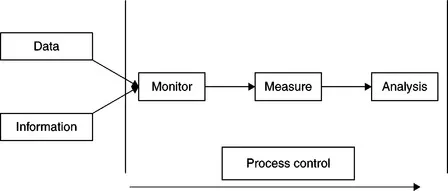
1.1 Some steps in process control.
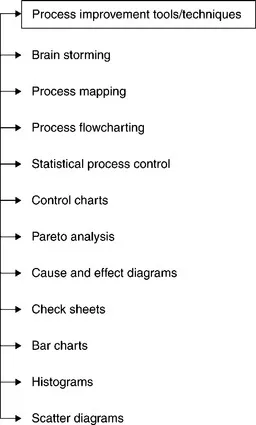
1.2 Process control tools and techniques.
1.2 Process mapping, analysis and control
Product quality is directly dependent upon the process quality. To achieve an excellent quality and defect-free operations process mapping becomes very important. It starts with understanding the process, its approach and the application level and presenting the information with graphical representation. Once the process mapping is done, the control and analysis part comes into picture. This allows us to determine whether the process is in control or not and to analyse if the quality improvement efforts have the desired effect.
This is discussed in detail in the following subsections.
1.2.1 Process mapping
One of the fundamental steps in understanding or improving a process is process mapping. Information about the activities/steps that take place in a process is gathered and mapped so as to create a model representing the complete process. Complex interactions may be represented in a simplified manner. Activities can be grouped into several sub-processes. By the use of process maps, improvement teams are better able to understand the process and become more efficient in ensuring effective control and finding opportunities for improvement.
To ensure process control is effective, the correct product attributes must first be identified. Data or information about the product is collected. The specific characteristics of the product are referred to as the critical attributes and determine the type of measurement. Not all attributes will be critical for the customer. Some may be very important while others may add little value to the product. It is necessary to use appropriate tools to determine a ranking procedure. Among these may be failure mode and effect analysis (FMEA), which analyses the manner in which failure is observed, the causes of the failure, and the effect of failure on the product and other operations.
A process flowchart is an important tool in the construction of a process and provides a snapshot of the complete process. Standard symbols are used for drawing the flowchart. Through process flowcharting, a conclusion may be drawn as to why any redundant operations are being carried out, the final objective being to seek opportunities for process improvement.
A cause-and-effect diagram is also known as...
Table of contents
- Cover image
- Title page
- Table of Contents
- Copyright
- Contributor contact details
- Woodhead Publishing Series in Textiles
- Foreword
- Part I: General issues
- Part II: Process control in fibre production and yarn manufacture
- Part III: Process control in fabric manufacture, coloration and finishing
- Index
Trusted by 375,005 students
Access to over 1.5 million titles for a fair monthly price.
Study more efficiently using our study tools.
Frequently asked questions
Yes, you can cancel anytime from the Subscription tab in your account settings on the Perlego website. Your subscription will stay active until the end of your current billing period. Learn how to cancel your subscription
No, books cannot be downloaded as external files, such as PDFs, for use outside of Perlego. However, you can download books within the Perlego app for offline reading on mobile or tablet. Learn how to download books offline
Perlego offers two plans: Essential and Complete
- Essential is ideal for learners and professionals who enjoy exploring a wide range of subjects. Access the Essential Library with 800,000+ trusted titles and best-sellers across business, personal growth, and the humanities. Includes unlimited reading time and Standard Read Aloud voice.
- Complete: Perfect for advanced learners and researchers needing full, unrestricted access. Unlock 1.5M+ books across hundreds of subjects, including academic and specialized titles. The Complete Plan also includes advanced features like Premium Read Aloud and Research Assistant.
We are an online textbook subscription service, where you can get access to an entire online library for less than the price of a single book per month. With over 1.5 million books across 990+ topics, we’ve got you covered! Learn about our mission
Look out for the read-aloud symbol on your next book to see if you can listen to it. The read-aloud tool reads text aloud for you, highlighting the text as it is being read. You can pause it, speed it up and slow it down. Learn more about Read Aloud
Yes! You can use the Perlego app on both iOS and Android devices to read anytime, anywhere — even offline. Perfect for commutes or when you’re on the go.
Please note we cannot support devices running on iOS 13 and Android 7 or earlier. Learn more about using the app
Please note we cannot support devices running on iOS 13 and Android 7 or earlier. Learn more about using the app
Yes, you can access Process Control in Textile Manufacturing by Abhijit Majumdar,Apurba Das,R Alagirusamy,V K Kothari in PDF and/or ePUB format, as well as other popular books in Technology & Engineering & Materials Science. We have over 1.5 million books available in our catalogue for you to explore.