- 392 pages
- English
- ePUB (mobile friendly)
- Available on iOS & Android
eBook - ePub
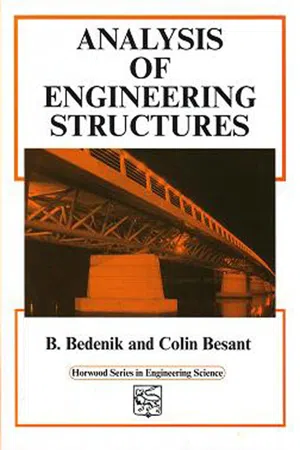
Analysis of Engineering Structures
About this book
This text delivers a fundamental coverage for advanced undergraduates and postgraduates of structural engineering, and professionals working in industrial and academic research. The methods for structural analysis are explained in detail, being based on basic static, kinematics and energy methods previously discussed in the text. A chapter deals with calculations of deformations which provides for a good understanding of structural behaviour. Attention is given to practical applications whereby each theoretical analysis is reinforced with worked examples. A major industrial application consisting of a simple bridge design is presented, based on various theoretical methods described in the book. The finite element as an extension of the displacement method is covered, but only to explain computer methods presented by use of the structural analysis package OCEAN. An innovative approach enables influence lines calculations in a simple mannger. Basic algebra given in the appendices provides the necessary mathematical tools to understand the text.
- Provides an understanding of structural behaviour, paying particular attention to applications, and reinforces theoretical analysis with worked examples
- Details the methods for structural analysis, based on basic static, kinematics and energy methods
Information
1
Introduction
Publisher Summary
Structural analysis is a science that ensures that the structures are safe and fulfill the functions for which they were built. Safety requirements must be met so that a structure is able to serve its purpose with the minimum of costs. Structural concepts arise from the work of engineers from different fields with a common aim that the structure is functional, aesthetic, and economic. Detailed planning of the structure usually comes from several studies made by town planners, investors, users, architects, and other engineers. In general, an architect is responsible to the investor and a structural engineer works in collaboration with the architect as an equal partner in a project. In some structures, such as industrial halls, bridges, and sports halls, a structural engineer has the main influence on the overall structural design and an architect is involved in aesthetic details. The process of analysis has to be repeated until the structure as a whole is optimal from all points of view, followed by final analysis and dimensioning.
Structural analysis is a science, which ensures that structures are safe and fulfill the functions for which they were built. Safety requirements must be met so that a structure is able to serve its purpose with the minimum of costs. Structural concepts arise from the work of engineers from different fields with a common aim that the structure is functional, aesthetic and economic.
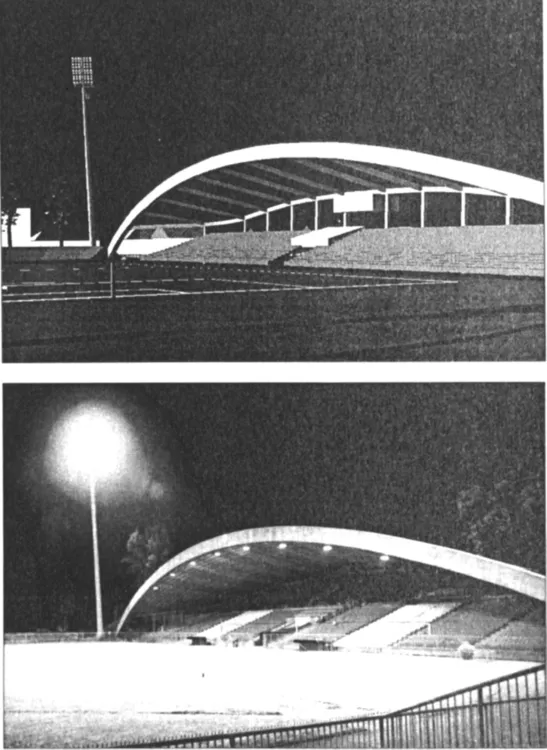
Detailed planning of the structure usually comes from several studies made by town planners, investors, users, architects and other engineers. In general an architect is responsible to the investor and a structural engineer works in collaboration with the architect as an equal partner in a project. In some structures such as industrial halls, bridges and sports halls, a structural engineer has the main influence on the overall structural design and an architect is involved in aesthetic details.
After the preliminary design of the structure, an approximate analysis of loads and stresses in all elements must be carried out including the determination of deformation in individual elements as well as in structure as a whole. This preliminary analysis is a check to show where and how the structure can be improved and reduced in costs. It is possible that the initial design proves to be uneconomic and the structure has to be changed in individual elements or as a whole.
The process of analysis has then to be repeated until the structure as a whole is optimal from all points of view, followed by final analysis and dimensioning. The whole process can be divided into:
– initial design
– preliminary dimensioning
– optimisation (when necessary, change of individual elements of the structure or change of the structure entirely must be made)
– final analysis and dimensioning.
It is obvious that the processes of structural analysis and design are closely related, since each change in element dimensions influences the optimal structural shape, weight and stiffness. These quantities are known only after the elements have been designed. Thus, analysis and design are mutually interacting and the process is called structural analysis.
1.1 Types of Structures
Structural analysis deals with a number of different structures:
– Buildings (residential, industrial)
– Bridges
– Underground structures, tunnels
– Industrial structures, power stations, reactor containers
– Planes, missiles
– Vehicles (automobiles, railcars, ships)
– Machines, cranes, elevators, aerials, electricity pylons
Structures can be divided according to the nature of their components into three main classes:
– Linear or uniaxial members: truss elements, beams, columns, arches and their combinations. Elements of this type are simple to analyse and are therefore suitable for elementary presentation of structural theory. It is possible to idealise even complex structures as assemblies of such members.
– Two-dimensional elements such as plates, shells and walls. Although the analysis of such elements has been considered as a branch of the theory of elasticity, modern computational methods facilitates analysis to any degree of accuracy.
– Three-dimensional eleme...
Table of contents
- Cover image
- Title page
- Table of Contents
- Inside Front cover
- Copyright
- SYNOPSIS
- PREFACE
- Acknowledgements
- Chapter 1: Introduction
- Chapter 2: Definitions and basic concepts
- Chapter 3: Statically determinate structures
- Chapter 4: Kinematics of structures
- Chapter 5: Basic concepts of structural analysis
- Chapter 6: Deformations
- Chapter 7: Stiffness and flexibility
- Chapter 8: The Force Method (Method of consistent deformations)
- Chapter 9: The Displacement Method
- Chapter 10: The Finite Element Method
- Chapter 11: Inelastic material behaviour in structures
- Chapter 12: A simple bridge analysis
- Chapter 13: Computer applications
- Appendix A: Basics of matrix algebra
- Appendix B: Tables
- References
- Index
Trusted by 375,005 students
Access to over 1.5 million titles for a fair monthly price.
Study more efficiently using our study tools.
Frequently asked questions
Yes, you can cancel anytime from the Subscription tab in your account settings on the Perlego website. Your subscription will stay active until the end of your current billing period. Learn how to cancel your subscription
No, books cannot be downloaded as external files, such as PDFs, for use outside of Perlego. However, you can download books within the Perlego app for offline reading on mobile or tablet. Learn how to download books offline
Perlego offers two plans: Essential and Complete
- Essential is ideal for learners and professionals who enjoy exploring a wide range of subjects. Access the Essential Library with 800,000+ trusted titles and best-sellers across business, personal growth, and the humanities. Includes unlimited reading time and Standard Read Aloud voice.
- Complete: Perfect for advanced learners and researchers needing full, unrestricted access. Unlock 1.5M+ books across hundreds of subjects, including academic and specialized titles. The Complete Plan also includes advanced features like Premium Read Aloud and Research Assistant.
We are an online textbook subscription service, where you can get access to an entire online library for less than the price of a single book per month. With over 1.5 million books across 990+ topics, we’ve got you covered! Learn about our mission
Look out for the read-aloud symbol on your next book to see if you can listen to it. The read-aloud tool reads text aloud for you, highlighting the text as it is being read. You can pause it, speed it up and slow it down. Learn more about Read Aloud
Yes! You can use the Perlego app on both iOS and Android devices to read anytime, anywhere — even offline. Perfect for commutes or when you’re on the go.
Please note we cannot support devices running on iOS 13 and Android 7 or earlier. Learn more about using the app
Please note we cannot support devices running on iOS 13 and Android 7 or earlier. Learn more about using the app
Yes, you can access Analysis of Engineering Structures by B Bedenik,C B Besant in PDF and/or ePUB format, as well as other popular books in Technology & Engineering & Civil Engineering. We have over 1.5 million books available in our catalogue for you to explore.