- 740 pages
- English
- ePUB (mobile friendly)
- Available on iOS & Android
eBook - ePub
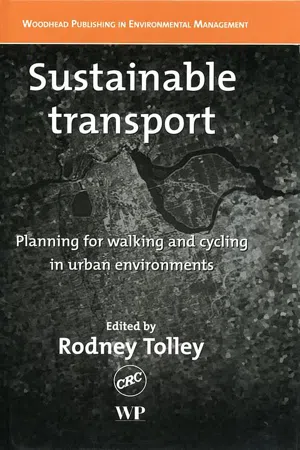
Sustainable Transport
About this book
Cycling and walking are both essential components in sustainable transport strategy and are becoming an ever more important part of urban planning. There is now a wealth of international experience of how well sustainable planning works in practice and how it can be improved. With a wide range of contributions from America, Australia, Europe as well as the UK, Sustainable transport sums up many of the lessons learnt and how they can be applied in improved planning. Non-motorised transport planning depends on combining improvements to infrastructure with education.There are chapters examining both national strategies and local initiatives in cities around the world, including such topics as changes to existing road infrastructure and the integration of cycling and walking with public transport. Since education is a critical element in sustainable transport planning, contributors also consider such topics as developing healthier travel habits and ways of promoting cycling and walking as alternatives to the car.With its blend of practical experience and suggestions for improvement, Sustainable transport is essential reading for urban planners, environmental groups and those researching transport issues.
- Comprehensive handbook covering sustainable transport initiatives world wide
- Focuses on walking and cycling as alternatives to motorised transport systems
- Presents practical advice on how to encourage sustainable transport schemes
Information
Part I
Principles
1
Ecological footprints and urban transportation
William Rees University of British Columbia, Canada
1.1 Introduction: The new global context for local planning
The world in 2003 is not the same world humans inhabited 50 years previously. Environmental problems are no longer simply local effects of local activities. An unprecedented era of human-induced global ecological change has arrived (Daly, 1991; Goodland, 1991; Rees, 1995a, 2000; Vitousek, 1994). The reason is simple. By sheer growth in scale – four to fivefold since the Second World War – the global economy has, in effect, begun to merge with the ecosphere and human activities are radically reshaping the global landscape. Indeed, half of the world’s landmass has already been transformed for human purposes and half of the planet’s accessible fresh water is being used by people. Given the steady erosion of ‘natural’ habitats, it should be no surprise that the rate of biodiversity loss is now estimated to be 1000 times the ‘background’ rate.
The effect on material processes is equally disturbing. With the growth of production and consumption some material economic processes now rival natural flows and their impacts are global in scope. More atmospheric nitrogen is fixed and injected into terrestrial ecosystems by humans than by all natural terrestrial processes combined (Vitousek, 1994); stratospheric ozone depletion now affects both the Southern and Northern Hemispheres; atmospheric carbon dioxide has increased by 30 % since the Industrial Revolution and is now higher than at any time in at least the past 160 000 years. Partially as a result of this increase, mean global temperature is also at a record high and the world is threatened by increasingly variable climate and more frequent and violent weather events (Lubchenco, 1998; Tuxill, 1998; Vitousek et al., 1997; WRI/UNDP, 2000; WWF, 2000).
Concomitant with these structural changes, humankind has become the functionally dominant species in all the world’s major ecosystems. By the end of the twentieth century, human beings, one species among millions, were already appropriating directly and indirectly up to half of net terrestrial primary productivity and 30 % of net estuarine and continental shelf production (the source of 96 % of the global fisheries catch) for their own use (Vitousek et al., 1986; Pauly and Christensen, 1995). The inevitable result is the human displacement of other species from their niches and the accelerating extinction rate noted above (Rees, 2000). In short, with the continuing increase in human populations and per capita consumption, critical biophysical systems are stressed beyond capacity and many local and global waste sinks have been filled to overflowing. For the first time in their two million year history, humans are capable of altering the geological and biological evolution of the entire planet.
Paradoxically, the globalisation of ecological change has been accompanied by the localisation of human populations and settlements. Up to 80 % of the citizens of many so-called industrialised countries now live in cities and half the world’s population of about 6 billion will be urbanised by 2010.
Cities are, of course, centres of intense economic activity. This means that many of the forces driving global change originate in cities. As much as 75 % of final consumption and pollution generation already takes place in urban areas although they occupy only about two per cent of the world’s landmass. The construction, operation and maintenance of buildings alone account for 40 % of the materials used by the world economy and for about 33 % of energy consumption (Worldwatch Institute, 1995). On the positive side, ‘the sheer concentration of population and consumption gives cities enormous leverage (e.g., economies of scale, agglomeration economies) in the quest for global sustainability’ (Rees and Wackernagel, 1996).
This chapter shows why we urgently need to plan for more sustainable transportation, particularly transit, bicycles and walking, in our cities. Its major premise is that the onset of global change requires (among other things) a radical rethinking of the policy framework for local governance and development. To develop this point, the chapter first emphasises the nature of cities as ecological entities. Remarkably, this is unfamiliar territory for most citizens and politicians. However, with the urbanisation of the human population, urban ecology may well become a major preoccupation of sustainable development planning in coming decades. It then shows the potential contribution of cities to sustainability through improved transportation planning. This demands a much expanded role for self-propelled transportation – bicycling and walking.
1.2 The human ‘ecological footprint’
It is one of the great ironies of our human-induced ecological crisis that people do not even think of themselves as ecological beings, as part of the natural world. Indeed, the industrial era has been characterised by a perceptual ‘Cartesian dualism’ that has been remarkably successful in maintaining the psychological separation of humankind from the rest of nature. One consequence is that we tend to think of pollution or the collapse of ecosystems as environmental problems rather than as problems of human economic dysfunction. Even economics, the study of how society can most efficiently exploit the natural world, has historically considered most forms of ecosystem destruction to be mere ‘negative externalities’ and therefore somehow outside the (market) system of concern.
In an effort to overcome this perceptual bias, the author has pioneered with his students a more holistic approach to global ecological change called ‘ecological footprint analysis’ (Rees and Wackernagel, 1994; Rees 1996; Wackernagel and Rees, 1996). This model recognises that, far from being separate from nature, human beings are integral components of the ecosystems that support them.
Ecological footprint analysis is related to traditional trophic ecology. The analysis begins by quantifying the material and energy flows required to support any defined human population and identifying the corresponding sources and sinks. In effect, it describes the material dimensions of the human ecological niche, including the population’s extended food-web. Of course, the human food-web differs significantly from those of other species. In addition to food energy, the human food-web must also account for the material and energy flows necessary to maintain industrial metabolism. In short, the human food-web incorporates the material demands of the entire economic process supporting the study population.
Ecological footprinting gets its name from the fact that many forms of material and energy flow (resource consumption and waste production) can be converted into land- and water-area equivalents. Thus:
The ecological footprint of a specified population is the total area of land/water required, on a continuous basis, to produce the resources that the population consumes and to assimilate the wastes that the population produces wherever on earth the relevant land and water is located. (Rees, 2001a)
In other words, ecological footprinting estimates the area of productive ecosystems scattered all over the planet whose biophysical output is effectively appropriated by the study population for its exclusive use – land used to produce soybeans for the Japanese cannot simultaneously be used to produce bok choi for the Taiwanese. When data are available, population eco-footprint estimates are trade-corrected (consumption = production + imports – exports). Indeed they include both the area appropriated through commodity trade and the area required to produce the referent population’s share of the free land- and water-based services of nature (e.g., the carbon sink function).
1.3 The eco-footprints of cities
Great cities are planned and grow without any regard for the fact that they are parasites on the countryside which must somehow supply food, water, air, and degrade huge quantities of wastes. (Odum, 1971)...
Table of contents
- Cover image
- Title page
- Table of Contents
- Copyright page
- Preface
- Contributor contact details
- Introduction: talking the talk but not walking the walk
- Part I: Principles
- Part II: Strategies
- Part III: Practice
- Part IV: Case studies
- Index
Trusted by 375,005 students
Access to over 1.5 million titles for a fair monthly price.
Study more efficiently using our study tools.
Frequently asked questions
Yes, you can cancel anytime from the Subscription tab in your account settings on the Perlego website. Your subscription will stay active until the end of your current billing period. Learn how to cancel your subscription
No, books cannot be downloaded as external files, such as PDFs, for use outside of Perlego. However, you can download books within the Perlego app for offline reading on mobile or tablet. Learn how to download books offline
Perlego offers two plans: Essential and Complete
- Essential is ideal for learners and professionals who enjoy exploring a wide range of subjects. Access the Essential Library with 800,000+ trusted titles and best-sellers across business, personal growth, and the humanities. Includes unlimited reading time and Standard Read Aloud voice.
- Complete: Perfect for advanced learners and researchers needing full, unrestricted access. Unlock 1.5M+ books across hundreds of subjects, including academic and specialized titles. The Complete Plan also includes advanced features like Premium Read Aloud and Research Assistant.
We are an online textbook subscription service, where you can get access to an entire online library for less than the price of a single book per month. With over 1.5 million books across 990+ topics, we’ve got you covered! Learn about our mission
Look out for the read-aloud symbol on your next book to see if you can listen to it. The read-aloud tool reads text aloud for you, highlighting the text as it is being read. You can pause it, speed it up and slow it down. Learn more about Read Aloud
Yes! You can use the Perlego app on both iOS and Android devices to read anytime, anywhere — even offline. Perfect for commutes or when you’re on the go.
Please note we cannot support devices running on iOS 13 and Android 7 or earlier. Learn more about using the app
Please note we cannot support devices running on iOS 13 and Android 7 or earlier. Learn more about using the app
Yes, you can access Sustainable Transport by R Tolley in PDF and/or ePUB format, as well as other popular books in Biological Sciences & Ecology. We have over 1.5 million books available in our catalogue for you to explore.