eBook - ePub
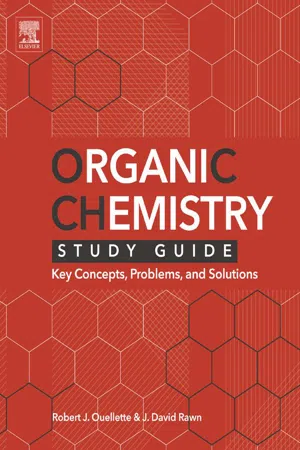
Organic Chemistry Study Guide
Key Concepts, Problems, and Solutions
- 614 pages
- English
- ePUB (mobile friendly)
- Available on iOS & Android
eBook - ePub
Organic Chemistry Study Guide
Key Concepts, Problems, and Solutions
About this book
Organic Chemistry Study Guide: Key Concepts, Problems, and Solutions features hundreds of problems from the companion book, Organic Chemistry, and includes solutions for every problem. Key concept summaries reinforce critical material from the primary book and enhance mastery of this complex subject.
Organic chemistry is a constantly evolving field that has great relevance for all scientists, not just chemists. For chemical engineers, understanding the properties of organic molecules and how reactions occur is critically important to understanding the processes in an industrial plant. For biologists and health professionals, it is essential because nearly all of biochemistry springs from organic chemistry. Additionally, all scientists can benefit from improved critical thinking and problem-solving skills that are developed from the study of organic chemistry.
Organic chemistry, like any "skill", is best learned by doing. It is difficult to learn by rote memorization, and true understanding comes only from concentrated reading, and working as many problems as possible. In fact, problem sets are the best way to ensure that concepts are not only well understood, but can also be applied to real-world problems in the work place.
- Helps readers learn to categorize, analyze, and solve organic chemistry problems at all levels of difficulty
- Hundreds of fully-worked practice problems, all with solutions
- Key concept summaries for every chapter reinforces core content from the companion book
Information
Topic
Physical SciencesSubtopic
Organic Chemistry1
Structure and Bonding in Organic Compounds
Keys to the Chapter
Atomic Structure and Properties
Two periodic trends are important to understanding the physical and chemical properties of organic compounds. They are electronegativity and atomic radius.
The electronegativity scale is an index of the attraction of an atom for an electron. It increases from left to right in a period and from bottom to top in a group of the periodic table. The order of electronegativities for the three most common elements in organic molecules, excluding hydrogen, is C < N < O. Their electronegativity values differ by 0.5 between neighboring elements in this part of the second period. There is a more pronounced difference between second and third period elements. Thus, fluorine and chlorine differ by 1.0, as do oxygen and sulfur. The order of the electronegativity values of the halogens is I < Br < Cl.
Ionic and Covalent Bonds
There are two main classes of bonds. Ionic bonds predominate in inorganic compounds, but covalent bonds are much more important in organic chemistry. When positive and negative ions combine to form an ionic compound, the charges of the cations and anions must be balanced to give a neutral compound. For ionic compounds, the cation is named first and then the anion. Thus, ammonium sulfide contains (NH4)2 and S2−. Two ammonium ions are required to balance the charge of one sulfide ion, so the formula of ammonium sulfide is (NH4)2S. Parentheses enclose a polyatomic ion when a formula unit contains two or more of that ion, and the subscript is placed outside the parentheses.
A covalent bond forms when two nuclei are simultaneously attracted to the same pair of electrons. Carbon usually forms covalent bonds to other elements. The stability of Lewis structures is attributed to the octet rule that states that second row elements tend to form associations of atoms with eight electrons (both shared and unshared) in the valence shell of all atoms of the molecule.
One or more pairs of electrons can be shared between carbon atoms. ...
Table of contents
- Cover image
- Title page
- Table of Contents
- Copyright
- 1: Structure and Bonding in Organic Compounds
- 2: Part I: Functional Groups and Their Properties
- 3: Introduction to Organic Reaction Mechanisms
- 4: Alkanes and Cycloalkanes Structures and Reactions
- 5: Alkenes Structures and Properties
- 6: Alkenes Addition Reactions
- 7: Alkynes
- 8: Stereochemistry
- 9: Haloalkanes and Alcohols Introduction to Nucleophilic Substitution and Elimination Reactions
- 10: Nucleophilic Substitution and Elimination Reactions
- 11: Conjugated Alkenes and Allylic Systems
- 12: Arenes and Aromaticity
- 13: Electrophilic Aromatic Substitution
- 14: Methods for Structure Determination Nuclear Magnetic Resonance and Mass Spectrometry
- 15: Alcohols: Reactions and Synthesis
- 16: Ethers and Epoxides
- 17: Organometallic Chemistry of Transition Metal Elements and Introduction to Retrosynthesis
- 18: Aldehydes and Ketones
- 19: Aldehydes and Ketones: Nucleophilic Addition Reactions
- 20: Carboxylic Acids
- 21: Carboxylic Acid Derivatives
- 22: Condensation Reactions of Carbonyl Compounds
- 23: Amines and Amides
- 24: Aryl Halides, Phenols, and Anilines
- 25: Pericyclic Reactions
- 26: Carbohydrates
- 27: Amino Acids, Peptides, and Proteins
- 28: Synthetic Polymers
- Index
Trusted by 375,005 students
Access to over 1.5 million titles for a fair monthly price.
Study more efficiently using our study tools.
Frequently asked questions
Yes, you can cancel anytime from the Subscription tab in your account settings on the Perlego website. Your subscription will stay active until the end of your current billing period. Learn how to cancel your subscription
No, books cannot be downloaded as external files, such as PDFs, for use outside of Perlego. However, you can download books within the Perlego app for offline reading on mobile or tablet. Learn how to download books offline
We are an online textbook subscription service, where you can get access to an entire online library for less than the price of a single book per month. With over 1.5 million books across 990+ topics, we’ve got you covered! Learn about our mission
Look out for the read-aloud symbol on your next book to see if you can listen to it. The read-aloud tool reads text aloud for you, highlighting the text as it is being read. You can pause it, speed it up and slow it down. Learn more about Read Aloud
Yes! You can use the Perlego app on both iOS and Android devices to read anytime, anywhere — even offline. Perfect for commutes or when you’re on the go.
Please note we cannot support devices running on iOS 13 and Android 7 or earlier. Learn more about using the app
Please note we cannot support devices running on iOS 13 and Android 7 or earlier. Learn more about using the app
Yes, you can access Organic Chemistry Study Guide by Robert J. Ouellette,J. David Rawn in PDF and/or ePUB format, as well as other popular books in Physical Sciences & Organic Chemistry. We have over 1.5 million books available in our catalogue for you to explore.