- 420 pages
- English
- ePUB (mobile friendly)
- Available on iOS & Android
eBook - ePub
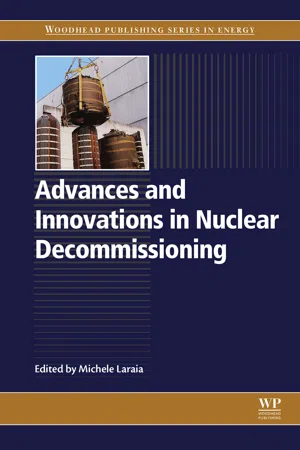
Advances and Innovations in Nuclear Decommissioning
About this book
Advances and Innovations in Nuclear Decommissioning is an essential resource for industry professionals and academics interested in acquiring the most up-to-date information on the current state of nuclear decommissioning. Written and edited by the world's leading experts, this book considers lessons learned and new innovations in the field. Edited by Dr. Laraia, it is the perfect companion to his 2012 book, Nuclear Decommissioning, which critically reviews the nuclear decommissioning processes and technologies applicable to nuclear power plants and other civilian nuclear facilities.
Where the earlier book covers the basics of decommissioning, this new book brings you up-to-date with new areas of interest and approaches, innovative technologies, and lessons learned by both the nuclear and non-nuclear decommissioning sectors.
- Focuses on new aspects, trends and innovative technologies
- Includes content on decommissioning after a severe accident, including the use of robotics
- Brings together information from around the world and considers the lessons learned from the non-nuclear sector as well
Information
Topic
Physical SciencesSubtopic
Energy1
Introduction
M. Laraia Independent consultant, Rome, Italy
Abstract
The primary objective of this book is to update the strategies and issues to be addressed in order to decommission a nuclear installation safely, cost-effectively, and in a timely fashion. The baseline is the book on Nuclear Decommissioning published by Woodhead 5 years ago (Laraia, 2012). Furthermore, the current book (and its introductory chapter, which summarizes the main contents of the book) takes into account advances, experiences, and lessons learned after 2012 in order to support more general statements. For example, it expands on new roles the stakeholders have assumed, which can grant success (or generate hindrances) to a decommissioning project. The book gives ample space to nontechnological aspects of decommissioning, whose growing importance has been proved by the experience of the last few years. It is felt that most of the issues described in the book are applicable to all nuclear installations: a significant enlargement of the scope of this book in respect to Laraia (2012) is the extensive coverage given to decommissioning after a severe accident, which reflects in full the aftermath of the Fukushima accident and its roadmap to decommissioning. This chapter also focuses on the scale of the decommissioning industry and strategic trends; and it is supported by key references.
Keywords
Planning; IAEA; Market; Knowledge management; Robots; Stakeholders
1.1 Introduction
If one looks at the shutdown rate of nuclear facilities (especially reactors) and decommissioning strategies country by country, many novelties have emerged since 2011, when the publishing process of Ref. [1] was almost complete.
Due to time constraints the impacts of the Fukushima accident (Mar. 2011) were scarcely taken into account in the drafting of Ref. [1]. Full consideration to decommissioning a reactor after a severe accident is given in this book (Chapter 9). The immediate impact of the Fukushima accident has been the premature shutdown of a number of power reactors in Japan (which was to be expected) and in Germany (more surprisingly). Apart from these two countries, the other nuclear countries chose not to shut down their generating reactors on account of the Fukushima accident (but some countries chose to slow down or temporarily cancel the construction of new units).
As highlighted below, the circumstances in the United Kingdom and the United States deserve special considerations in that they exemplify typical factors and trends in reactor shutdown and decommissioning strategies worldwide.
In the United States, the early retirements of six nuclear reactors over the last few years have been a major blow to the nuclear industry. Two purely economic retirements (Kewaunee and Fort Calhoun, both single-reactor sites), one due to tax and local opposition (Vermont Yankee, one reactor), and three based on unbearable costs of repairs (Crystal River, one reactor, and San Onofre, two reactors) indicate that there is a variety of operational and economic problems. The reactors that were shut down were not competitive because the United States has the technical ability and plentiful, diverse resources to meet the need for electricity with less expensive and less risky options [2].
Other nuclear utilities made it known that several more reactors may close down within the next couple of years and reach the decommissioning phase. Some of these have had their operating licenses extended an additional 20 years, but this factor has not been enough to reverse the trend towards early retirement.
As of late, the US Energy Information Administration (EIA) noted that in the current market, if old reactors need significant repair, it may not be worthwhile to do so and extend operation. The EIA stated “Lower Power Prices and Higher Repair Costs Drive Nuclear Retirements” [3]. But the situation is more complicated than that; it is not only reactors in bad condition that are at near risk of shutdown. As old reactors become more costly to manage, they may become uneconomic to stay in operation. Actually, the first reactor that retired in 2013 (Kewaunee) was in good operating condition and had just had its license extended for 20 years, but its owners concluded it could not compete and would soon start producing losses in the electricity market, so the decision was made to decommission it.
First, in most parts of the United States, the electricity price is set by natural gas. In those areas where the wholesale price of electricity is set by the market, prices have been decreasing considerably. In parallel, the demand for electricity has been decreasing due to growing efficiency of electricity-consuming equipment. While nuclear fuel costs are currently low, nuclear power plant (NPP) operation and maintenance costs and ongoing capital costs are high. As reactors age, these costs rise. If a reactor is inefficient (i.e., high operating costs), needs major repairs, or safety retrofits are in order, it can be easily pushed beyond the point of nonprofitability.
The second factor is reliability. In the years 2011 and 2012 there were frequent and prolonged outages. Most outages were due to large reactors with operational problems (among those being Crystal River, San Onofre). The reactors with the longest outages, and related high repair costs, Crystal River and San Onofre, have permanently been shut down. It should also be noted that older reactors have shorter refueling cycles, 18 months, than newer reactors, which have 24 months. Therefore, over time older reactors are inevitably doomed to lower load factors.
Third, small units that stand alone—geographically or organizationally—will typically have higher costs and are more prone to premature shutdowns (e.g., Fort Calhoun). These factors generally reflect economies of scale because large, multiunit sites integrated into corporate fleets of reactors can share operational costs.
Fourth, the Fukushima effect poses more serious challenges as older reactors tend to become more distant from the state-of-the-art appreciation of safety. Responding to growing safety concerns may become too costly for existing reactors, because modernization of older plants is made difficult by their designs.
The foregoing overview clearly shows that the rate of decommissioning projects in the US and elsewhere is going to rise over the next 2 or 3 decades. This trend is not due to the gradual expiration of service lives (as it was believed only some years ago) but to political and economic factors. Along with these developments and taking account of the high costs, the industry will have to constantly upgrade and optimize resources to achieve smooth and cost-effective completion of decommissioning projects. The following sections of the Introduction highlight new challenges that are coming to the attention of planners and implementers. These challenges were hardly addressed by Ref. [1] and it is felt that they need proper coverage in this book.
There are a few clear lessons from US decommissioning projects that are underway. First, the project tends to take longer and be more expensive than planned. Second, the long-term storage of spent nuclear fuel on-site considerably impacts the local communities, which was not anticipated at the onset of the nuclear project and will not be offset by social benefits. This damage is significant because it tends to cause a tension between the utility, the regulators, and local stakeholders. And experience has shown that in order to be successful, decommissioning should be based on sound working relationships between all stakeholders.
Experiences in the United States highlight another trend, namely the transfer of decommissioning responsibility (and licenses) from the former operating organization to one devoted only to decommissioning. In Spain, the transfer of decommissioning responsibility to the state-owned company ENRESA has been legally enforced for many years, but this has remained an almost unique national approach until now. The new US trend was already anticipated in Ref. [1, Chapter 2] for the Zion NPP case.
The recent Lacrosse NPP case in the United States confirms the trend [4]. The US Nuclear Regulatory Commission approved the Lacrosse license transfer from the Dairyland Power Cooperative to LaCrosse Solutions LLC, a subsidiary of radioactive waste disposal and decommissioning company Energy Solutions LLC (currently responsible for Zion decommissioning). The move was intended to speed up decommissioning of the long-shutdown small boiling water reactor (BWR). In contractual terms, Dairyland will remain the owner of the La Crosse site and will be in charge of the spent fuel storage (possibly extending long after completion of the reactor decommissioning). LaCrosse Solutions will be the decommissioning licensee.
It has been recently learned that this form of ownership transfer may regard other shutdown reactors, e.g., Vermont Yankee.
The traditional decommissioning strategy for the United Kingdom’s Magnox reactors has been for many years a long-term safe enclosure (called “care and maintenance” in the United Kingdom). Following reactor defueling and preparatory activities for safe enclosure, final dismantling is deferred up to 100 years. But recently the Nuclear Decommissioning Authority (NDA) stated it was time to question this long-held assumption:
Whilst we will celebrate as the first few sites are made safe and secure for a long period of quiescence, it is hard to ignore the question of what comes next. Increasingly we find ourselves questioning whether the baseline strategy is appropriate as a blanket strategy for all reactors in the Magnox fleet.
Ref. [5].
Ongoing research has identified two major issues with a long-term safe enclosure. First, it had originally been estimated that radioactive decay over many decades would allow activated waste to decategorize to low-level waste (LLW)—less expensive and less hazardous to manage and dispose of. However, more recently it has been demonstrated that even after the long safe enclosure phase a major portion of the Magnox decommissioning waste will still not be eligible for LLW management.
Secondly, an updated cost model seems to infer the reduction in decommissioning costs over long periods of safe enclosure—for example, resulting from eased accessibility—is mostly offset by the significant costs of preparing for and managing the safe enclosure.
Thirdly, NDA-driven research proved that even after many decades of safe enclosure remote techniques would still be required for Magnox dismantling to minimize industrial risks and occupational exposures, which further reduces cost benefits. The increasing deterioration of structures, systems, and components over the long periods of safe enclosure could increase dismantling costs even more.
NDA highlighted more risks associated with long-term safe enclosure, such as loss of skills, records and plant knowledge, managing assets (e.g., land) that could be profitably diverted to other uses, uncertainty over changing regulations, and occasional events such as the collapse of financi...
Table of contents
- Cover image
- Title page
- Table of Contents
- Copyright
- Dedication
- List of contributors
- Editor biography
- Preface
- 1: Introduction
- Part One: Planning
- Part Two: Execution
- Part Three: International experience
- Index
Trusted by 375,005 students
Access to over 1.5 million titles for a fair monthly price.
Study more efficiently using our study tools.
Frequently asked questions
Yes, you can cancel anytime from the Subscription tab in your account settings on the Perlego website. Your subscription will stay active until the end of your current billing period. Learn how to cancel your subscription
No, books cannot be downloaded as external files, such as PDFs, for use outside of Perlego. However, you can download books within the Perlego app for offline reading on mobile or tablet. Learn how to download books offline
Perlego offers two plans: Essential and Complete
- Essential is ideal for learners and professionals who enjoy exploring a wide range of subjects. Access the Essential Library with 800,000+ trusted titles and best-sellers across business, personal growth, and the humanities. Includes unlimited reading time and Standard Read Aloud voice.
- Complete: Perfect for advanced learners and researchers needing full, unrestricted access. Unlock 1.5M+ books across hundreds of subjects, including academic and specialized titles. The Complete Plan also includes advanced features like Premium Read Aloud and Research Assistant.
We are an online textbook subscription service, where you can get access to an entire online library for less than the price of a single book per month. With over 1.5 million books across 990+ topics, we’ve got you covered! Learn about our mission
Look out for the read-aloud symbol on your next book to see if you can listen to it. The read-aloud tool reads text aloud for you, highlighting the text as it is being read. You can pause it, speed it up and slow it down. Learn more about Read Aloud
Yes! You can use the Perlego app on both iOS and Android devices to read anytime, anywhere — even offline. Perfect for commutes or when you’re on the go.
Please note we cannot support devices running on iOS 13 and Android 7 or earlier. Learn more about using the app
Please note we cannot support devices running on iOS 13 and Android 7 or earlier. Learn more about using the app
Yes, you can access Advances and Innovations in Nuclear Decommissioning by Michele Laraia in PDF and/or ePUB format, as well as other popular books in Physical Sciences & Energy. We have over 1.5 million books available in our catalogue for you to explore.