eBook - ePub
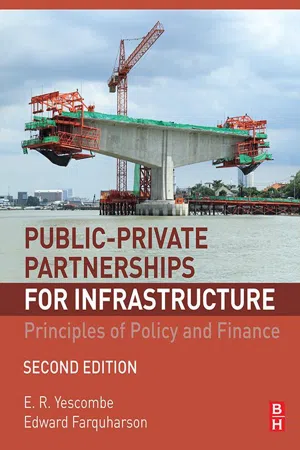
Public-Private Partnerships for Infrastructure
Principles of Policy and Finance
- 548 pages
- English
- ePUB (mobile friendly)
- Available on iOS & Android
eBook - ePub
Public-Private Partnerships for Infrastructure
Principles of Policy and Finance
About this book
Public-Private Partnerships for Infrastructure - Principles of Policy and Finance, Second Edition explains how public private partnerships are prepared, procured, financed, and managed from both the public- and private-sector perspectives. As the use of public private partnerships continues to develop world-wide, both in the area of public policy and private financing and contracting, the Second Edition of this leading textbook:
- Captures and explains the latest approaches, providing a comprehensive all-round guide for those on both the public- and private-sector sides of the table
- Emphasises a step-by-step approach within a comprehensive, cross-referenced format
- Includes clear explanations of PPP evaluation, structuring and financing concepts for the benefit of those new to the topic: no prior knowledge is assumed or required
- Provides detailed reference points for more experienced practitioners
- Draws from the authors' experience and practice in PPP markets worldwide to provide a perspective on practical application of the key underlying principles
- Includes an extensive glossary of technical and financial terms used in the PPP sector
- Includes more technical information and a stronger legal perspective than other books
- Emphasizes a step-by-step approach within a comprehensive, cross-referenced format
- Expands and updates the historical backgrounds and political contexts of public-private partnerships
Part I
Introduction
Outline
Chapter 1
Overview
Public-private partnerships (PPPs) have become increasingly popular as a way of procuring and maintaining public-sector infrastructure, in sectors that include transport (such as roads, bridges, tunnels, railways, ports and airports), social infrastructure (such as hospitals, schools, prisons and social housing), public utilities (such as water supply, wastewater treatment and waste disposal), government offices and other accommodation, and specialised services such as communication networks or defence equipment.
This book reviews the general policy issues that arise for the public sector in considering whether to adopt the PPP procurement route, and the specific application of this policy approach in PPP contracts. This book also offers a systematic and integrated approach to financing PPPs within this public-policy framework. Policy and finance are inextricably entangled in PPPs, so the public sector must develop PPP policies taking account of financing constraints, and be careful to avoid entering into PPP arrangements whose financial implications are misunderstood, or not understood at all, thus undermining the benefit of the PPP. Similarly, the policy background and drivers for public-sector decisions are also often quite unclear to private-sector investors and lenders.
Structuring PPPs is complex because of the need to reconcile the aims of the large number of parties involved—on the private-sector side, there are investors, lenders and companies providing construction and operational services; on the public-sector side, there are public-sector entities creating, implementing and overseeing PPP policies as well as those actually procuring and managing the PPP contract, not forgetting the general public who use the facilities that a PPP provides. Most of these parties need to have a basic understanding of policy and finance issues, and how their part of the project is linked to, and affected by, such issues.
Reflecting the authors’ own practical experience while sitting on the public- and private-sector sides of the table, this book is intended to provide a guide to both the general policy principles and the related financing issues that can cause the most difficulty in PPP negotiations and in the long-term management of PPP contracts. It serves both as an introduction for those who are new to the subject, whether in the academic, public-sector, investment and finance or contracting fields, and as an aide-mémoire for those developing PPP policies and negotiating and managing PPPs. No prior knowledge of PPPs or financing is assumed or required. The views expressed by the authors are their own and do not reflect those of any institution for whom they work.
This book is divided into six parts.
Part 1: Introduction
- • Chapter 2 defines PPPs and reviews their place in the provision of public infrastructure as a whole.
- • Chapter 3 provides a basic introduction to cash-flow and investment analysis, which are at the heart of understanding the financial benefits, costs and structuring of PPPs for both the public- and private-sector parties.
Part 2: The Public-Sector Perspective
This part covers the process of selecting, appraising and procuring PPP projects from the public-sector point of view:
- • Chapter 4 sets out the policy, legal and institutional frameworks behind a PPP programme.
- • Chapter 5 provides an initial summary of the PPP project cycle.
- • Chapter 6 discusses public-sector project management up to the end of the procurement process.
- • Chapter 7 deals with the initial needs assessment, project definition and selection; logically, these processes come before the decision to procure a particular project as a PPP, the processes for which are set out in the following chapters.
- • Chapter 8 explains the issues that arise when considering whether a PPP project provides value for money.
- • Chapter 9 looks at the further key issues of a PPP project’s affordability, budgeting for PPPs and financial/statistical reporting requirements.
- • Chapter 10 describes the procurement process for a PPP.
Part 3: Risk Analysis and Allocation
Risk allocation between the public and private sectors lies at the heart of the PPP process.
- • Chapter 11 summarises the theory behind risk allocation in PPPs, and the main risk categories.
- • Chapter 12 covers risk allocation during the construction phase, and Chapter 13 during the operation phase of a PPP project.
- • Chapter 14 explains how insurance is used to mitigate risks in both the construction and the operation phases.
Part 4: The PPP Contract
This part covers the main elements of a PPP contract, the support that the public sector may provide for such contracts and public-sector management of a PPP contract.
- • Chapter 15 describes the payment mechanisms and performance incentives usually found in a PPP contract.
- • Chapter 16 explains how changes in the original assumptions behind the PPP can be accommodated.
- • Chapter 17 covers termination of a PPP contract, either during or at the end of its term, and the hand-back of the asset to the public sector.
- • Chapter 18 describes the different forms of public-sector support for PPP contracts.
- • Chapter 19 sets out good practice for public-sector contract management during the life of a PPP.
Part 5: The Private-Sector Perspective
This part moves to the other side of the table and covers PPPs from the private-sector point of view.
- • Chapter 20 sets out the different categories of equity investors (i.e. shareholders) in PPP projects, how they organise themselves to bid for, de...
Table of contents
- Cover image
- Title page
- Table of Contents
- Copyright
- List of Figures
- List of Tables
- Part I: Introduction
- Part II: The Public-Sector Perspective
- Part III: PPP Risk Analysis and Allocation
- Part IV: The PPP Contract
- Part V: The Private-Sector Perspective
- Part VI: Alternative Models—Summing Up
- References and Further Reading
- Glossary and Abbreviations
- Index
Trusted by 375,005 students
Access to over 1.5 million titles for a fair monthly price.
Study more efficiently using our study tools.
Frequently asked questions
Yes, you can cancel anytime from the Subscription tab in your account settings on the Perlego website. Your subscription will stay active until the end of your current billing period. Learn how to cancel your subscription
No, books cannot be downloaded as external files, such as PDFs, for use outside of Perlego. However, you can download books within the Perlego app for offline reading on mobile or tablet. Learn how to download books offline
Perlego offers two plans: Essential and Complete
- Essential is ideal for learners and professionals who enjoy exploring a wide range of subjects. Access the Essential Library with 800,000+ trusted titles and best-sellers across business, personal growth, and the humanities. Includes unlimited reading time and Standard Read Aloud voice.
- Complete: Perfect for advanced learners and researchers needing full, unrestricted access. Unlock 1.5M+ books across hundreds of subjects, including academic and specialized titles. The Complete Plan also includes advanced features like Premium Read Aloud and Research Assistant.
We are an online textbook subscription service, where you can get access to an entire online library for less than the price of a single book per month. With over 1.5 million books across 990+ topics, we’ve got you covered! Learn about our mission
Look out for the read-aloud symbol on your next book to see if you can listen to it. The read-aloud tool reads text aloud for you, highlighting the text as it is being read. You can pause it, speed it up and slow it down. Learn more about Read Aloud
Yes! You can use the Perlego app on both iOS and Android devices to read anytime, anywhere — even offline. Perfect for commutes or when you’re on the go.
Please note we cannot support devices running on iOS 13 and Android 7 or earlier. Learn more about using the app
Please note we cannot support devices running on iOS 13 and Android 7 or earlier. Learn more about using the app
Yes, you can access Public-Private Partnerships for Infrastructure by E. R. Yescombe,Edward Farquharson in PDF and/or ePUB format, as well as other popular books in Business & Finance. We have over 1.5 million books available in our catalogue for you to explore.