eBook - ePub
RFID and Wireless Sensors Using Ultra-Wideband Technology
- 266 pages
- English
- ePUB (mobile friendly)
- Available on iOS & Android
eBook - ePub
RFID and Wireless Sensors Using Ultra-Wideband Technology
About this book
RFID and Wireless Sensors using Ultra-Wideband Technology explores how RFID-based technologies are becoming the first choice to realize the last (wireless) link in the chain between each element and the Internet due to their low cost and simplicity.
Each day, more and more elements are being connected to the Internet of Things. In this book, ultra-wideband radio technology (in time domain) is exploited to realize this wireless link. Chipless, semi-passive and active RFID systems and wireless sensors and prototypes are proposed in terms of reader (setup and signal processing techniques) and tags (design, integration of sensors and performance).
The authors include comprehensive theories, proposals of advanced techniques, and their implementation to help readers develop time-domain ultra-wideband radio technology for a variety of applications.
This book is suitable for post-doctoral candidates, experienced researchers, and engineers developing RFID, tag antenna designs, chipless RFID, and sensor integration.
- Includes comprehensive theories, advanced techniques, and guidelines for their implementation to help readers develop time-domain ultra-wideband radio technology for a variety of applications
- Discusses ultra-wideband (UWB) technology in time-domain that is used to develop RFID systems and wireless sensors
- Explores the development of hipless, semi-passive, and active identification platforms in terms of low-cost readers and tags
- Integrates wireless sensors in the proposed chipless and semi-passive platforms
Trusted by 375,005 students
Access to over 1.5 million titles for a fair monthly price.
Study more efficiently using our study tools.
Information
1
Introduction to RFID and Chipless RFID
Abstract:
Automatic identification (ID) of goods is widely used in industry, logistics, medicine and other fields. The aim is to obtain the ID information of a good in transit. Giant electronic commerce platforms such as Amazon, Alibaba or eBay are becoming the main choice for buyers worldwide. Instead of buying from a small retailer, final customers are directly in contact with a wholesaler or distributor. In this context, accurate tracking of each good to its final customer is a major concern in a massive and growing logistics market. An efficient, automatic organization of the stock in large warehouses (both sellers’ and logistics companies’) is also crucial to reduce costs and delivery times.
Keywords
Barcode system; Chipless RFID; Far-field RFID systems; Miillimeter wave identification MMID; RFID; SAW tag; Ultra-wideband technology; UWB-based RFID; WSNs
Automatic identification (ID) of goods is widely used in industry, logistics, medicine and other fields. The aim is to obtain the ID information of a good in transit. Giant electronic commerce platforms such as Amazon, Alibaba or eBay are becoming the main choice for buyers worldwide [LOE 14]. Instead of buying from a small retailer, final customers are directly in contact with a wholesaler or distributor. In this context, accurate tracking of each good to its final customer is a major concern in a massive and growing logistics market. An efficient, automatic organization of the stock in large warehouses (both sellers’ and logistics companies’) is also crucial to reduce costs and delivery times.
Nowadays, the barcode (see Figure 1.1) is the most used automatic ID solution [PAL 07]. It consists of a reader that optically reads a tag. The tag is created by printing black stripes on a white background. Depending on the number, width and separation of stripes, a unique ID is generated. In order to code more information in a smaller space, variations such as QR codes [DEN 14] have recently arisen. The cost of each barcode tag is extremely cheap because it only requires paper and ink. In addition, barcode readers are cheap, and even low-cost compact mobile phone cameras can provide high-resolution images to read barcodes [OHB 04]. However, it requires a direct line of sight between the reader and the tag. A specific positioning of the object is required in order to orientate the barcode toward the reader, and normally only one tag can be read at a time. Barcode storage capacity is also limited, and they cannot be reprogrammed. Another common problem with barcodes is misreading due to a low-resolution printing of the tag, or ink wearing away in harsh environments.
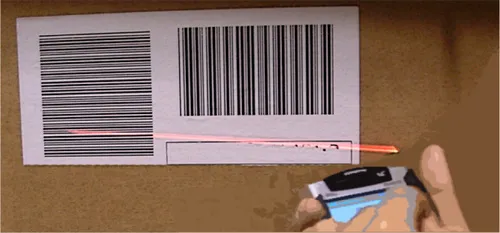
Figure 1.1 Photograph of a barcode system
1.1 RFID: state of the art
1.1.1 Introduction to RFID
In order to overcome barcode limitations, radio frequency identification (RFID) technologies have been developed in recent years [FIN 10]. RFID systems are used to remotely retrieve data from target objects (tags) without the need for physical contact or line of sight by using magnetic or electromagnetic (EM) waves. With some RFID systems, it is also possible to measure several tags at the same time and rewrite the tag information.
Figure 1.2 shows a basic scheme of an RFID system. There are two main families: near-field RFID (Figure 1.2(a)) and far-field RFID (Figure 1.2(b)) [WAN 06]. Near-field RFID is based on Faraday’s principle of magnetic induction (magnetic coupling). Both the reader and the tag have coils. The reader powers up the tag’s transponder chip, which can be rewritten. Near-field RFID based on this inductive communication is used for small distances, typically below λ/(2π) where λ is the wavelength [WAN 06]. ISO 15693 and 14443 standards set frequencies below 14 MHz, which results in a range of a few centimeters. Near-field RFID is widely used for cards and access control, but not for goods management due to its limited range. Far-field RFID uses EM waves propagated through antennas both in the reader and the tag. A reader can be monostatic if it only has an antenna that acts for transmission (Tx) and reception (Rx). On the contrary, if the reader has separate Tx and Rx antennas, it is bistatic. The reader sends an EM wave that is captured by the tag’s antenna at a distance of several meters. There are several standards for far-field RFID, with the Electronic Product Code (EPC) Gen2 standard, at the Ultra High Frequency (UHF) (868 MHz in Europe or 915 MHz in the United States) band, being the most used.
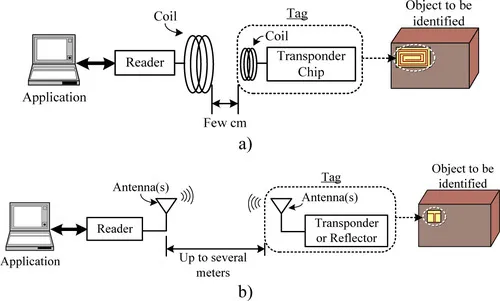
Figure 1.2 Scheme of an RFID system; a) near-field and b) far-field
Even though the barcode is still the de facto standard, RFID is one of the fastest growing sectors of the radio technology. As of 2014, nearly every commercially available smartphone integrates near-field RFID with the Near Field Communication (NFC) forum’s standards [HAR 14]. Wal-Mart and Tesco, some of the largest retailers in the United States the and the United Kingdom, respectively, are adopting RFID [WAN 06]. Furthermore, wireless ID has developed into an interdisciplinary field. Radio frequency (RF) technology, semiconductor technology, data protection and cryptography, telecommunications and related areas come together to develop cheap, secure, reliable, long-range and self-powered RFID tags.
Far-field RFID systems can be classified depending on how the tags get the necessary energy to respond to the readers. Active tags are the most expensive tags, since they need their own power supply (i.e. batteries) not only to power their own chip but also to generate the radio signal with the response to the reader. Semi-passive tags are less expensive than active tags, since they need batteries, but only to power their own logic circuitry, not a transmitter. The response is achieved by changing the reflected signal from the reader in a process called backscattering. This means that the batteries can be smaller and have longer life times (usually years). Finally, passive tags are the cheapest ones and have the largest commercial potential for large-scale spreading [VIT 05, COL 04]. Passive tags use the reader’s RF signal to harvest the necessary power for themselves [VIT 05]. Specifically, passive UHF EPC tags are the type of RFID tags most widely used for large-scale applications. Depending on the region, there are different frequency bands and maximum allowed powers allocated for RFID applications [GS1 14]. In Europe, the most used band is 865.6–867.6 MHz, with a maximum transmitted power of 2 W of effective radiated power (ERP), or, equivalently, 3.28 W of effective isotropic radiated power (EIRP). Similarly, in the United States the allowed RFID band is 902–928 MHz, with a maximum transmitted power of 4 W EIRP, or, equivalently, 2.44 W of ERP. It can be observed that American regulations permit more transmitted power than European regulations, allowing for longer read ranges. Most manufacturers provide UHF RFID tags and readers compatible with both European and American bands. Figure 1.3 shows an example of a typical commercial UHF EPC Gen2 reader and tag from Alien Technology [ALI 16]. These types of tags have a sensitivity of about −20 dBm [IMP 14, ALI 14], and read ranges between 6 and 10 m depending on the region [EXT 10]. Recent research has increased the read range to about 25 m by assisting the tag with a battery (battery-assisted passive tags) [ZHE 14].
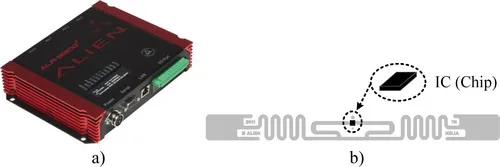
Figure 1.3 a) Alien ALR-9900 UHF EPC Gen2 RFID reader; b) Alien ALN9740 UHF RFID tag
There have also been recent developments in millimeter wave bands. Millimeter wave identification (MMID) has been presented in [PUR 08] as a concept of RFID operating at 60 GHz. MMID is not a replacement of RFID, since its read range is much shorter (a few centimeters). MMID, however, permits high data rate communications (even gigabit). Directive antennas at millimeter wave frequencies are also very small compared to UHF, permitting the possibility of selecting a tag by pointing toward it. The use of nonlinear devices for RFID tags has also been studied recently. Tags based on the inter-modulation distortion of devices have been presented in [CAR 07] using a diode for localization applications, and in [VII 09] using the micro electromechanical system.
1.1.2 Chipless RFID
Chipless tags are a specific type of passive RFID tags. In these tags, instead of storing the ID in a digital IC, it is stored in physical permanent modifications when the tag is fabricated. These modifications change from one tag to another. A notable reduction in costs for passive UHF tags has been achieved recently [VIT 05] due to the popularization in using RFID technology. However, each UHF tag price is fixed by the chip and by the process of connecting it to the ta...
Table of contents
- Cover image
- Title page
- Table of Contents
- Copyright
- Preface
- Acknowledgements
- 1: Introduction to RFID and Chipless RFID
- 2: Chipless Time-coded UWB RFID: Reader, Signal Processing and Tag Design
- 3: Wireless Sensors Using Chipless Time-coded UWB RFID
- 4: Semi-passive Time-coded UWB RFID: Analog and Digital Approaches
- 5: Wireless Sensors Using Semi-passive UWB RFID
- 6: Active Time-coded UWB RFID
- 7: Indoor Localization with Smart Floor Based on Time-coded UWB RFID and Ground Penetrating Radar
- Bibliography
- Index
Frequently asked questions
Yes, you can cancel anytime from the Subscription tab in your account settings on the Perlego website. Your subscription will stay active until the end of your current billing period. Learn how to cancel your subscription
No, books cannot be downloaded as external files, such as PDFs, for use outside of Perlego. However, you can download books within the Perlego app for offline reading on mobile or tablet. Learn how to download books offline
Perlego offers two plans: Essential and Complete
- Essential is ideal for learners and professionals who enjoy exploring a wide range of subjects. Access the Essential Library with 800,000+ trusted titles and best-sellers across business, personal growth, and the humanities. Includes unlimited reading time and Standard Read Aloud voice.
- Complete: Perfect for advanced learners and researchers needing full, unrestricted access. Unlock 1.5M+ books across hundreds of subjects, including academic and specialized titles. The Complete Plan also includes advanced features like Premium Read Aloud and Research Assistant.
We are an online textbook subscription service, where you can get access to an entire online library for less than the price of a single book per month. With over 1.5 million books across 990+ topics, we’ve got you covered! Learn about our mission
Look out for the read-aloud symbol on your next book to see if you can listen to it. The read-aloud tool reads text aloud for you, highlighting the text as it is being read. You can pause it, speed it up and slow it down. Learn more about Read Aloud
Yes! You can use the Perlego app on both iOS and Android devices to read anytime, anywhere — even offline. Perfect for commutes or when you’re on the go.
Please note we cannot support devices running on iOS 13 and Android 7 or earlier. Learn more about using the app
Please note we cannot support devices running on iOS 13 and Android 7 or earlier. Learn more about using the app
Yes, you can access RFID and Wireless Sensors Using Ultra-Wideband Technology by Angel Ramos,Antonio Lazaro,David Girbau,Ramon Villarino in PDF and/or ePUB format, as well as other popular books in Technology & Engineering & Mobile & Wireless Communications. We have over 1.5 million books available in our catalogue for you to explore.