- 262 pages
- English
- ePUB (mobile friendly)
- Available on iOS & Android
eBook - ePub
About this book
Performance Testing of Textiles: Methods, Technology and Applications examines the developed and established methodology for testing performance textiles, also summarizing the material properties for advanced applications.
This book emphasizes reproducible tests using commonly used experimental methods reported in scientific literature and internationally recognized testing standards to quantify textile material properties and performance.
After an introductory explanation of key fiber and textile properties and testing methods, the book summarizes electronic testing theories, technologies, and instrumentation for performance textiles. Also covered are aspects of military textile, medical textile, sportswear, smart composites, and wearable textiles which, as examples, present the latest research and results related to performance textile testing and applications.
- Offers up-to-date coverage of new and advanced performance testing techniques for the fiber and textile industries
- Explores key fiber and textile properties
- Summarizes electronic testing theories, technologies, and instrumentation for performance textiles
- Includes contributions from an international team of authors edited by an expert in the field
Information
Subtopic
Ingegneria industrialeSection B
Performance testing for specific applications
2
Comfort testing and fit analysis of military textiles
A. Schmidt; R. Paul; E. Classen; S. Morlock; J. Beringer Hohenstein Institute for Textile Innovation gGmbH, Boennigheim, Germany
Abstract
Apart from testing the functional properties, the testing of comfort parameters is very important in the case of military clothing. As the performance of the soldiers is directly connected to the clothing comfort, a perfect balance between functional properties and comfort is required. This chapter covers the most important comfort parameters and their testing methods. Other important areas, the fit of clothing as well as head protection systems, are also covered in detail.
Keywords
Military textiles; Comfort testing; Thermophysiological comfort; Skin Model; Thermal manikin; Skin sensorial comfort; Cooling power; Clothing fit.
2.1 Introduction
Clothing is the first line of defense for the wearer, not only in an emergency situation, but also in their daily routine. Occupational hazards determine the extent of protection that clothing has to offer. Protective textile materials can be broadly classified as: impermeable, semipermeable, air permeable, and selectively permeable materials. Although the majority of commercially available protective textiles available for end users consist of impermeable clothing, protection offered by impermeable clothing often comes at the expense of breathability and other comfort characteristics of textiles. This eventually results in high levels of discomfort and extreme physical stress for the wearer.
The deployment of soldiers to areas with extreme climates has put new demands on the functions of military clothing for weather protection and comfort. Nowadays, military clothing plays a key role in protecting soldiers and it must perform several functions in the most rugged conditions, and has to be adapted to different fields of operation. At the same time, it is highly desirable that the clothing remain durable and above all, comfortable.
In combat situations, ballistic protective vests should protect from bullets and shell splinters. Therefore a high protection level is the main target in development. On the other hand, wear comfort of such vests is limited, especially when the wearer sweats, due to heat and/or increased physical activity. This unsatisfactory wear comfort is a risk for soldiers too, eg, when feeling too warm, or clothing is scratching the skin, they will be deflected. Furthermore, too warm clothing systems reduce physical fitness, and in extreme cases, can cause hyperthermia.
The functional properties added to military clothing are aimed at providing increased safety and survivability of soldiers in the field. Military clothing systems normally have to resist greater strains than normal garments. Materials tend to age much faster in cold conditions and under extreme exposure to the sun. Successful missions nowadays often depend on the performance of the tactical clothing and equipment. The soldier’s survivability, mobility, and stamina are closely linked with wear comfort and the fit of the clothing. For wearers who perform high physical activity, it is vital that the military clothing system protects from the impact of the environment and that heat and moisture is led away from the body. A perfect balance between performance, comfort, and high durability is required. In this respect, several critical tests are necessary to ensure that strict performance requirements are met and, ultimately, the soldier is properly protected to ensure efficiency and effectiveness of military operations.
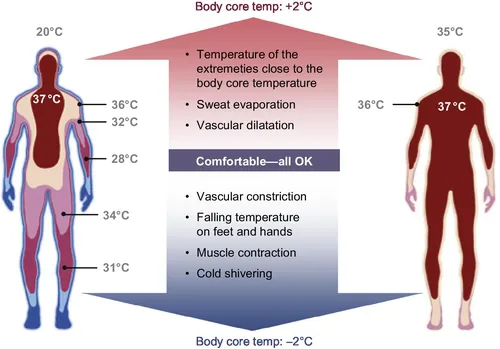
The body reacts to temperature changes with changes in energy use leading to reduced performance of soldiers. Optimal clothing supports the soldier by providing physiological function. This means that in a specific climate/activity scenario, properly designed clothing must assist human thermoregulation in such a way that the body core temperature remains at a steady value between 36.5°C and 37.5°C. The human body generates heat energy at a steady state “metabolic rate.” It varies from 80 W while sleeping up to 800 W or more in very high physical activity. To maintain the body core temperature constant at about 37°C within a limit of only ± 2°C at varying metabolic rates, the human body has its own thermoregulatory mechanism as shown in Fig. 2.1. Additionally, controlling the humidity in the “microclimate,” ie, in the air layer within the clothing next to the skin, is extremely important to maintain values low enough to be subjectively perceived as comfortable.
2.2 Comfort testing of military clothing
In general, the military specifications are normally set at higher levels or require specific modifications. Military textiles are normally tested and certified for textile ballistic resistance, textile safety, UV protection, antimicrobial effectiveness, fire resistance, and many other technical features. The wear comfort, fit, and design are equally important and this chapter focuses on these areas.
2.2.1 Thermophysiological properties
Wear comfort is essential for any successful military operation. Nowadays armed forces must be prepared to resolve conflicts anywhere in the world, from blistering deserts to frigid wastelands. Soldiers are the most important and most vulnerable part of a mission and are likely to encounter severe heat stress that must be managed for successful mission accomplishment.
Heat stress results from the interaction of climatic conditions, body heat production, and clothing or equipment that impedes heat loss. Tactical clothing often shows high thermal insulation and low permeability to water vapor, which greatly impedes heat loss, and thus exacerbates heat stress. Dedicated research on clothing physiology has resulted in developing innovative clothing systems that can reduce susceptibility to heat injury considerably.
By definition, clothing physiology is the interaction of body, climate, and clothing. With scientific methods the impact of clothing on the well-being of the wearer and wear comfort in textiles can be measured and quantified. In order to assess the physiological properties of textiles during design, among other factors, breathability has to be measured and expressed accurately and be reproducible. Such assessments must correlate to the physiological comfort perceived objectively and subjectively by the wearer.
Clothing physiology, the science and engineering of physiological function and the wear comfort of textiles and garments, became a quantitative science some 50 years ago (http://www.hohenstein.de/media/downloads/FC_EN_Bekleidungsphysiologie_mail.pdf). Over this time, scientific methods and apparatus have been developed to measure the water vapor transmission of textiles, which is critical to comfort and performance. These methods differ in the principle of the test, the complexity and duration of the test procedure, as well as the cost for the test apparatus. Among others, there are two primary methods and models that have emerged for testing the breathability of textiles. One method uses the so-called sweating guarded hot plate test (Skin Model), determining the water vapor resistance as Ret in m2 Pa/W. This method is internationally standardized in ISO 11092 or EN 31092. The second recognized method utilizes a so-called Cup Test determining the water vapor transmission rate (WVTR) g/m2 24 h, nationally st...
Table of contents
- Cover image
- Title page
- Table of Contents
- Copyright
- List of contributors
- Woodhead Publishing Series in Textiles
- Section A: Performance testing techniques, technologies and standards
- Section B: Performance testing for specific applications
- Index
Trusted by 375,005 students
Access to over 1.5 million titles for a fair monthly price.
Study more efficiently using our study tools.
Frequently asked questions
Yes, you can cancel anytime from the Subscription tab in your account settings on the Perlego website. Your subscription will stay active until the end of your current billing period. Learn how to cancel your subscription
No, books cannot be downloaded as external files, such as PDFs, for use outside of Perlego. However, you can download books within the Perlego app for offline reading on mobile or tablet. Learn how to download books offline
Perlego offers two plans: Essential and Complete
- Essential is ideal for learners and professionals who enjoy exploring a wide range of subjects. Access the Essential Library with 800,000+ trusted titles and best-sellers across business, personal growth, and the humanities. Includes unlimited reading time and Standard Read Aloud voice.
- Complete: Perfect for advanced learners and researchers needing full, unrestricted access. Unlock 1.5M+ books across hundreds of subjects, including academic and specialized titles. The Complete Plan also includes advanced features like Premium Read Aloud and Research Assistant.
We are an online textbook subscription service, where you can get access to an entire online library for less than the price of a single book per month. With over 1.5 million books across 990+ topics, we’ve got you covered! Learn about our mission
Look out for the read-aloud symbol on your next book to see if you can listen to it. The read-aloud tool reads text aloud for you, highlighting the text as it is being read. You can pause it, speed it up and slow it down. Learn more about Read Aloud
Yes! You can use the Perlego app on both iOS and Android devices to read anytime, anywhere — even offline. Perfect for commutes or when you’re on the go.
Please note we cannot support devices running on iOS 13 and Android 7 or earlier. Learn more about using the app
Please note we cannot support devices running on iOS 13 and Android 7 or earlier. Learn more about using the app
Yes, you can access Performance Testing of Textiles by Lijing Wang in PDF and/or ePUB format, as well as other popular books in Tecnologia e ingegneria & Ingegneria industriale. We have over 1.5 million books available in our catalogue for you to explore.