Mechanical and thermal properties are reviewed and electrical and magnetic properties are emphasized. Basics of symmetry and internal structure of crystals and the main properties of metals, dielectrics, semiconductors, and magnetic materials are discussed. The theory and modern experimental data are presented, as well as the specifications of materials that are necessary for practical application in electronics. The modern state of research in nanophysics of metals, magnetic materials, dielectrics and semiconductors is taken into account, with particular attention to the influence of structure on the physical properties of nano-materials.
The book uses simplified mathematical treatment of theories, while emphasis is placed on the basic concepts of physical phenomena in electronic materials. Most chapters are devoted to the advanced scientific and technological problems of electronic materials; in addition, some new insights into theoretical facts relevant to technical devices are presented.
Electronic Materials is an essential reference for newcomers to the field of electronics, providing a fundamental understanding of important basic and advanced concepts in electronic materials science.
Provides important overview of the fundamentals of electronic materials properties significant for device applications along with advanced and applied concepts essential to those working in the field of electronics
Takes a simplified and mathematical approach to theories essential to the understanding of electronic materials and summarizes important takeaways at the end of each chapter
Interweaves modern experimental data and research in topics such as nanophysics, nanomaterials and dielectrics
The nature of chemical bonds in solids—crystals, polycrystals, glasses, and amorphous structures—is described on the basis of generally accepted views. Particular attention is paid to polar bonds, which determine special properties of active (functional) dielectrics (piezoelectrics, pyroelectrics, ferroelectrics) and some semiconductors. Moreover, various types of structural defects in crystals and their influence on crystal properties are analyzed. A brief theory of crystal structures symmetry is described, mainly in aspects necessary for understanding special phenomena in materials used in electronic engineering. Some attention is paid to features of quasicrystals and nanomaterials, and a brief review of their main structures is given, including structures of composites and metamaterials.
Keywords
Atomic bonds; Polar bonding; Structural defects; Elements of symmetry; Classes of symmetry; Composites; Quasicrystals; Nanomaterials; Metamaterials
Before describing the most diverse properties of materials used in electronics, it is necessary to consider the features of their structures, in which these properties are realized.
The formation of crystal, amorphous, and other substances from atoms is accompanied by a decrease of the energy in a system as compared to unconnected atoms. The minimum energy in solids corresponds to a regular arrangement of atoms that agrees with the specific distribution of electronic density between them. In accordance with the electronic theory of valence, interatomic bonds are formed due to the redistribution of electrons in their valence orbitals, resulting in a stable electronic configuration of noble gas (octet) due to formation of ions or of shared electron pairs between atoms.
1.1 Atomic Bonding in Metals, Semiconductors, and Dielectrics
Any connections of atoms, molecules, or ions are conditioned by electrical and magnetic interactions. At longer distances, electrical forces of attraction dominate between particles whereas, at short distances, repulsion of particles increases sharply. The balance between such long-range attraction and short-range repulsion is the cause of the basic properties of substances. The atomic connection is attributable to the restructuring of atomic electronic shells, thus creating chemical bonds. In other words, chemical bonds are the phenomenon of atomic interaction by means of overlap of their electronic clouds, and this is accompanied by a decrease of the total energy of a system.
Chemical bonding is characterized by both energy and length. A measure of bond strength is the energy, expended in case of bond destruction, or the energy gained during compound formation from individual atoms. Consequently, the energy of chemical bonds equals the work that must be expended to separate particles that are constrained, or to alienate them from each other on the infinite distance [1].
During the formation of chemical bonds, exactly those electrons that belong to the valence shells play a major role because their contribution to solid body formation is much greater than that of the inner electrons of atoms. However, division into ionic residues and valence electrons is a matter of convention. For example, in metals it is sufficient to consider that valence electrons are transformed into conduction electrons whereas all other electrons belong to ionic residues.
In the atoms of a metal, their outer electronic orbits are filled with a relatively small number of electrons that have low ionization energy. When these atoms come together (i.e., when crystal is formed from atoms), the orbits of valence electrons strongly overlap. As a result, valence electrons in metals become uniformly distributed in a space between cations, and these electrons have a common wave function. Therefore valence electrons in most metals are fully collectivized, and thus such crystals constitute a lattice of positively charged ions crowded by “electronic gas.” Unlike, for example, covalent bonds, the complete delocalization of electrons is a distinctive feature of metallic bonds.
It is in this way that the spatial distribution of valence electrons lies at the heart of the classification of solids (dielectrics, semiconductors, and metals). The division of crystals into different classes suggests that solids consist of:
•ionic residues, that is, nuclei themselves and those electrons that are so strongly associated with their nuclei that the residues formed cannot significantly change their configuration as compared with the atom;
•valence electrons, that is, electrons, the distribution of which, in solids, may differ significantly from the configuration existing in isolated atoms.
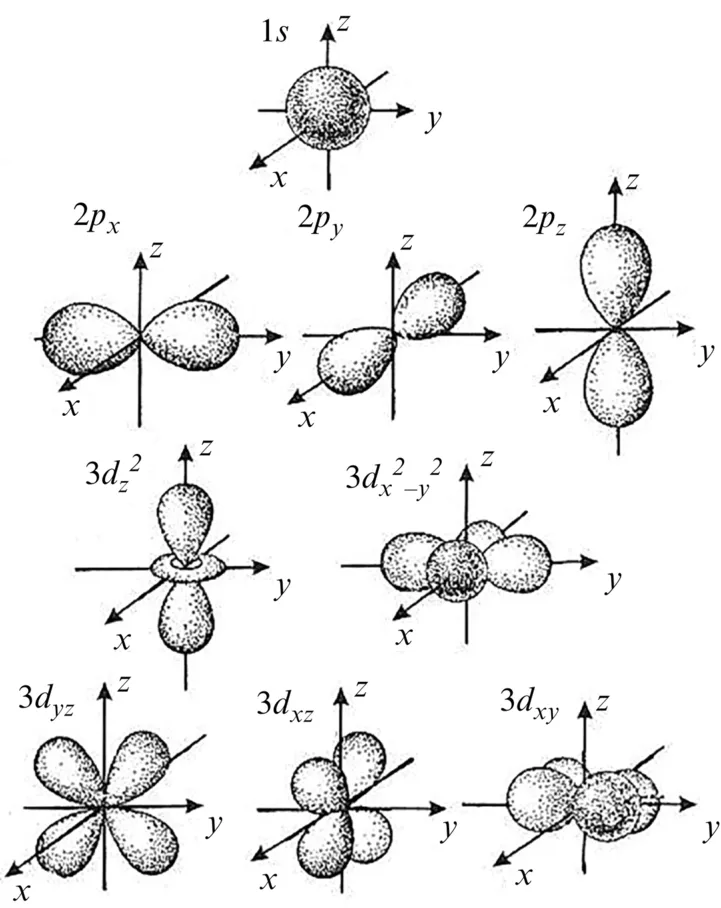
The spatial distribution of electronic orbitals of certain atoms has a strong influence on the bond strength and their direction. Fig. 1.1 schematically shows how major electronic orbitals for s-, p-, and d-states of electrons in the atoms might look. Only the s-orbital is characterized by spherical symmetry. In contrast, the p-orbital has a very specific form, and this is especially true for the d-orbitals: their forms are considered to contribute to the specific properties of transition metals. Rare earth metals have f-electrons, and they may play a dual role: as residue electrons of “atomic core” and as “free” electrons (because of their complexity, f-orbitals are not shown in Fig. 1.1).
Fig. 1.1 Forms of s-, p-, and d- orbitals: angular dependence of square wave functions.
Thus during chemical bond formation, valence electrons play a dominant role because, at crystal formation, their contribution is much greater than that of electrons, which form atomic internal orbitals in the residues.
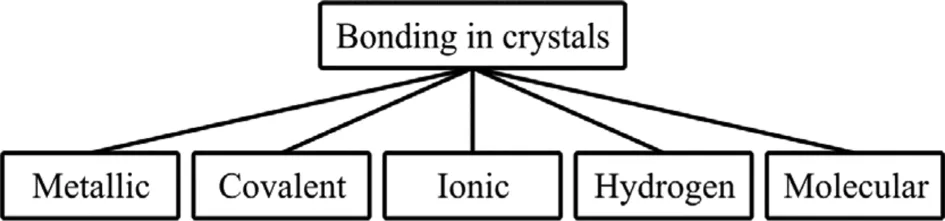
A classification of the possible bonds of particles in crystals is shown in Fig. 1.2. This division is rather conditional, because it corresponds to simplified models. In many cases, the actual bonding is more complicated and often presents as an intermediate case between simple models.
Fig. 1.2 Various models of atomic bonds in crystals [2].
Molecular and metallic bonds are shown at the opposite sides of the scheme, because they are absolute opposites. In molecular crystals, electrons usually are completely locked in their molecules (or atoms; Fig. 1.3A). The nuclei are surrounded by spaces (shown as black balls), where the density of the electronic cloud reaches significant values.
Fig. 1.3 Two-dimensional image of electrical charge distribution: (A) molecular crystal, in which quadrupole electronic fluctuation (+ − … − +) results in the attraction ...
Table of contents
Cover image
Title page
Table of Contents
Copyright
Preface
Acknowledgments
Introduction
Chapter 1: Structure of electronic materials
Chapter 2: Mechanical properties of solids
Chapter 3: Thermal properties of solids
Chapter 4: Quasiparticles in solids
Chapter 5: Metals
Chapter 6: Magnetics
Chapter 7: Dielectrics
Chapter 8: Semiconductors
Chapter 9: Polar dielectrics in electronics
Chapter 10: Phase transitions in solids
Index
Trusted by 375,005 students
Access to over 1.5 million titles for a fair monthly price.
Study more efficiently using our study tools.
Frequently asked questions
Yes, you can cancel anytime from the Subscription tab in your account settings on the Perlego website. Your subscription will stay active until the end of your current billing period. Learn how to cancel your subscription
No, books cannot be downloaded as external files, such as PDFs, for use outside of Perlego. However, you can download books within the Perlego app for offline reading on mobile or tablet. Learn how to download books offline
Perlego offers two plans: Essential and Complete
Essential is ideal for learners and professionals who enjoy exploring a wide range of subjects. Access the Essential Library with 800,000+ trusted titles and best-sellers across business, personal growth, and the humanities. Includes unlimited reading time and Standard Read Aloud voice.
Complete: Perfect for advanced learners and researchers needing full, unrestricted access. Unlock 1.5M+ books across hundreds of subjects, including academic and specialized titles. The Complete Plan also includes advanced features like Premium Read Aloud and Research Assistant.
Both plans are available with monthly, semester, or annual billing cycles.
We are an online textbook subscription service, where you can get access to an entire online library for less than the price of a single book per month. With over 1.5 million books across 990+ topics, we’ve got you covered! Learn about our mission
Look out for the read-aloud symbol on your next book to see if you can listen to it. The read-aloud tool reads text aloud for you, highlighting the text as it is being read. You can pause it, speed it up and slow it down. Learn more about Read Aloud
Yes! You can use the Perlego app on both iOS and Android devices to read anytime, anywhere — even offline. Perfect for commutes or when you’re on the go. Please note we cannot support devices running on iOS 13 and Android 7 or earlier. Learn more about using the app
Yes, you can access Electronic Materials by Yuriy Poplavko in PDF and/or ePUB format, as well as other popular books in Physical Sciences & Condensed Matter. We have over 1.5 million books available in our catalogue for you to explore.