Auxetic Textiles provides a detailed introduction to the basic properties of auxetic materials and how they differ from conventional materials, particularly auxetic textiles, such as polymers, fibers, yarns, fabrics and textile composites. The book discusses the beneficial properties of auxetic structures in textiles and how to translate those benefits into actual materials development. Sections cover the deformation mechanism of textile structures to achieve auxetic behavior and the modelling and simulation of auxetic textile structures. Finally, the book provides expert insights into potential application areas.
Cutting across textiles disciplines, from technical textiles and advanced composites, to fashion and design, the book is a valuable introduction to the field for newcomers, with potent insights into the potential of these materials.
- Introduces the concept of auxetic materials and their differences from conventional materials
- Provides a practical guide to the mechanics of achieving auxetic properties in textile materials, including polymers, fibers, yarns, fabrics and composites
- Reviews and links up research and development in auxetic materials with the textile industry, helping enable the development of a range of new applications
This chapter introduces the definition of Poisson’s ratio and briefly discusses its bounds from the point of view of classical elasticity theory. The enhancements of the mechanical and physical properties of materials due to auxetic or negative Poisson’s ratio behaviour are presented. The classifications of auxetic materials and auxetic textiles and a brief introduction on each class are also given.
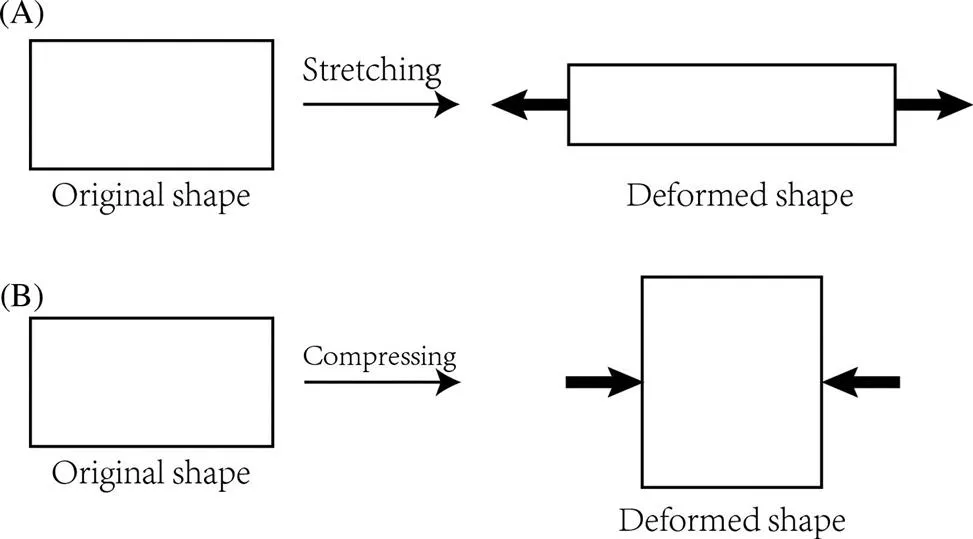
For ordinary materials in the world, it is a common sense that when materials are stretched or compressed in one direction, they contract or expand in the other direction perpendicular to the loading direction correspondently, as shown in Fig. 1.1A and B. For each type of material the contraction or expansion against the stretching or compression can be defined by a specific ratio known as Poisson’s ratio.
Figure 1.1 Schematic illustration for the deformation of materials with positive Poisson’s ratio: (A) under stretching; (B) under compression.
Therefore the Poisson’s ratio v is defined as the negative ratio between the strain in the transverse direction
and the strain in the loading direction
.
(1.1)
(1.1)
The negative sign introduced in Eq. (1.1) is used to characterise the common and even intuitive phenomenon that stretching is expected to make materials thinner and compression results in bulge.
1.2 Nonconventional behaviour of auxetic materials
1.2.1 Definition of auxetic materials
It is logical to think that Poisson’s ratio is positive, and for most of the materials in engineering,
lies in the range from 0.2 to 0.5 [1]. Actually, the negative value of Poisson’s ratio does not contradict the classical elasticity, although it sounds incredible. Bounds for the Poisson’s ratio have been sufficiently discussed in literature. As early as 1848, Saint-Venant [2] suggested that the Poisson’s ratio may be negative in anisotropic materials and also may be greater than 0.5 for the first time in history. The limitation of the Poisson’s ratio (between −1 and 0.5) for isotropic materials was given by Fung [3] in 1965 according to the mathematical theory of elasticity. Similar conclusion was also reported elsewhere [4–6]. Based on the first law of thermodynamics, classical elasticity posits a free energy
for isotropic body as a function of the strain tensor [4]:
(1.2)
(1.2)
where the general summation rule on repeated indices was used in the text book by Landau and Lifshitz [4], and the quantities
and
are called Lamé coefficients (
is also called the shear modulus).
Since any deformation of bodies can be represented as the sum of a pure shear and a hydrostatic compression, an identical expression for the strain tensor can be given as
(1.3)
(1.3)
where δik is Kronecker delta and D = 2, 3 refers to the numbers of dimensions. What should be noted is that the values of subscripts i, k, n are x, y with D=2 while that are x, y, z with D=3. As mentioned by Landau and Lifshitz [4], the first term on the right is a pure shear, and the second term is a hydrostatic compression.
By using Eqs. (1.2) and (1.3) a general expression for the free energy of a deformed isotropic body in D dimension is given as follows [5]:
(1.4)
(1.4)
where
and the quadratic Eq. (1.4) is positive definite if and only if the quantities
and
are positive, that is
,
.
The stress tensor can be obtained by calculate the derivatives
:
(1.5)
(1.5)
Intuitively, we can find from Eq. (1.5) that
(1.6)
(1.6)
Then, it is not difficult to give the converse formula that expresses strain tensor
in terms of stress tensor
:
(1.7)
(1.7)
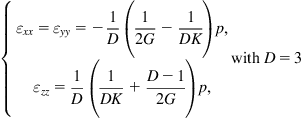
For a 3D isotropic body, just considering a hydrostatic pressure of
along the z axis, we have
,
,
, and all the component
and
with
are zero. The remaining components of
can be obtained according to Eq. (1.7):
(1.8)
(1.8)
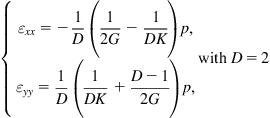
Similarly, in the case of the 2D isotropic body, considering a hydrostatic pressure of
along the y axis, we can find
(1.9)
(1.9)
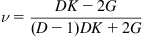
According to the definition of the Poisson’s ratio [see Eq. (1.1)], a general expression for the Poisson’s ratio of isotropic body in D dimensions can be given by using Eqs. (1.8) and (1.9):
(1.10)
(1.10)
Since
and
...
Table of contents
Cover image
Title page
Table of Contents
Copyright
Acknowledgements
1. Introduction
2. Auxetic structures and mechanisms
3. Auxetic polymers
4. Auxetic fibres and yarns
5. Auxetic fabrics based on knitted structures
6. Auxetic fabrics based on woven structures
7. Auxetic fabrics based on nonwoven structures
8. Auxetic fabrics based on braided structures
9. Auxetic fibre–reinforced composites
10. Applications of auxetic textiles
Index
Trusted by 375,005 students
Access to over 1.5 million titles for a fair monthly price.
Study more efficiently using our study tools.
Frequently asked questions
Yes, you can cancel anytime from the Subscription tab in your account settings on the Perlego website. Your subscription will stay active until the end of your current billing period. Learn how to cancel your subscription
No, books cannot be downloaded as external files, such as PDFs, for use outside of Perlego. However, you can download books within the Perlego app for offline reading on mobile or tablet. Learn how to download books offline
Perlego offers two plans: Essential and Complete
Essential is ideal for learners and professionals who enjoy exploring a wide range of subjects. Access the Essential Library with 800,000+ trusted titles and best-sellers across business, personal growth, and the humanities. Includes unlimited reading time and Standard Read Aloud voice.
Complete: Perfect for advanced learners and researchers needing full, unrestricted access. Unlock 1.5M+ books across hundreds of subjects, including academic and specialized titles. The Complete Plan also includes advanced features like Premium Read Aloud and Research Assistant.
Both plans are available with monthly, semester, or annual billing cycles.
We are an online textbook subscription service, where you can get access to an entire online library for less than the price of a single book per month. With over 1.5 million books across 990+ topics, we’ve got you covered! Learn about our mission
Look out for the read-aloud symbol on your next book to see if you can listen to it. The read-aloud tool reads text aloud for you, highlighting the text as it is being read. You can pause it, speed it up and slow it down. Learn more about Read Aloud
Yes! You can use the Perlego app on both iOS and Android devices to read anytime, anywhere — even offline. Perfect for commutes or when you’re on the go. Please note we cannot support devices running on iOS 13 and Android 7 or earlier. Learn more about using the app
Yes, you can access Auxetic Textiles by Hong Hu,Minglonghai Zhang,Yanping Liu in PDF and/or ePUB format, as well as other popular books in Technology & Engineering & Materials Science. We have over 1.5 million books available in our catalogue for you to explore.