- 448 pages
- English
- ePUB (mobile friendly)
- Available on iOS & Android
eBook - ePub
About this book
Measuring Ocean Currents: Tools, Technologies, and Data covers all major aspects of ocean current measurements in view of the implications of ocean currents on changing climate, increasing pollution levels, and offshore engineering activities. Although more than 70% of the Earth is covered by ocean, there is limited information on the countless fine- to large-scale water motions taking place within them. This book fills that information gap as the first work that summarizes the state-of-the-art methods and instruments used for surface, subsurface, and abyssal ocean current measurements.
Readers of this book will find a wealth of information on Lagrangian measurements, horizontal mapping, imaging, Eulerian measurements, and vertical profiling techniques. In addition, the book describes modern technologies for remote measurement of ocean currents and their signatures, including HF Doppler radar systems, satellite-borne sensors, ocean acoustic tomography, and more. Crucial aspects of ocean currents are described in detail as well, including dispersion of effluents discharged into the sea and transport of beneficial materials—as well as environmentally hazardous materials—from one region to another. The book highlights several important practical applications, showing how measurements relate to climate change and pollution levels, how they affect coastal and offshore engineering activities, and how they can aid in tsunami detection.
- Coverage of measurement, mapping and profiling techniques
- Descriptions of technologies for remote measurement of ocean currents and their signatures
- Reviews crucial aspects of ocean currents, including special emphasis on the planet-spanning thermohaline circulation, known as the ocean's "conveyor belt," and its crucial role in climate change
Information
Chapter 1
Oceanic Currents and Their Implications
Abstract
This chapter begins with a general introduction on oceans’ thermohaline conveyor belt circulation and its coupling to global climate change. This is followed by a description of ocean current features such as meandering currents, eddies, rings, and hydrographic fronts and their influence on fishery and weather. Major current systems in the world oceans are addressed next. These include the Antarctic circumpolar current and western boundary currents in the Atlantic, Pacific, and Indian oceans. Equatorial undercurrents in all three oceans that cross the equator are addressed next. This chapter winds up with a discussion of currents of different origins and their implications to living creatures on this planet. A list of references is provided.
Keywords
Thermohaline circulation; global conveyor belt; frontal circulation system; meanders; eddies; rings; sea surface currents; western boundary currents; equatorial undercurrents; tidal current; drifters; current charts; maritime navigation
Chapter Outline
1.1. Oceans’ Thermohaline Conveyor Belt Circulation and Global Climate Change
1.2. Meandering Currents, Eddies, Rings, and Hydrographic Fronts
1.2.1. Meandering Currents
1.2.2. Eddies
1.2.3. Rings
1.2.4. Hydrographic Fronts
1.3. Influence of Eddies and Fronts on Fishery and Weather
1.4. Major Current Systems in the World Oceans
1.4.1. Antarctic Circumpolar Current
1.4.2. Western Boundary Currents in the Atlantic Ocean
1.4.2.1. The Gulf Stream
1.4.2.2. The Brazil Current
1.4.3. Western Boundary Current in the Pacific Ocean: The Kuroshio Current
1.4.4. Western Boundary Currents in the Indian Ocean
1.4.4.1. The Agulhas Current
1.4.4.2. The Somali Current
1.4.5. Equatorial Undercurrents
1.4.5.1. Equatorial Undercurrent in the Atlantic Ocean
1.4.5.2. Equatorial Undercurrent in the Pacific Ocean
1.4.5.3. Equatorial Undercurrent in the Indian Ocean
1.5. Currents of Different Origins
1.5.1. Wind-Driven Current
1.5.1.1. Ekman Spiral
1.5.1.2. Langmuir Circulation
1.5.2. Inertia Current
1.5.3. Tidal Currents in Open Seas, Estuaries, and Ridge Valleys
1.5.4. Rip Currents
1.6. Implications of Ocean Currents
References
Climate and oceanic researchers consider that one of the most important roles played by the planet’s oceans is the regulation of the Earth’s climate; naturally this has become the focus of the global approach to research in recent decades. We are increasingly concerned about global climate change (i.e., long-term fluctuations in temperature, precipitation, wind, and all other aspects of the Earth’s climate) and its regional impacts. The sea ice extent in the Arctic Ocean has decreased to record minimums in recent years (e.g., Serreze et al., 2003; Comiso, 2006), and such Arctic processes might amplify changes in global climate.
An examination of autonomous drifting float observations collected during the 1990s and historical shipboard measurements suggests that the mid-depth (700–1,100 m) Southern Ocean temperatures have risen since the 1950s (Gille, 2002). This warming is faster than that of the global ocean and is concentrated in the Antarctic Circumpolar Current (ACC), where temperature rates of change are comparable with Southern Ocean atmospheric temperature increases (Gille, 2002). It has been found that the warming is associated with a southward migration of the ACC since the 1950s of about 50 km in the Pacific (Swift, 1995) as well as the Atlantic and Indian oceans (Gille, 2002). A more recent analysis of 32 yr (1966–98) of subsurface layer (200–900 m) temperature observations in the Indian sector of the Southern Ocean similarly show a warming trend concentrated in the ACC, indicative of a southward shift of the ACC of about 50 km (Aoki et al., 2003).
These changes seem to be associated with long-term changes in the overlying atmospheric circulation (Thompson and Solomon, 2000; Fyfe, 2003; Marshall, 2003). From the global ocean modeling standpoint it is known that a change in the position of the surface wind stress over the Southern Ocean can affect a change in the position of the ACC (Hall and Visbeck, 2002; Oke and England, 2004). Transient climate-change simulations carried out by Fyfe and Saenko (2005) suggest that about half of the observed poleward shift of the ACC seen since the 1950s is the consequence of human activity. In the future the ACC is predicted to continue to shift poleward as well as to accelerate. Based on theoretical studies, these changes appear to be indicative of the oceanic response to changing surface wind stress. The potential impacts of these changes on the global climate system merit investigation.
Global climate change continues to be a hot topic among scientists, climatologists, and the general public across the globe. It has become important to focus closely on the issue of climate change because the climate change is expected to increase the frequency and intensity of weather- and climate-related hazards (Goldenberg et al., 2001; Meehls et al., 2007; Ulbrich, et al., 2009) and will deplete and stress the planet’s ecosystems, upon which we all depend (Holmes, 2009). Between 1980 and 2007, more than 8,000 natural disasters killed 2 million people, and more than 70% of casualties and 75% of economic losses were caused by extreme weather events (Jarraud, 2009). It is feared that there is an increased threat of future hurricanes as a result of climate change.
Analysis of the sea-level measurements made across the globe over the past several decades indicates that sea level is currently rising at an accelerating rate of 3 mm/year as a result of global warming. Arctic sea ice cover is shrinking and high-latitude areas are warming rapidly. Extreme weather events cause loss of life and place an enormous burden on the insurance industry. Globally, 8 of the 10 warmest years since 1860, when instrumental records began, occurred in the past decade. Their impacts are in some cases beneficial (e.g., opening of Arctic shipping routes) and in others adverse (increased coastal flooding, more extreme and frequent heat waves and weather events such as severe tropical cyclones). Likewise, the response of ocean boundary currents to climate change may directly affect marine ecosystems and regional climate (e.g., Stock et al., 2011).
1.1 Oceans’ Thermohaline Conveyor Belt Circulation and Global Climate Change
One of the ways the sun’s energy is transported from the Earth’s equator toward its poles is through the globally interconnected movement of ocean waters (i.e., ocean currents). Currents and countercurrents were first noticed in the oceans by ancient mariners. In understanding the system of oceanic circulation, they made a very simple assumption that from whatever part of the ocean a current is found to run, to the same part a current of equal volume is obliged to run. The whole system of ocean currents and countercurrents is based on this principle. Dr. Smith appears to have been the first to conjecture in 1683 (vide Philosophical Transactions) the existence of an undercurrent in the ocean. His conjecture was based on the finding of a high-salinity surface current in the Mediterranean Sea. This current was found to carry an immense amount of salt into the Mediterranean from the Atlantic Ocean. Because the Mediterranean is not salting up (i.e., its salinity is not increasing day by day), it was logical to infer the existence of an undercurrent through which this salt finds its way out into the Atlantic Ocean again, thus preventing a perpetual increase of saltness (i.e., salinity) in the Mediterranean Sea beyond that existing in the Atlantic. The proofs derived exclusively from reason and analogies were clearly in favor of an undercurrent from the Mediterranean to the Atlantic.
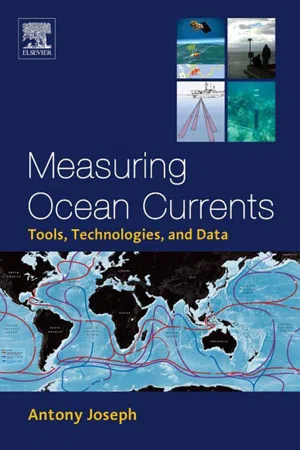
Seawater temperature and salinity together play an important role in the preservation of equilibrium in the ocean; thus there exists a special category of ocean currents known as thermohaline circulation (thermo for heat and haline for salt). This circulation, primarily driven by differences in heat and salt content, influences the net transport of mass in the ocean. Thermohaline circulation transports large quantities of warm water from the equator to the polar regions and cold water from the high-latitude regions to the low-latitude regions via various pathways and therefore plays an important role in distributing heat energy across the oceans and seas. The ocean currents can thus warm or cool a large region. The planet-spanning thermohaline circulation, also called meridional overturning circulation (MOC), is referred to as the oceans’ thermohaline conveyor belt circulation (see the main image on the front cover of this book).
The wonderful conveyor system of global oceanic circulation consisting of a chain of surface, subsurface, and deep-ocean circulation paths and its role in controlling the global climate have attracted considerable attention in recent years. For maintenance of an efficient conveyor belt circulation system, there should be “sinking” regions as well as “rising” regions at diverse locations in the global oceans to connect them together as a closed circuit.
Careful observations by navigators in the 19th century brought to light the existence of an efficient rising region in the Arctic Ocean. The movement of right whales provided a reliable indicator in identifying such a region. Examination of the log books containing the records maintained by various ships for hundreds of thousands of days for preparation of mariner wind and current charts led to the interesting discovery that the tropical regions of the oceans are to right whales as a sea of fire, through which they cannot pass and into which they never enter. Note that whereas sperm whales are warm-water mammals, right whales are a special category of whale that delights in cold water. It was also found that the right whales of the northern hemisphere are a different species from those of the southern hemisphere (Maury, 1855).
It was the custom among the ancient whale hunters to have their harpoons marked with the date and the name of their ship before they fired the harpoons at whales. The presence of a region in the Arctic Ocean that was not covered by ice sheets was identified in the 19th century based on a very short travel time made by the harpoon-stricken right whales in traveling from the Atlantic side to the Pacific side of the Arctic Ocean. The calculation of the short travel time was arrived at based on the logic that the harpoon-stricken whale could not have traveled below the ice sheet for such a long distance, stretching across the entire Arctic path, nor could they have traveled around either Cape Horn (at the southern tip of South America) or the Cape of Good Hope (at the southern tip of South Africa) because of their proven dislike for warm waters. (Right whales are a class that cannot cross the equator because their habits are averse to the warm waters of the equatorial belt.) In this way circumstantial evidence afforded the most irrefragable and irrefutable proof that there is, at times at least, the presence of open water (i.e., water free from ice cover) in the Arctic Sea.
Further, based on rapid drifting of icebergs against a strong surface current, it was inferred that there is a powerful undercurrent through Davis Strait. The most dominant meridianal overturning cross-equatorial thermohaline circulation, which traverses northward across the ocean surface all the way up from Antarctica (the return flow of cold water underneath traversing all the way into the middle of the Pacific), is found in the Atlantic Ocean (see the main image on the front cover of this book), and the climatic effect of this arm of the global thermohaline circulation is due to its large heat transport in the North Atlantic. It has been estimated that the amount of heat transported into the northern Nort...
Table of contents
- Cover image
- Title page
- Table of Contents
- Copyright
- Acknowledgments
- Foreword
- Preface
- Chapter 1. Oceanic Currents and Their Implications
- Chapter 2. The History of Measuring Ocean Currents
- Chapter 3. Lagrangian-Style Surface Current Measurements Through Tracking of Surface Drifters
- Chapter 4. Remote Mapping of Sea Surface Currents Using HF Doppler Radar Networks
- Chapter 5. Imaging of Seawater Motion Signatures Using Remote Sensors
- Chapter 6. Lagrangian-Style Subsurface Current Measurements Through Tracking of Subsurface Drifters
- Chapter 7. Horizontally Integrated Remote Measurements of Ocean Currents Using Acoustic Tomography Techniques
- Chapter 8. Eulerian-Style Measurements Incorporating Mechanical Sensors
- Chapter 9. Eulerian-Style Measurements Incorporating Nonmechanical Sensors
- Chapter 10. Vertical Profiling of Horizontal Currents Using Freely Sinking and Rising Probes
- Chapter 11. Vertical Profiling of Currents Using Acoustic Doppler Current Profilers
- Chapter 12. Remote Measurements of Ocean Currents Using Satellite-Borne Altimeters
- Chapter 13. Conclusions
- Index
Trusted by 375,005 students
Access to over 1.5 million titles for a fair monthly price.
Study more efficiently using our study tools.
Frequently asked questions
Yes, you can cancel anytime from the Subscription tab in your account settings on the Perlego website. Your subscription will stay active until the end of your current billing period. Learn how to cancel your subscription
No, books cannot be downloaded as external files, such as PDFs, for use outside of Perlego. However, you can download books within the Perlego app for offline reading on mobile or tablet. Learn how to download books offline
We are an online textbook subscription service, where you can get access to an entire online library for less than the price of a single book per month. With over 1.5 million books across 990+ topics, we’ve got you covered! Learn about our mission
Look out for the read-aloud symbol on your next book to see if you can listen to it. The read-aloud tool reads text aloud for you, highlighting the text as it is being read. You can pause it, speed it up and slow it down. Learn more about Read Aloud
Yes! You can use the Perlego app on both iOS and Android devices to read anytime, anywhere — even offline. Perfect for commutes or when you’re on the go.
Please note we cannot support devices running on iOS 13 and Android 7 or earlier. Learn more about using the app
Please note we cannot support devices running on iOS 13 and Android 7 or earlier. Learn more about using the app
Yes, you can access Measuring Ocean Currents by Antony Joseph in PDF and/or ePUB format, as well as other popular books in Biological Sciences & Ecology. We have over 1.5 million books available in our catalogue for you to explore.