- 462 pages
- English
- ePUB (mobile friendly)
- Available on iOS & Android
eBook - ePub
About this book
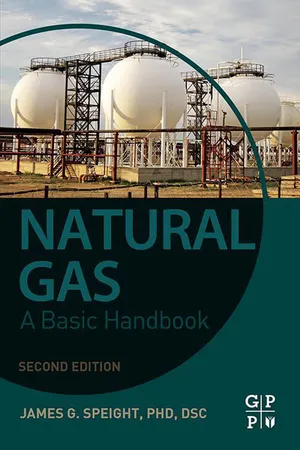
Natural Gas: A Basic Handbook, Second Edition provides the reader with a quick and accessible introduction to a fuel source/industry that is transforming the energy sector. Written at an introductory level, but still appropriate for engineers and other technical readers, this book provides an overview of natural gas as a fuel source, including its origins, properties and composition. Discussions include the production of natural gas from traditional and unconventional sources, the downstream aspects of the natural gas industry. including processing, storage, and transportation, and environmental issues and emission controls strategies.
This book presents an ideal resource on the topic for engineers new to natural gas, for advisors and consultants in the natural gas industry, and for technical readers interested in learning more about this clean burning fuel source and how it is shaping the energy industry.
- Updated to include newer sources like shale gas
- Includes new discussions on natural gas hydrates and flow assurance
- Covers environmental issues
- Contain expanded coverage of liquefied natural gas (LNG)
Information
Part I
Origin and Properties
Outline
1
History and use
Abstract
This chapter presents an introduction to the terminology and definitions involved with the natural gas technology. The terminology and definitions applied to natural gas (and, for that matter, to other gaseous products and fuels) are extremely important and have a profound influence on the manner by which the technical community and the public perceive that gaseous fuel. For the purposes of this book, natural gas and those products that are isolated from natural gas during recovery (such as natural gas liquids, gas condensate, and natural gasoline) are introduced in the chapter. The chapter also introduces the reader to the history of natural as technology as well as to the uses of natural gas.
Keywords
History; use; conventional gas; associated gas; nonassociated gas; gas condensate
1.1 Introduction
Natural gas (also called marsh gas and swamp gas in older texts) is a gaseous fossil fuel that is found in oil fields and natural gas field. While it is commonly grouped in with other fossil fuels and sources of energy, there are many characteristics of natural gas that make it unique. The term natural gas is often extended to gases and liquids from the recently developed shale formations (Kundert and Mullen, 2009; Aguilera and Radetzki, 2014; Khosrokhavar et al., 2014; Speight, 2017b) as well as gas (biogas) produced from biological sources (John and Singh, 2011; Ramroop Singh, 2011; Singh and Sastry, 2011). However, for the purposes of this book, the petroliferous natural gas is placed under the category of conventional gas, while petroliferous gas from tight formations and the nonpetroliferous gases (such as biogas and landfill gas) are placed under the term nonconventional gas (sometime called unconventional gas) (Chapter 3: Unconventional gas).
Although the terminology and definitions involved with the natural gas technology are quite succinct, there may be those readers that find the terminology and definitions somewhat confusing. Terminology is the means by which various subjects are named so that reference can be made in conversations and in writings and so that the meaning is passed on. Definitions are the means by which scientists and engineers communicate the nature of a material to each other either through the spoken or through the written word. Thus, the terminology and definitions applied to natural gas (and, for that matter, to other gaseous products and fuels) are extremely important and have a profound influence on the manner by which the technical community and the public perceive that gaseous fuel. For the purposes of this book, natural gas and those products that are isolated from natural gas during recovery [such as natural gas liquids (NGLs), gas condensate, and natural gasoline] are a necessary part of this text. Thus:
- Conventional gas
- Associated gas
- Nonassociated gas
- Gas condensate
- Unconventional gas
- Gas hydrates
- Biogas
- Coalbed methane
- Coal gas
- Flue gas
- Gas in geopressurized zones
- Gas in tight formations
- Landfill gas
- Manufactured gas
- Refinery gas
- Shale gas
- Synthesis gas
A more meaningful categorization of these gases would be as fuel gases with a third category that includes the gases produced in manufacturing processes. Thus: - Conventional natural gas
- Associated gas
- Nonassociated gas
- Gas condensate
- Unconventional gas
- Gas hydrates
- Coalbed methane
- Gas in geopressurized zones
- Gas in tight formations
- Shale gas
- Manufactured gas
- Biogas
- Coal gas
- Flue gas
- Landfill gas
- Refinery gas
- Synthesis gas
These categorizations are based on the source of the gas or the method of production of the gas which also has some relationship to the composition of the gas. Nevertheless, whatever, the source or origin, natural gas and other fuel gases are vital components of the energy supply of the world and form a necessary supply chain for energy production: - reservoir gas → produced gas – wellhead gas → transported gas → stored gas → sales gas
Specifically, the term natural gas is the generic term that is applied to the mixture of and gaseous hydrocarbon derivatives and low-boiling liquid hydrocarbon derivatives (typically up to and including hydrocarbon derivatives such as n-octane, CH3(CH2)6CH3, boiling point 125.1–126.1°C, 257.1–258.9°F) (Tables 1.1 and 1.2) that is commonly associated with petroliferous (petroleum-producing, petroleum-containing) geologic formations (Mokhatab et al., 2006; Speight, 2014a).
Table 1.1
| Constituent | Formula | % v/v |
|---|---|---|
| Methane | CH4 | >85 |
| Ethane | C2H6 | 3–8 |
| Propane | C3H8 | 1–5 |
| n-Butane | C4H10 | 1–2 |
| iso-Butane | C4H10 | <0.3 |
| n-Pentane | C5H12 | 1–5 |
| iso-Pentane | C5H12 | <0.4 |
| Hexane, heptane, octanea | CnH2n+2 | <2 |
| Carbon dioxide | CO2 | 1–2 |
| Hydrogen sulfide | H2S | 1–2 |
| Oxygen | O2 | <0.1 |
| Nitrogen | N2 | 1–5 |
| Helium | He | <0.5 |
aHexane (C6H14) and higher molecular weight hydrocarbon derivatives up to octane as well as benzene (C6H6) and toluene (C6H5CH3).
Table 1.2
| Hydrocarbon constituents | |
| Dry gas or natural gas | Methane (CH4) |
| Ethane (C2H6) | |
| Liquefied petroleum gas | Propane (C3H8) |
| n-Butane (C4H10) | |
| iso-Butane (C4H10) | |
| Natural gas liquids | Pentane isomers (C5H15) |
| Hexane isomers (C6H14) | |
| Heptane isomers (C7H16) | |
| Octane isomers (C8H18) | |
| Condensate (≥C5H12) | |
| Natural gasoline (≥C5H12) | |
| Naphtha (≥C5H12) | |
| Nonhydrocarbon constituents | |
| Carbon dioxide (CO2) | |
| Hydrogen sulfide (H2S) | |
| Water (H2O) | |
| Nitrogen (N2) | |
| Carbonyl sulfide (COS) | |

From a chemical standpoint, natural gas is a mixture of hydrocarbon compounds and nonhydrocarbon compounds with crude oil being much more complex than natural gas (Mokhatab et al., 2006; Speight, 2012, 2014a). The fuels that are derived from this natural product supply more than one quarter of the total world energy supply. The more efficient use of natural gas is of paramount importance and the technology involved in processing both feedstocks will supply the industrialized nations of the world for (at least) the next five decades until suitable alternative forms of energy (such as biogas and other nonhydrocarbon fuels) are readily available (Boyle, 1996; Ramage, 1997; Rasi et al., 2007, 2011; Speight, 2011a,b,c, 2008). Any gas sold, however, to an industrial or domestic consumer must meet designated specification that is designed according to the use of the gas.
Typically, in field operations, the composition of natural gas (which affects the specific gravity), especially of associated gas, can vary significantly as the product flowing out of the well can change with variability of the production conditions as well as the change of pressure as gas is removed from the reservoir (Burruss and Ryder, 2003, 2014). Constituents of the gas that were in the liquid phase under the pressure of the reservoir can revert to the gas phase as the reservoir pressure is reduced by gas removal.
As a result, it should not be a surprise that at each stage of natural gas production, wellhead treating, transportation, and processing, analysis of the gas to determine the composition and properties of the gas by standard test methods is an essential part of the chemistry and technology of natural gas. Use of analytical methods offers (Speight, 2018) vital information about the behavior of natural gas during recovery, wellhead processing, transportation, gas processing, and use (Fig. 1.1). The data produced from the test methods are the criteria by means of which the suitability of the gas for use and the potential for interference with the environment.

1.2 History
Natural gas is a naturally occurring gaseous fossil fuel that is found in gas-bearing formations, oil-bearing formations—coalbed methane is often referred to (incorrectly) as natural gas or as coal gas due to lack of ...
Table of contents
- Cover image
- Title page
- Table of Contents
- Copyright
- Preface to the second edition
- Part I: Origin and Properties
- Part II: Gas Processing
- Part III: Energy Security and the Environment
- Appendix A. Examples of standard test methods for application to fuel gases and condensate
- Conversion factors
- Glossary
- Index
Trusted by 375,005 students
Access to over 1.5 million titles for a fair monthly price.
Study more efficiently using our study tools.
Frequently asked questions
Yes, you can cancel anytime from the Subscription tab in your account settings on the Perlego website. Your subscription will stay active until the end of your current billing period. Learn how to cancel your subscription
No, books cannot be downloaded as external files, such as PDFs, for use outside of Perlego. However, you can download books within the Perlego app for offline reading on mobile or tablet. Learn how to download books offline
Perlego offers two plans: Essential and Complete
- Essential is ideal for learners and professionals who enjoy exploring a wide range of subjects. Access the Essential Library with 800,000+ trusted titles and best-sellers across business, personal growth, and the humanities. Includes unlimited reading time and Standard Read Aloud voice.
- Complete: Perfect for advanced learners and researchers needing full, unrestricted access. Unlock 1.5M+ books across hundreds of subjects, including academic and specialized titles. The Complete Plan also includes advanced features like Premium Read Aloud and Research Assistant.
We are an online textbook subscription service, where you can get access to an entire online library for less than the price of a single book per month. With over 1.5 million books across 990+ topics, we’ve got you covered! Learn about our mission
Look out for the read-aloud symbol on your next book to see if you can listen to it. The read-aloud tool reads text aloud for you, highlighting the text as it is being read. You can pause it, speed it up and slow it down. Learn more about Read Aloud
Yes! You can use the Perlego app on both iOS and Android devices to read anytime, anywhere — even offline. Perfect for commutes or when you’re on the go.
Please note we cannot support devices running on iOS 13 and Android 7 or earlier. Learn more about using the app
Please note we cannot support devices running on iOS 13 and Android 7 or earlier. Learn more about using the app
Yes, you can access Natural Gas by James G. Speight in PDF and/or ePUB format, as well as other popular books in Technology & Engineering & Energy. We have over 1.5 million books available in our catalogue for you to explore.