eBook - ePub
Rheology
Concepts, Methods, and Applications
- 500 pages
- English
- ePUB (mobile friendly)
- Available on iOS & Android
eBook - ePub
Rheology
Concepts, Methods, and Applications
About this book
Rheology: Concepts, Methods and Applications, Third Edition provides a thorough historical and theoretical grounding in the field, and introduces rheology as the method of solving many practical problems in materials science and engineering. The book is practical and relevant for industry, but is also consistent with rheology courses in academia, making it relevant to both academics and accomplished rheologists in industry.
The first four chapters discuss various aspects of theoretical rheology and, through examples from numerous studies, show how particular theories, models, or equations can be used in solving different problems. The shared experience and insight contained in these chapters assists practitioners carrying out rheological studies in generating relevant data. This helps to avert costly errors in analysis which are common when data are generated under the wrong conditions, or are incorrectly used. The fifth chapter covers methods of measurement and treatment of raw data—eight groups of methods are discussed in this chapter, providing the reader with many options for experimentation, along with guidance on where and how to use them properly.
The final chapter demonstrates how to use rheological methods for different groups of products and manufacturing methods. The usefulness of chemorheological (rheokinetical) measurements is also emphasized. The chapter has a particular emphasis on real-world applications of rheology, and gives practical guidance to enable materials scientists to gather data and solve problems using these methods. This book is a systematic presentation of the subject of rheology—written by two of the foremost researchers in the field—showing the subject as an interrelated system of concepts, principal phenomena, experimental methods, and directions of their application. It also links with other branches of theoretical and applied sciences.
- Provides substantial experience and insight to assist rheologists working in a range of industries to generate relevant data, avoiding costly errors in analysis
- Includes eight groups of measurement methods, providing the reader with options so they can choose the most effective for their situation
- Offers thorough coverage of different applications of rheology, demonstrating how to use rheological methods for different products—from polymeric materials to food products, biological fluids, and electro and magnetic materials
Information
Subtopic
Química industrial y técnica1
CONTINUUM MECHANICS AS A FOUNDATION OF RHEOLOGY
Rheology is a science dealing with deformation and flow of matter. Relationships between stresses and deformations are the fundamental concepts of continuum mechanics, which are discussed in this chapter. The modern history of rheology was marked by the publication of several books1 in the 1940s, which impacted the education of future generations of rheologists.
1.1 STRESSES
Internal stresses are directly related to forces applied to a body regardless of their origin. Only in special cases do internal stresses exist in the absence of external forces. These are, for example, thermal stresses caused by temperature inhomogeneity throughout a body or frozen stresses stored as a result of thermal and/or mechanical history of a body treatment caused by its heterogeneity.
1.1.1 GENERAL THEORY
Any external force applied to a body leads either to a movement of the body as a whole or to a change of its initial shape. Both may occur simultaneously. The movement of a body in space and/or its rotation around its center of gravity, with no change to its shape is a subject of study by mechanics, and as such is not discussed in this book. The principal focus of our discussion here are changes which occur inside a body on application of an external force. The applied forces create dynamic reactions at any point of a body, which are characterized by a physical factor called stress.
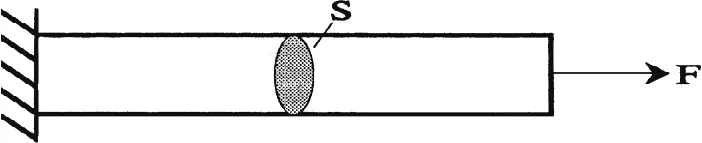
Stress can be explained using a simple example. Let us consider a body (a bar). The area of its normal cross-section is S (Fig. 1.1.1). The force, F, is normal to the surface, S. The specific force at any point of the cross-section equals F/S. The ratio is a normal stress or a tensile stress, σE:

i.e., stress is the force per unit of the surface area. The force at any surface may not be constant, i.e., be a function of coordinates. For example, a train moving on rails presses rails at local zones (where wheels touch the rail). The force is then distributed within the rail according to a complex pattern of stress distribution.
In our case, we do not consider force distribution because we have selected a small surface area, ΔS. A relative (specific) force, ΔF, acting on the area of ΔS is used to calculate the ratio ΔF/ΔS. By decreasing the surface area, we eventually come to its limiting form, as follows:

This is a more general and exact definition of stress than given by Eq. 1.1.1 because it is related to a reference point, such as the surface area, ΔS. However, the definition is still not complete. A force at the area ΔS can have any direction, therefore a force is, in fact...
Table of contents
- Cover image
- Title page
- Table of Contents
- Copyright
- PREFACE
- PREFACE TO THE 2ND EDITION
- PREFACE TO THE 3RD EDITION
- INTRODUCTION: RHEOLOGY: SUBJECT AND GOALS
- Chapter 1: CONTINUUM MECHANICS AS A FOUNDATION OF RHEOLOGY
- Chapter 2: VISCOELASTICITY
- Chapter 3: LIQUIDS
- Chapter 4: SOLIDS
- Chapter 5: RHEOMETRY EXPERIMENTAL METHODS
- Chapter 6: APPLICATIONS OF RHEOLOGY
- NOTATION
- SOLUTIONS
- INDEX
Trusted by 375,005 students
Access to over 1.5 million titles for a fair monthly price.
Study more efficiently using our study tools.
Frequently asked questions
Yes, you can cancel anytime from the Subscription tab in your account settings on the Perlego website. Your subscription will stay active until the end of your current billing period. Learn how to cancel your subscription
No, books cannot be downloaded as external files, such as PDFs, for use outside of Perlego. However, you can download books within the Perlego app for offline reading on mobile or tablet. Learn how to download books offline
Perlego offers two plans: Essential and Complete
- Essential is ideal for learners and professionals who enjoy exploring a wide range of subjects. Access the Essential Library with 800,000+ trusted titles and best-sellers across business, personal growth, and the humanities. Includes unlimited reading time and Standard Read Aloud voice.
- Complete: Perfect for advanced learners and researchers needing full, unrestricted access. Unlock 1.5M+ books across hundreds of subjects, including academic and specialized titles. The Complete Plan also includes advanced features like Premium Read Aloud and Research Assistant.
We are an online textbook subscription service, where you can get access to an entire online library for less than the price of a single book per month. With over 1.5 million books across 990+ topics, we’ve got you covered! Learn about our mission
Look out for the read-aloud symbol on your next book to see if you can listen to it. The read-aloud tool reads text aloud for you, highlighting the text as it is being read. You can pause it, speed it up and slow it down. Learn more about Read Aloud
Yes! You can use the Perlego app on both iOS and Android devices to read anytime, anywhere — even offline. Perfect for commutes or when you’re on the go.
Please note we cannot support devices running on iOS 13 and Android 7 or earlier. Learn more about using the app
Please note we cannot support devices running on iOS 13 and Android 7 or earlier. Learn more about using the app
Yes, you can access Rheology by Alexander Y. Malkin,Avraam I. Isayev,Alexander Ya. Malkin in PDF and/or ePUB format, as well as other popular books in Tecnología e ingeniería & Química industrial y técnica. We have over 1.5 million books available in our catalogue for you to explore.