- 344 pages
- English
- ePUB (mobile friendly)
- Available on iOS & Android
eBook - ePub
About this book
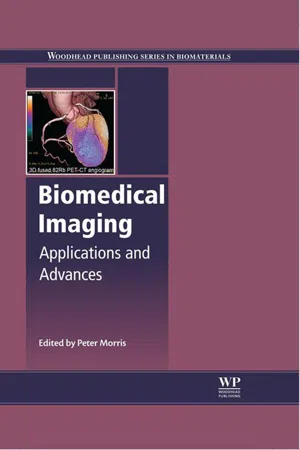
Biomedical Imaging: Applications and Advances discusses the technologies and latest developments in the increasingly important field of imaging techniques for the diagnosis of disease, monitoring of medical implants, and strategies for personalized medicine.
Chapters in part one explore the full range of imaging technologies from atomic force microscopy (AFM) to positron emission tomography (PET), as well as the next-generation techniques that could provide the basis for personalized medicine. Part two highlights application-specific biomedical imaging methods, including ophthalmic imaging of ocular circulation, imaging methods for detection of joint degeneration, neural brain activation imaging, and the use of brain imaging to assess post-therapy responses. Further chapters review intravascular, cardiovascular, and whole-body magnetic resonance imaging (MRI).
Biomedical Imaging is a technical resource for those concerned with imaging and diagnosis, including materials scientists and engineers as well as clinicians and academics.
- Explores the full range of imaging technologies from atomic force microscopy (AFM) to positron emission tomography (PET), as well as next-eneration techniques for personalized medicine
- Highlights application-specific biomedical imaging methods, including ophthalmic imaging of ocular circulation, imaging methods for detection of joint degeneration, neural brain activation imaging, and the use of brain imaging to assess post therapy responses
- Reviews intravascular, cardiovascular, and whole-body magnetic resonance imaging (MRI)
Trusted by 375,005 students
Access to over 1 million titles for a fair monthly price.
Study more efficiently using our study tools.
Information
Part I
Imaging technologies
Outline
1 Biomedical Positron Emission Tomography (PET) imaging
2 Atomic Force Microscopy (AFM) in biomedical research
3 Next generation techniques for biomedical imaging
1
Biomedical Positron Emission Tomography (PET) imaging
S. Chua, The Royal Marsden Hospital, UK
A. Groves, UCL Institute of Nuclear Medicine, UK
Abstract:
Positron Emission Tomography (PET) is a major functional imaging technique with wide-ranging applications across the biological sciences and clinical medicine. Its best known clinical application is in oncological imaging but it also has important roles in cardiology and neurology. Its unique ability to noninvasively and quantitatively localise bioactive molecules has already transformed the development of new pharmaceutical agents and it is poised to become a key enabler of the emerging field of personalised medicine. This review summarises the development of PET and its current applications in clinical medicine and preclinical research, and discusses possible future directions for the technology.
Key words
PET; PET/CT; positron emission tomography; functional imaging; oncological imaging
1.1 Introduction
The principle which underpins positron emission tomography (PET) imaging is the detection of the gamma rays produced by the radioactive decay of positron-emitting radionuclides. These can be conjugated to a wide variety of biological molecules, ranging from sugars, enzymes, amino acids, metabolites, cell receptors and their ligands, to nucleic acids, drugs, targeted antibodies, and even inorganic substances such as water and oxygen (Kumar et al., 2008). PET scans image the temporal and spatial distribution of these radiotracers and thus effectively represent functional maps of the biological processes relevant to these molecules. PET’s ability to noninvasively probe a theoretically limitless variety of molecular and cellular processes has fuelled its development into a major bioimaging technique over the past 30 years, with wide-ranging applications across the biological sciences and clinical medicine. It is now a mainstay of oncological imaging, having radically changed the diagnostic algorithms for many malignancies, and it is playing an increasingly important role in cardiology and neurology. Its contributions to the discovery, selection, validation and development of new drugs have been of huge benefit to the pharmaceutical industry and, as individually tailored molecular therapies begin to enter clinical use, it is likely to find an important role in the emerging field of personalised medicine. This review summarises the history and development of PET, its current roles and applications in clinical medicine and preclinical research, and also considers possible future directions for the technology.
1.1.1 History and development of positron emission tomography (PET) imaging
A positive antiparticle of identical weight to the negatively charged electron was first detected by the American physicist Carl David Anderson in 1932 (Anderson, 1933), leading to his award of the 1936 Nobel Prize. It was also noted at this time that when a positron collides with an electron, annihilation occurs, producing two gamma ray photons with opposite trajectories 180° apart (Sodickson et al., 1961). This production of photons at a known angle enables highly efficient detection of the annihilation event, which underlies the excellent sensitivity of PET (approximately two to three orders of magnitude greater than single positron emission computed tomography (SPECT) (Rahmim and Zaidi, 2008)). Although the invention of the cyclotron, also in 1932, enabled the production of several short-lived positron emitters such as carbon-11 and fluorine-18, detection of positron radiation in the clinical setting was not possible until the development of the first positron-detector in 1952 by Gordon Brownell and William Sweet at the Massachussetts General Hospital (Sweet and Brownell, 1955). Their intention was to build on the earlier work of Moore, who reported his pioneering efforts to localise brain tumours by counting gamma radiation using a detector placed on the scalp, following the injection of 131-I labelled diiodofluorescein (Moore, 1948). This was initially used to detect and localise suspected brain tumours, and in spite of the relatively unsophisticated nature of the device, the images were found to be superior to those from any other imaging technique available at the time. In this system, data was obtained by coincidence detection using an opposed pair of detectors with mechanical motion in two dimensions, and a printout formed a two dimensional image of the source of positron emission (Sweet and Brownell, 1955). It was clear, however, that a single pair of detectors could not produce the sensitivity desired for accurate three-dimensional localisation of a lesion, and a scanner with banks of multiple detectors was a logical and necessary development. This was achieved in 1969, with the first tomographic images being produced in 1970 (Brownell et al., 1971). During the 1970s, further scanner development was driven by the remarkable progress that occurred during that decade in the synthesis of new radiopharmaceuticals, in particular 18-fluoride labelled fluorodeoxy-D-glucose (FDG) (Reivich et al., 1977). These advances included the ring array system of detectors, and the creation of the mathematical algorithms for image reconstruction, enabling the use of multiple closely-positioned small detectors to produce high resolution PET images without the requirement for motion (Sweet and Brownell, 1955). These developments culminated in the production by Michael Phelps, Michel Ter-Progossian and colleagues at Washington University of the first modern prototype PET scanner, named PETT II for positron emission transaxial tomography, in 1973, later shortened to PET (Phelps et al., 1975). This finally combined annihilation radiation coincidence detection with linear and angular sampling, attenuation correction and tomographic image reconstruction, to produce whole body PET images. PET IV was the first multiple slice iteration of the device in the late 1970s, and the first commercially available system became available at a price of $600 000, in 1978 (Nutt, 2002). Since that date, improvements in cyclotron design and reduction in cost have made cyclotron installation a more practical option for hospitals. The 1990s, in particular, saw a rapid expansion in the clinical indications for PET, as understanding of its potential in oncology and neurology increased, and, in the US, the list of Medicare-approved indications for its use was extended on multiple occasions throughout the decade (Tilyou, 2012).
1.1.2 The emergence of positron emission tomography (PET)/computer tomography (CT)
PET scanning alone is limited by its relatively low spatial resolution and inability to provide accurate anatomical localization of the physiological processes it detects. The integrated PET/CT scan, developed in 2000, combines the superior spatial and anatomical resolution of CT with the functional biological information obtainable from PET, maximizing their respective strengths in a single, one-step scan. This ability to combine functional and anatomical data has contributed enormously to the better differentiation of physiological and pathological uptake, more accurate localisation of pathology and better characterisation of small or equivocal uptake foci. The increased sensitivity and specificity of hybrid PET/CT over standalone PET have been demonstrated in numerous studies. This is well illustrated by a study comparing PET/CT and PET in the nodal staging of oesophageal carcinoma, whose findings have been broadly replicated across many malignancies. In this analysis, the sensitivity, specificity, accuracy, positive predictive value, and negative predictive value of PET/CT were 93.90%, 92.06%, 92.44%, 75.49% and 98.31%, respectively, compared to standalone PET at 81.71%, 87.30%, 86.15%, 62.62%, and 94.83%, respectively (Yuan et al., 2006). Additionally, CT data is valuable for attenuation correction of the PET data, reducing scanning time by 20%–30%, such that standard whole body PET/CT now takes only 20–30 minutes. The replacement of PET scanners by PET/CT worldwide has progressed at such a pace that, for practical purposes, the term PET is now effectively synonymous with PET/CT, and PET used as shorthand for PET/CT throughout this chapter.
1.1.3 Analysis of PET scans
PET results may be assessed by qualitative analysis (visual assessment), and this method is usually sufficient for staging or restaging and for assessment of response in lymphomas (Boellaard, 2009). However, the subjective nature of purely visual interpretation of PET can lead to considerable inter-and intra-observer variability, especially in evaluation of the response to therapy of solid tumours, so that quantitative methods of analysis are increasingly used. Measurement of the standardized uptake value (SUV) or lesion-to-background ratio, comparing uptake to that in background liver, brain, muscle or blood pool, are the most widely used methods of simple semi-quantitative analysis of PET findings. SUV represents the ratio of the actual radioactivity concentration present in a selected part of the body at a certain time point, and the radioactivity concentration in the hypothetical case of an even distribution of the injected radioactivity across the whole body (Lucignani et al., 2004). It can be normalised to body mass or, preferably, to lean body mass or body surface area. Because of its ease of measurement, SUV is an attractive metric for introducing greater reproducibility into semi-quantitative analysis of PET, but careful standardization of PET protocols is required to achieve reproducible SUVs within a single centre (Wahl et al., 2009). Comparison of SUV results between centres is impossible for practical purposes, owing to the widespread variability that exists between methodologies of data acquisition, image reconstruction, and data analysis. It has been suggested that this lack of standardisation is one reason why the most recent (2009) Response Evaluation Criteria In Solid Tumors (RECIST) criteria still do not incorporate quantitative PET results, despite their clinical value being widely recognised (Boellaard, 2009). The need for validation and standardization of quantitative PET protocols for multicentre trials is therefore pressing. Guidelines and recommendations have been published for the standardization of the following aspects of scanning: patient preparation, 18F-FDG administration procedures, PET acquisition parameters and image quality, optimal settings for image reconstruction, data analysis and SUV normalisation. Use of these is highly desirable towards achieving consistent results across different scanners and centres (Boellaard, 2009). A draft framework for PET Response Criteria in Solid Tumours (PERCIST) has been proposed, to serve as an initial framework for use both in clinical trials and as a template for standardised quantitative clinical reporting (Wahl et al., 2009). PET is, by its nature, a quantitative technique and PERCIST sets out suggested standards that include which tumour is to be assessed where more than one are present (the ‘hottest’ in terms of tracer uptake), the size of the region of interest (ROI) applied, scan timings, data quality and definitions for complete and partial metabolic responses (CMR and PMR) and stable and progressive metabolic disease (SMD and PMD). While the authors acknowledge that PERCIST represents a starting point that will require subsequent modification and improvement, it is an important milestone in the full integration of PET into clinical trials, and the full exploitation of its quantitative capabilities.
It has been suggested that, for the purposes of clinical trials, findings based on SUV measurements should be verified against a quantitative analysis of absolute glucose in at least a small number of patients (Lammertsma et al., 2006). The latter is carried out using kinetic modelling, based upon a three compartmental model representing the concentrations of FDG in plasma, in tissues prior to phosphorylation by hexokinase and in tissues as its phosphorylated form, respectively (Basu et al., 2011). Dynamic scanning carried out in tandem with rapid arterial blood FDG assay allows time–activity curves for specific tumours or tissues under study to be graphed. Quantitative analysis can then be undertaken by non-linear regression, Patlak graphical analysis or simplified quantitative methods (Basu et al., 2011). The requirements for arterial blood sampling and complex protocols mean, however, that this approach is not practical for routine clinical ...
Table of contents
- Cover image
- Title page
- Table of Contents
- Copyright
- Contributor contact details
- Woodhead Publishing Series in Biomaterials
- Foreword
- Preface
- Part I: Imaging technologies
- Part II: Application-specific biomedical imaging techniques
- Index
Frequently asked questions
Yes, you can cancel anytime from the Subscription tab in your account settings on the Perlego website. Your subscription will stay active until the end of your current billing period. Learn how to cancel your subscription
No, books cannot be downloaded as external files, such as PDFs, for use outside of Perlego. However, you can download books within the Perlego app for offline reading on mobile or tablet. Learn how to download books offline
Perlego offers two plans: Essential and Complete
- Essential is ideal for learners and professionals who enjoy exploring a wide range of subjects. Access the Essential Library with 800,000+ trusted titles and best-sellers across business, personal growth, and the humanities. Includes unlimited reading time and Standard Read Aloud voice.
- Complete: Perfect for advanced learners and researchers needing full, unrestricted access. Unlock 1.4M+ books across hundreds of subjects, including academic and specialized titles. The Complete Plan also includes advanced features like Premium Read Aloud and Research Assistant.
We are an online textbook subscription service, where you can get access to an entire online library for less than the price of a single book per month. With over 1 million books across 990+ topics, we’ve got you covered! Learn about our mission
Look out for the read-aloud symbol on your next book to see if you can listen to it. The read-aloud tool reads text aloud for you, highlighting the text as it is being read. You can pause it, speed it up and slow it down. Learn more about Read Aloud
Yes! You can use the Perlego app on both iOS and Android devices to read anytime, anywhere — even offline. Perfect for commutes or when you’re on the go.
Please note we cannot support devices running on iOS 13 and Android 7 or earlier. Learn more about using the app
Please note we cannot support devices running on iOS 13 and Android 7 or earlier. Learn more about using the app
Yes, you can access Biomedical Imaging by Peter Morris in PDF and/or ePUB format, as well as other popular books in Technology & Engineering & Biomedical Science. We have over one million books available in our catalogue for you to explore.